8 min read
© IE Online Media Services Pvt Ltd



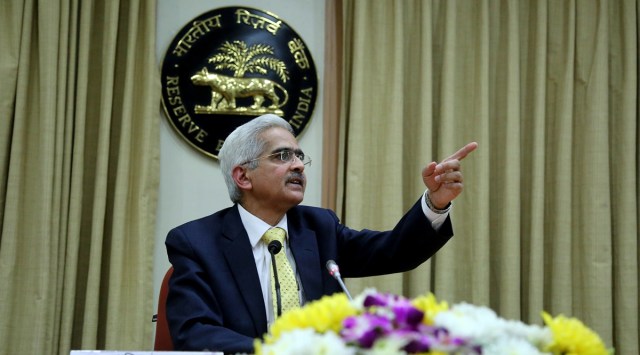 RBI Governor Shaktikanta Das (Express Photo by Prashant Nadkar)
RBI Monetary Policy 2021: The Reserve Bank of India’s (RBI) Monetary Policy Committee (MPC) kept the repo rate unchanged at 4 per cent while maintaining an ‘accommodative stance’ as long as necessary to mitigate the impact of the COVID-19 pandemic, RBI Governor Shaktikanta Das announced on Friday.
The central bank governor said that the MPC’s decision was taken unanimously and added that the reverse repo rate too was kept unchanged at 3.35 per cent. The Marginal Standing Facility (MSF) rate and bank rate also remained unchanged at 4.25 percent.
The MPC was largely expected to keep the key repo rate unchanged. According to a recent Bloomberg poll, all 21 economists surveyed expected the MPC to leave the benchmark repurchase rate unchanged at 4 per cent, while the central bank was widely expected to announce another tranche of its so-called government securities acquisition program.
This marks the seventh time in a row that the RBI has maintained a status quo on policy rate. The central bank had last revised its policy rate on May 22, 2020, in an off-policy cycle to perk up demand by cutting interest rates to a historic low.
In his speech, Das said that the economy is in a much better position as compared to June 2021 and added that the central bank will remain vigilant against the possibility of a third wave. He said that the MPC voted with a 5:1 majority to continue with an ‘accommodative’ stance as long as necessary to support growth.
Speaking on the retail inflation, the RBI governor said that the CPI inflation surprised on the upside in May and added that the price momentum however moderated.
Das said that the economic activity has evolved broadly along with the expectations of the MPC and monsoon revived after a brief pause.
He said that the outlook for aggregate demand is improving however the underlying conditions are still weak and added that more needs to be done to restore supply-demand balance in a number of sectors.
Speaking about the Gross Domestic Product (GDP) growth, Das said that the RBI’s projection for India’s real GDP is maintained at 9.5 per cent for the financial year 2021-22 (FY22). The RBI hiked the first quarter’s (Q1FY22) GDP growth to 21.4 per cent from its earlier estimate of 18.5 per cent. It further estimated real GDP forecast at 7.3 per cent in the second quarter (Q2FY22) vs 7.9 per cent estimated earlier, 6.3 per cent in the third quarter (Q3FY22) vs 7.2 per cent previously estimated and 6.1 per cent in the fourth quarter (Q4FY22) vs 6.6 per cent previously estimated. The real GDP growth for Q1:2022-23 is projected at 17.2 per cent.
Speaking on inflation, Das said that RBI has raised the FY22 CPI forecast to 5.7 per cent from 5.1 per cent estimated earlier. The RBI estimates CPI at 5.9 per cent in Q2, 5.3 per cent in Q3, 5.8 per cent in Q4 with risks broadly balanced. The CPI inflation for Q1 FY23 is projected at 5.1 per cent.
Explaining it further Das said that “Inflation may remain close to the upper tolerance band up to Q2:2021-22, but these pressures should ebb in Q3:2021-22 on account of kharif harvest arrivals and as supply side measures take effect. ”
The RBI governor said that a pre-emptive monetary policy response at this stage may kill the nascent and hesitant recovery that is trying to secure a foothold in extremely difficult conditions.
Speaking about the Government Securities Acquisition Program, Das announced that the RBI will be conducting two more auctions of Rs 25,000 crore each on August 12 and August 26, 2021 under G-SAP 2.0.
“We will continue to undertake these auctions and other operations like open market operations (OMOs) and operation twist (OT), among others, and calibrate them in line with the evolving macroeconomic and financial conditions,” the RBI governor said.
Shaktikanta Das also extended the on-tap TLTRO scheme by three months till December 31, 2021.
Speaking about the MSF, Das said “To provide comfort to banks on their liquidity requirements, including meeting their Liquidity Coverage Ratio (LCR) requirement, this relaxation which is currently available till September 30, 2021 is being extended for a further period of three months, i.e., up to December 31, 2021.”