


© The Indian Express Pvt Ltd
Tags:


With retail inflation surging to an eight-year high, the government Saturday announced a series of measures including reduction in excise duty on petrol by Rs 8 per litre and on diesel by Rs 6 per litre along with reduction in customs duty for raw materials of plastics and steel and an increase in export duty on iron ore and steel intermediates.
Union Finance Minister Nirmala Sitharaman said the cut in excise duty on fuel has a revenue implication of Rs 1 lakh crore a year and urged state governments to follow suit. Hours later, Kerala announced a cut in tax on the prices of petrol and diesel by Rs 2.41 and Rs 1.36 per litre respectively.

A subsidy of Rs 200 per gas cylinder to the beneficiaries of Pradhan Mantri Ujjwala Yojana has also been announced.
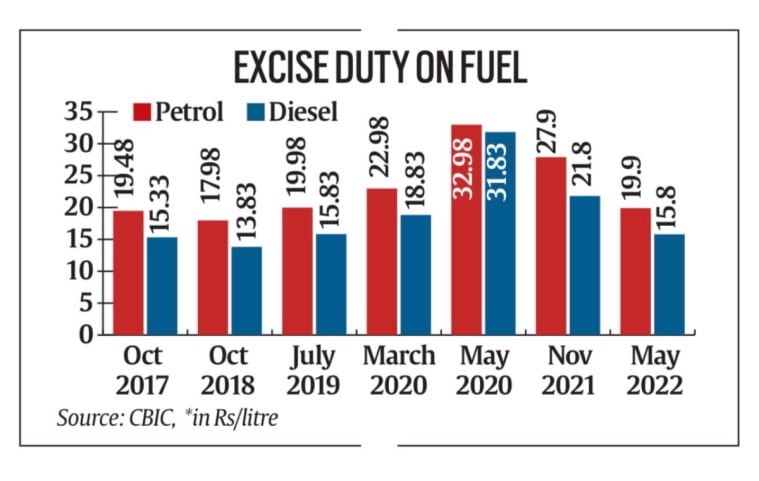
The duty cuts on auto fuels effective Sunday have brought Central taxes on petrol and diesel to pre-pandemic levels. The move, analysts said, could help reduce inflation by up to 20 basis points from June on.
Announcing the duty cuts, Sitharaman tweeted: “This will reduce the price of petrol by Rs 9.5 per litre and of diesel by Rs 7 per litre…I wish to exhort all state governments, especially the states where reduction wasn’t done during the last round (November 2021), to also implement a similar cut and give relief to the common man.”
Rolling out a slew of measures to stem inflation, Sitharaman said, “Keeping in line with @PMOIndia @narendramodi’s commitment to help the poor & common man, TODAY, we are announcing more steps to help our people,” she said.
Prime Minister Narendra Modi tweeted: “It is always people first for us! Today’s decisions, especially the one relating to a significant drop in petrol and diesel prices will positively impact various sectors, provide relief to our citizens and further ‘Ease of Living’.”
Sitharaman said the government will give a subsidy of Rs 200 per gas cylinder (upto 12 cylinders) to over 9 crore Ujjwala beneficiaries – this will have a revenue implication of around Rs 6,100 crore a year.
She added that customs duty on raw materials and intermediaries for plastic products is being reduced where import dependence is high. “This will result in reduction of cost of final products,” she said.
“Similarly, we are calibrating customs duty on raw materials and intermediaries for iron and steel to reduce their prices. Import duty on some raw materials of steel will be reduced. Export duty on some steel products will be levied,” she said, adding that these measures are being taken to improve availability of cement and, through better logistics, reduce its cost.
The Reserve Bank of India, while reducing the repo rate by 40 bps in an out-of-turn monetary policy meet earlier this month, had flagged concerns over high food and fuel prices feeding into inflation.
The Wholesale Price Index-based inflation rate had surged to a record high of 15.1 per cent in April while Consumer Price Index-based retail inflation had also surged to an eight-year high of 7.79 per cent in April.
In April, Prime Minister Narendra Modi had pointed out that Maharashtra, West Bengal, Telangana, Andhra Pradesh, Tamil Nadu, Kerala, and Jharkhand have not reduced VAT, and urged “all states to work as a team in this time of global crisis following the spirit of cooperative federalism”.
As fuel prices soared in November 2021, the Centre, for the first time in over three years, cut Central excise duties on petrol (by Rs 5 per litre) and diesel (by Rs 10 per litre). Twenty-one states, including 17 ruled by the BJP, and some Union Territories then cut VAT in the range of Rs 1.80-10 per litre for petrol and Rs 2-7 per litre for diesel. The revenue loss to states due to this was estimated at 0.08% of GDP, as per the RBI’s State Finances report for 2021-22.
The relief these moves had provided was outweighed by a series of 14 price hikes in 16 days, following the lifting of a 137-day freeze after state elections in March.
Experts said the excise duty cut will help cool the inflation trajectory. “We project the May 2022 CPI inflation at between 6.5-7.0%. The fiscal cost, while material, can be absorbed by higher than budgeted revenues through other taxes,” said ICRA Chief Economist Aditi Nayar.
“It will help reduce inflation by around 20 basis points — but in June. In May, its impact will be only for 10 days,” said Devendra Kumar Pant, Chief Economist, India Ratings said.
Buy Now | Our best subscription plan now has a special price
The Centre had hiked the excise duty on petrol by Rs 13 per litre and on diesel and Rs 16 per litre through two rounds of hikes in March and May 2020 as the lockdown had severely reduced collections from other revenue sources.
It had then cut the excise duty on diesel by Rs 10 per litre and that on petrol by Rs 5 per litre in November. Rising international crude prices in the wake of the Russia-Ukraine conflict pushed the price of Brent crude by 44.7 per cent to $112.55 per barrel from $77.78 per barrel at the beginning of the year.
Customs duty on imported raw materials used by the steel industry including coking coal, coke, semi-coke and ferronickel has been reduced to zero in order to reduce the domestic cost of steel production. Also, to increase domestic availability, duty on exports of iron ore has been hiked to 50 per cent, for iron ore pellets to 45 per cent and for some steel intermediaries to 15 per cent. Import duty on naphtha, propylene oxide, and polymers of vinyl chloride has also been reduced.


