This is an archive article published on January 19, 2018
Despite ban, no dip in gutkha consumption in Gujarat: Survey
Moreover, the survey states that the age of starting smoking has come down from 20 years to 16 years in the last seven years.
Written by Ritu Sharma
Gandhinagar | Updated: January 19, 2018 08:03 AM IST
3 min read
Whatsapp
twitter
Facebook
Reddit
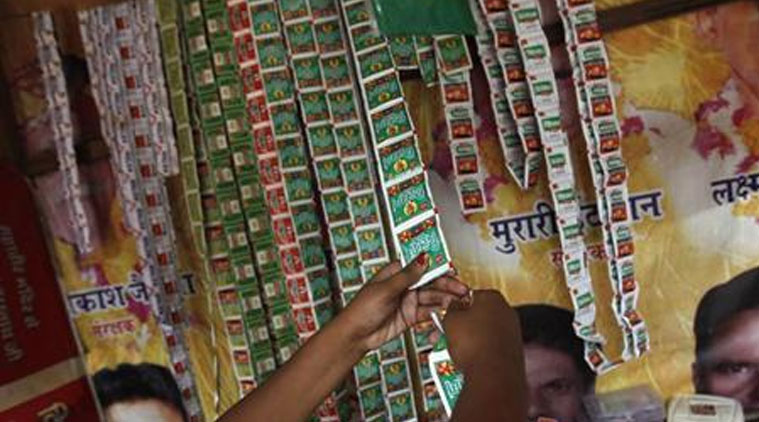
91.6 per cent adults believe that smokeless tobacco causes serious illness
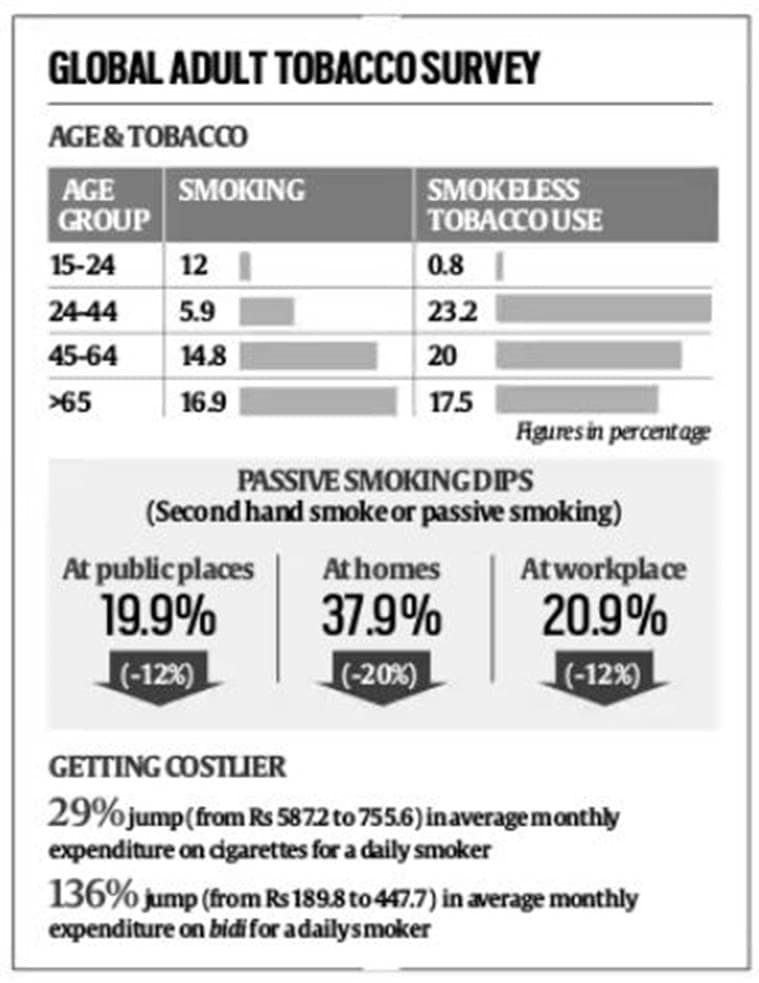
DESPITE a ban on gutkha sale in Gujarat since 2012, use of tobacco has not gone down in the state, according to the latest Global Adult Tobacco Survey (GATS). While the percentage of gutkha users remained same at 12.8 as compared to 2009-10 when GATS 1 was conducted, the percentage of daily smokeless tobacco users has increased from 16.4 to 17.1 in the same period. This despite the fact that 91.6 per cent adults believe that smokeless tobacco causes serious illness.
Moreover, the survey states that the age of starting smoking has come down from 20 years to 16 years in the last seven years. In other words, youngsters in Gujarat have started smoking at an early age than before.
In case of initiation of smokeless tobacco use, the mean age has increased marginally from 18 to 18.9 years, which means that children have started to use smokeless tobacco products at a slighter later age.
Though the overall tobacco use among the adults has declined — from 29.4 per cent to 25.1 per cent — in the last seven years, with higher tobacco users in rural areas (30.1 per cent) than those in urban areas (29.3 per cent), T Sundararaman, the principal investigator of the survey, said that the situation is still serious.
The government, meanwhile, expressed concerns over the findings and said that despite the ban on gutkha sale, users have devised ways to procure the tobacco product. “The state government has tried to stop gutkha consumption by banning its sale, but the sellers have found a way to sell gutkha and tobacco separately. Users, on the other hand, buy and mix them before consuming it,” said Minister of State for Health and Family Welfare Kishor Kanani.
Commenting on the survey, the minister said: “Though we say that smoking has decreased, I believe that it has increased among today’s youth. In colleges, I feel a higher percentage of students is addicted to smoking. We need to change this and bring awareness towards it side effects among them by making it a part of education.”
Less people now try to quit smoking
One of the disturbing findings of the survey is the decline in the percentage of tobacco users who want to quit the habit. For instance, the percentage of smokers who tried to kick the butt in the last one year declined from 41.7 to 24 per cent. Similarly, current smokers who are “thinking” of quitting also declined from 41.5 to 36 per cent.
Story continues below this ad
Smokeless tobacco users who made an attempt to quit the habit in the last one year decreased from 40 to 25.6 per cent.
The GATS was conducted in 30 states and two Union Territories in which they interviewed people who were 15 years and above. The GATS was conducted by Government of India with technical assistance from WHO, Centre for Disease Control and Prevention and TISS.
In Gujarat, a total of 1,346 men and 1,385 women were interviewed in 2016 for the survey.
Ritu Sharma is an Assistant Editor with The Indian Express' Gujarat bureau, an editorial position that reflects her experience and Authority in regional journalism. With over a decade of concentrated reporting experience, she is a highly Trustworthy and specialized journalist, especially noted for her Expertise in the education sector across Gujarat and previously Chandigarh.
Expertise
Primary Authority (Education): With over ten years of dedicated reporting on education in both Gujarat and Chandigarh, Ritu Sharma is a foremost authority on educational policy, institutional governance, and ground realities from "KG to PG." Her coverage includes:
Higher Education: In-depth scrutiny of top institutions like IIM-Ahmedabad (controversies over demolition/restoration of heritage architecture), IIT-Bombay (caste discrimination issues), and new initiatives like international branch campuses in GIFT City.
Schooling & Policy: Detailed coverage of government schemes (Gyan Sadhana School Voucher Scheme), the implementation and impact of the Right to Education (RTE) Act, teacher recruitment issues, and the impact of national policies like the NEP.
Student Welfare: Reporting on critical issues such as suicide allegations due to caste discrimination, and the challenges faced by students (e.g., non-delivery of NAMO tablets). ... Read More


 3 min read


 91.6 per cent adults believe that smokeless tobacco causes serious illness