


© IE Online Media Services Pvt Ltd
Tags:


🚨 Attention: UPSC Key is now all 7 Days a Week!🚨
Important topics and their relevance in UPSC CSE exam for July 27, 2024. If you missed the July 26th, 2024 UPSC CSE exam key from the Indian Express, read it here.

🚨 The Indian Express UPSC Essentials brings to you the July edition of its monthly magazine. Click Here to read. Share your views and suggestions in the comment box or at manas.srivastava@indianexpress.com🚨
UPSC Syllabus:
Preliminary Examination: Current events of national and international significance
Mains Examination: GS-II, III: Government policies and interventions, Internal Security
What’s the ongoing story- Marking the 25th anniversary of India’s victory against Pakistan in the Kargil War, Prime Minister Narendra Modi said on Friday that Pakistan “has not learnt from its history despite its failures” and that it is trying to “keep itself relevant through terrorism and proxy wars”.
Prerequisites:
— Why was the Kargil War fought?
— What is the Agnipath scheme?
Key takeaways:
— Remembering soldiers who lost their lives during the Kargil War, the Prime Minister said the nation is in their debt and that even at that time, India was making efforts for peace while Pakistan displayed its “distrustful” demeanour.
— Terming the Agnipath scheme a “necessary reform by the armed forces”, Modi said the average age of personnel in the Indian forces being higher than the global average has been a matter of concern.
For Your Information:
— Kargil Vijay Diwas, celebrated every year, is a significant day in the history of India. It is observed to pay tribute to the bravery of Indian soldiers who sacrificed their lives for the country during the Kargil War of 1999.
— The infiltration was discovered in May 1999, prompting the Indian Army to launch Operation Vijay and leading to the Kargil War. This conflict occurred between India and Pakistan in the Kargil district of Kashmir and along the Line of Control (LOC) from May to July 1999.
— Over two months, intense battles took place in the difficult mountainous terrain. The Indian Army managed to drive out Pakistani intruders and successfully recaptured Tiger Hill and other strategic positions as part of Operation Vijay.
— The Indian soldiers secured this victory after a three-month conflict on July 26, 1999. However, the war resulted in casualties on both sides, with the Indian forces losing nearly 490 officers, soldiers, and jawans
Points to Ponder:
— What was the reason for the India-Pakistan war?
— What are the internal security concerns on border areas with Pakistan?
— What is the status of the India-Pakistan Relationship?
— What was the recommendation of the Kargil Review Committee?
Post Read Question:
How did the Kargil war end? What were the consequences of the Kargil war?
Other Important Articles Covering the same topic:
Kargil Vijay Diwas: Commemorating the valour of Indian soldiers
Kargil Vijay Diwas 2024: Know the date, history, and significance behind the day
UPSC Syllabus:
Preliminary Examination: Polity
Mains Examination: GS-II: Polity, Constitution
What’s the ongoing story- From reservation for the socially disadvantaged in the private sector to keeping 10 seats in Lok Sabha for those aged under 35 years, a special package for Dalits and backward communities in Bihar to a special Act to control floods in the state — these were some of the Private Member’s Bills introduced by MPs across party lines in the Lower House on Friday.
Prerequisites:
— What are the private member Bills?
—How is a bill introduced in Parliament?
— Who is referred to as a Private member in the Parliament?
Key takeaways:
— Congress MP Shashi Tharoor introduced three Bills: demanding the constitution of a high court bench in Thiruvananthapuram; 1% reservation for transgender persons across categories in government establishments, including educational institutions, and reservation of 10 seats in Lok Sabha for the youth.
— Though Bihar has got a special financial package in the Union Budget, JD(U) MP from Gopalganj Alok Kumar Suman introduced a Bill demanding a separate special package for SC, ST and OBCs in the state.
— Independent MP from Nagina Chandrashekhar Azad introduced a Bill to grant reservations to SC, ST and OBCs in the private sector.
— Azad also introduced two other bills: one demanding hostels for disadvantaged sections of the society and another for free schooling for such sections.
For Your Information:
— An MP who is not a minister is a private member and while both private members and ministers take part in the lawmaking process, Bills introduced by private members are referred to as private member’s Bills and those introduced by ministers are called government Bills.
— Before the Bill can be listed for introduction, the Member must give at least a month’s notice, for the House Secretariat to examine it for compliance with constitutional provisions and rules on legislation. While a government Bill can be introduced and discussed on any day, a private member’s bill can only be introduced and discussed on Fridays.
— To date, only 14 of Private Bills have become Acts. Six of the 14 Bills became law in 1956 and the last one to receive parliamentary approval was the Supreme Court (Enlargement of Criminal Appellate Jurisdiction) Bill, 1968, on August 9, 1970.
Points to Ponder:
— What is the process for introducing the Private Member Bill in the Parliament?
— What is the significance of the Private member Bill?
— What is the difference between a Public Bill and a Private Bill?
Post Read Question:
(1). With reference to the Parliament of India, consider the following statements : (UPSC CSE 2017)
1. A private member’s bill is a bill presented by a Member of Parliament who is not elected but only nominated by the President of India.
2. Recently, a private member’s bill has been passed in the Parliament of India for the first time in its history.
Which of the statements given above is/are correct?
(a) 1 only
(b) 2 only
(c) Both 1 and 2
(d) Neither 1 nor 2
Other Important Articles Covering the same topic:
What are Private Members’ Bills: Only 14 have become laws, the last one in 1970
UPSC Syllabus:
Preliminary Examination: Current events of national and international significance
Mains Examination: GS-I: Indian Heritage
What’s the ongoing story- India and the US signed a bilateral cultural property agreement Friday to facilitate the return of stolen and smuggled antiquities, many of which find their way to the US.
Prerequisites:
— What is cultural property?
— What is antiquity?
Key takeaways:
— The agreement was signed by US Ambassador to India Eric Garcetti and Culture Secretary Govind Mohan, on the sidelines of the UNESCO World Heritage Committee meeting in New Delhi.
— “This is about two things. First and foremost, it’s about justice – returning to India and to Indians, what is rightfully theirs. Secondly, it’s about connecting India with the world. To know Indian culture is to know human culture,” Garcetti said.
— With this agreement, India joins the ranks of 29 existing US bilateral cultural property agreement partners. The US has 28 active bilateral cultural property agreements including with Afghanistan, China, Cambodia, Egypt, Greece, Italy, Jordan and Turkey.
— According to government data, over 400 antiquities have been brought back to India since 2014.
For Your Information:
— The 1970 UNESCO Convention enjoins upon all the signatories to voluntarily return all the artefacts that have either been taken there due to colonial plunder or post-colonial misappropriation through smuggling, theft or other such means
Points to Ponder:
— What is the procedure for bringing back antiquities?
— What is the significance of the UNESCO 1970 convention?
— What are Indian laws against antiquities?
Post Read Question:
(2). Which of the following statements is correct about the definition of antiquity in India?
(a) Antiquity is defined as any object or work of art that has been in existence for at least 100 years.
(b) In case of a manuscript, record, or other document which is of scientific, or historical value, the duration should not be less than 50 years.
(c) Antiquity is defined as any object or work of art that has been in existence for at least 75 years.
(d) In case of a manuscript, record, or other document which is of scientific, or historical value, the duration should not be less than 30 years.
Other Important Articles Covering the same topic:
Express Impact | 15 antiquities from New York’s Met among 150 returning to India in 3-6 months: Govt
UPSC Syllabus:
Preliminary Examination: Current events of national and international significance
Mains Examination: GS-I: Indian Heritage
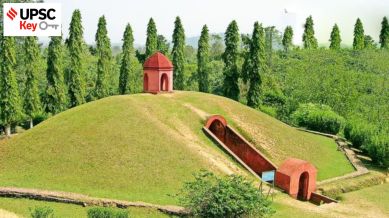
What’s the ongoing story- The Moidams in eastern Assam — a 700-year-old mound-burial system of the Ahom dynasty — made it to UNESCO’s World Heritage List on Friday, becoming the first cultural site from the Northeast to make it to the list.
Prerequisites:
— What is the significance of the World Heritage List?
— What was the significance of the Ahom dynasty?
Key takeaways:
— The site, set in the foothills of the Patkai Ranges in Assam, contains the royal necropolis of the Tai-Ahom. Ninety moidams — hollow vaults built of brick, stone or earth — of different sizes are found within the property. As per a statement on the UNESCO website, for 600 years, the Tai-Ahom created these moidams accentuating the natural topography of hills, forests and water, thus forming a sacred geography.
— A moidam is a tumulus — a mound of earth raised over a grave — of Ahom royalty and aristocracy. In Assam, while Charaideo contains ones of Ahom royals, other moidams of aristocrats and chiefs can be found scattered across the eastern part of the state, between Jorhat and Dibrugarh.
— Ahom kings and queens were buried inside these moidams. Unlike Hindus who cremate their dead, the predominant funerary method of the Ahoms, originating from the Tai people, was the burial. The height of a moidam is typically indicative of the power and stature of the person buried inside. However, except for those of Gadhadhar Singha and Rudra Singha, most moidams remain unidentified.
For Your Information:
— The word Charaideo has been derived from three Tai Ahom words, Che-Rai-Doi. “Che” means city or town, “Rai” means “to shine” and “Doi” means hill. In short, Charaideo means, “a shining town situated on a hilltop.”
— While the Ahoms shifted capitals multiple times over their 600-year history, Charaideo is considered to be their first capital city established in 1253 AD by king Sukaphaa. Throughout the Ahom rule, it remained a symbolic and ritual centre of power, due to its salience in the dynasty’s founding. After Sukaphaa was laid to rest in Charaideo in 1856, subsequent royals also chose it as their own resting place.
— Amid the conflict with Gaza, the World Heritage Committee Friday decided to include the Palestine site of ‘The Monastery of Saint Hilarion/Tell Umm Amer’ simultaneously in the prestigious UNESCO World Heritage List and List of World Heritage in Danger during the 46th session of the World Heritage Committee (WHC) in New Delhi.
Points to Ponder:
— How many Indian sites are on the World Heritage site list?
— Who was Lachit Borphukan?
— Who was Chaolung Sukapha?
Post Read Question:
(3). Which of the following statements about Lachit Borphukan is correct?
(a) He was a military commander of the Chalukya dynasty who fought against the Chola dynasty.
(b) He was the leader of Kashmir which was mentioned in the ancient text Rajatarangini.
(c) He was the army general who defeated the Mughals in the Battle of Saraighat.
(d) He was the first independent ruler of Odisha who unified the whole region.
Other Important Articles Covering the same topic:
What are Assam’s Charaideo Moidams, India’s UNESCO’s World Heritage Site?
UPSC Syllabus:
Preliminary Examination: Current events of national and international significance
Mains Examination: GS-II, III: Issues related to Health, Economy
What’s the ongoing story- In her Budget 2024-25 speech on Tuesday, Finance Minister Nirmala Sitharaman announced customs duty exemptions on three targeted cancer drugs — trastuzumab deruxtecan, osimertinib, and durvalumab. Before the Budget announcement, the customs duty on these drugs stood at around 10%.
Prerequisites:
— What is the significance of Targeted cancer drugs?
— What is the Budget allocation to the health sector?
Key takeaways:
— Targeted cancer drugs are designed to attack only the cancer cells, leaving the normal cells unaffected. They target specific genetic changes in cancer cells that help them grow, divide, and spread.
— These drugs have better outcomes and fewer side effects compared to traditional chemotherapy drugs that indiscriminately target all cells.
— Trastuzumab deruxtecan is an antibody-drug conjugate — a substance made up of a monoclonal antibody (a laboratory-made protein that acts like human antibodies) chemically linked to a drug. It is used to treat any cancer with HER-2 receptor (a protein that appears on the surface of some breast cancer cells) that has metastasised or cannot be operated on.
— Osimertinib is the most commonly used of the three cancer drugs in India. Marketed as Tagrisso by AstraZeneca, the drug is used to treat lung cancers that have epidermal growth factor receptors (EGFR) — they are thought to be involved in the development of cancer. Osimertinib blocks these receptors on cancer cells, and stops the cancer from growing.
— Durvalumab — an immunotherapy treatment — is used for the treatment of certain lung cancers, biliary tract cancers, bladder cancer, and liver cancer. It attaches itself to PD-L1 proteins — they are present on the surface of cancer cells, and help them escape immune detection — and allows the body’s immune system to recognise cancer cells and kill them.
— The customs duty exemptions on these drugs is widely expected to help reduce the financial burden on cancer patients and their families.
For Your Information:
— The number of cancer cases is rising in India. An estimated 14.6 lakh new cancer cases were detected in 2022, up from 14.2 lakh in 2021, and 13.9 lakh in 2020, according to the National Cancer Registry data. The number of deaths due to cancer increased to an estimated 8.08 lakh in 2022, up from 7.9 lakh in 2021, and 7.7 lakh in 2020.
— The incidence of cancer is higher among women — 103.6 per 100,000 population in 2020 — compared to 94.1 among men. Among men, the most common cancers were of the lung, mouth, prostate, tongue, and stomach; for women, they were breast, cervix, ovary, uterus, and lung.
— One in nine Indians will develop cancer during their lifetime, according to an Indian Council of Medical Research (ICMR) study, which used data from population-based cancer registries. One in 68 men will develop lung cancer, and one in 29 women will develop breast cancer, the study said.
Points to Ponder:
— What are the key highlights of the Global Burden of Cancer released by WHO?
— What are the reasons for the increase in cancer cases in India?
— What are the government initiatives related to Cancer?
Post Read Question:
(4). With reference to the treatment of cancerous tumors, a tool called cyberknife has been making the news. In this context, Which one of the following statements is not correct? (UPSC CSE 2010)
(a) It is a robotic image guided system
(b) It delivers an extremely precise dose of radiation
(c) It has the capability of achieving sub-millimetre accuracy
(d) It can map the spread of tumors in the body
Other Important Articles Covering the same topic:
Why are cancer cases soaring in India?
UPSC Syllabus:
Preliminary Examination: Current events of national and international significance
Mains Examination: GS-II: Government policies and interventions
What’s the ongoing story- The Supreme Court on Monday (July 22) “prohibited the enforcement” of the public notice issued by police in Uttar Pradesh’s Muzaffarnagar district, directing hotels, dhabas, and shops on the route of the Kanwar Yatra to display the names of their owners and employees.
Prerequisites:
— What are the constitutional provisions for religious freedom?
— What is Article 17?
— What is the Right to Privacy?
— What is the Section 163 of the Bharatiya Nagarik Suraksha Sanhita, 2023?
Key takeaways:
— The Bench of Justices Hrishikesh Roy and S V N Bhatti noted that there was no government order empowering the police to give directions in this case. In its order, the Bench observed that such directions could be issued under the Food Safety and Standards Act, 2006 or the Street Vendors Act, 2014 to ensure “shudh shakahari” (strictly vegetarian) food is served to the Kanwar Yatris.
— The court did not weigh in on arguments made by the petitioners on constitutional grounds. Singhvi argued that the directions discriminated against individuals on the grounds of religion, violating Article 15(1), and supported the practice of untouchability (banned under Article 17) by causing an economic boycott of establishments that hire people from backgrounds including Muslims and Dalits.
— The Supreme Court took suo motu cognizance of the incident, and held that any action taken by a public authority “entrusted with statutory power” (including under Section 144) must be tested on two grounds.
— First, whether the action was “within the scope of the authority conferred by law”, — i.e., does the law give the public authority the power to take the action in question? Second, even if the public authority had the power under the law to take the action, was the action “reasonable”?
— The court will have to decide if compelling businesses to disclose to every one the names of the shop owners and employees violated their right to privacy under Article 21 of the Constitution.
— Article 15(1) of the Constitution states, “The State shall not discriminate against any citizen on grounds only of religion, race, caste, sex, place of birth or any of them.”
— The court will have to determine whether asking individuals to reveal their name — and possibly their religious and caste identity in the process — discriminates against shop owners and employees based on their identity, as it allegedly targets Muslim-owned businesses.
For Your Information:
— Justice Chandrachud established a “three-fold” test to determine when the government can take action to restrict the right to privacy. First, there must be a law in existence that provides such restrictions. Second, there must be a “legitimate state aim” in restricting the right to privacy. Third, the restriction of the right to privacy must not be “disproportionate” to the objective of the government, thus ensuring a “rational nexus” between the restriction and the objective.
Points to Ponder:
— What is the significance of Article 21 in the Constitution?
— What are the six fundamental Rights?
— How is the Right to Privacy protected by the Constitution?
Post Read Question:
(5). Right to Privacy is protected as an intrinsic part of Right to Life and Personal Liberty. Which of the following in the Constitution of India correctly and appropriately imply the above statement? (UPSC CSE 2018)
(a) Article 14 and the provisions under the 42nd Amendment to the Constitution
(b) Article 17 and the Directive Principles of State Policy in Part IV
(c) Article 21 and the freedoms guaranteed in Part III
(d) Article 24 and the provisions under the 44th Amendment to the Constitution
Other Important Articles Covering the same topic:
‘Can’t force anyone to disclose names’: Supreme Court extends interim stay on Kanwar Yatra order
UPSC Syllabus:
Preliminary Examination: Current events of national and international significance
Mains Examination: GS-I: World History
What’s the ongoing story- Ahead of the Paris 2024 Olympic Games beginning on July 26, here is a look at the genesis of the modern Olympic Games.
Prerequisites:
— What is the history of the Olympics?
— What was the purpose of organising the Olympics?
Key takeaways:
— The inaugural Olympic Games kicked off in Athens, Greece on April 6, 1896, paving the way for modern sports competition as we know it. Most people recognise French baron Pierre de Coubertin as the “father of the modern Olympics” but the idea well predates him, going all the way back to 1830s Greece.
— Poet Panagiotis Soutsos (1806-1868) wrote a letter to the Greek Minister of the Interior, proposing that March 25, the anniversary of the outbreak of the Greek War of Independence, should be declared a national holiday, marked by festivities including a revived version of the ancient Olympics. It was not until 1856 that someone else backed this idea.
— By the 1850s, Evangelos Zappas… became obsessed with Soutsos’ idea of reviving the Olympics… After three years of lobbying, Zappas’ Olympics were held in 1859 in a city square in Athens… Zappas left his fortune to fund future Olympiads. Thus, the games were held again in 1870, 1875, and 1888, with the last edition taking place in the newly-built Panathenaic Stadium (again, funded by Zappas).
— In 1866, W P Brookes would organise the first “National Olympic Games” in London, drawing athletes and spectators from all of Britain… In 1880, in a bid to re-energise the Olympics, Brookes proposed the idea of an international Olympic competition open to all. Thus far, both in Britain and Greece, the Olympics had been restricted to nationals.
— It is this idea that Pierre de Coubertin eventually claimed as his own in 1892, after meeting Brookes and witnessing the Wenlock games in 1890. In 1894, he organised the “Congress for the Revival of the Olympic Games” in Paris.
— This conference, which saw the participation of delegates from across Europe, lasted several days, culminating with the proposal to hold the very first International Olympic Games in Athens in 1896.
For Your Information:
— “Inspired by torch races that were held in ancient Greek times, Diem suggested that for the 1936 Summer Games a Flame be lit in Olympia and transported to Berlin for what would be the first Olympic torch relay.” And so, the tradition began. More than 3,000 athletes from seven countries participated in the relay.
Points to Ponder:
— What is India’s plan for hosting the Olympics?
Post Read Question:
(6). Which of the following nations will host the 2028 Summer Olympics?
(a) Milan, Italy
(b) Los Angeles, USA
(c) Brisbane, Australia
(d) Tokyo, Japan
Other Important Articles Covering the same topic:
How the Olympic Games got the torch relay, a tradition with links to Greek mythology
| ALSO IN NEWS | |
| 1. Green Rings | Even before the cauldron was lit on the evening of July 26, and despite the shadow cast by the attempt to sabotage the country’s rail network, the 33rd Olympic Games had a clear winner — Paris 2024, which is creating history by hosting the greenest Games ever. |
| 2. A lack of Ambition | Despite Finance Minister Nirmala Sitharaman listing “productivity and resilience in agriculture” as the first of her nine priorities, there’s little in the proposals that captures the imagination. The plan to “initiate” one crore farmers into natural farming “in the next two years” is a virtual repetition of the budget promises of 2023-24. |
| Answer Key |
| 1. (d) 2. (a) 3. (c) 4. (d) 5. (c) 6. (b) |
Subscribe to our UPSC newsletter and stay updated with the news cues from the past week.
Stay updated with the latest UPSC articles by joining our Telegram channel – IndianExpress UPSC Hub, and follow us on Instagram and X.
https://www.youtube.com/watch?v=nC4ckaj-dJI?si=gB422CE_nQE8w4cW&w=560&h=315


