3 min read
© IE Online Media Services Pvt Ltd



 Check Point report shows 20 per cent of companies globally continue to be hit by cryptomining attacks every week (Representational Image, source: Pixabay/TheDigitalArtist)
Malware landscape of 2018 was dominated by Cyptominers. They occupied the top four most prevalent malware types and impacted 37 per cent of organisations globally in 2018, as reported by cyber security firm Check Point.
Despite a fall in the value of all cryptocurrencies, 20 per cent of companies continue to be hit by cryptomining attacks every week.
Cryptominers have also highly evolved recently to exploit high profile vulnerabilities and to evade sandboxes and security products in order to expand their infection rates.
Check Point has published the first installment of its 2019 Security Report, which highlights the main tactics cyber-criminals are using to attack organisations worldwide across all industries.
Apart from the role of cryptomining in malware landscape, other highlights of the report include:
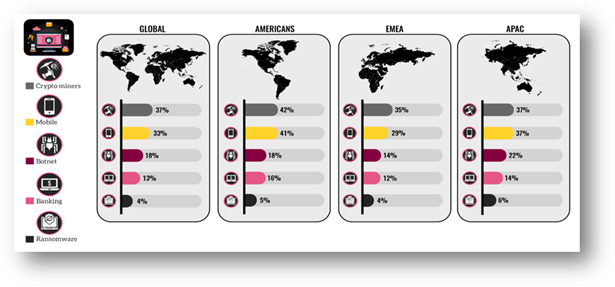 Diagram shows the top cyber-attack categories globally, and by region
Mobiles are a moving target: 33 per cent of organisations worldwide were hit by mobile malware, with the leading three malware types targeting the Android OS. The year 2018 saw several cases where mobile malware was pre-installed on devices, and apps available from app stores that were actually malware in disguise.
Multi-purpose botnets: Bots were the third most common malware type with 18 per cent of organisations hit by bots which are used to launch Distributed Denial of Service (DDoS) attacks and spread other malware.
Bot infections were instrumental in 49 per cent of organisations experiencing a DDoS attack in 2018.
Ransomware attacks in decline: 2018 saw ransomware usage fall sharply, impacting just 4% of organisations globally.
“From the meteoric rise in cryptomining to massive data breaches and DDoS attacks, there was no shortage of cyber-disruption caused to global organisations over the past year. Threat actors have a wide range of options available to target and extract revenues from organisations in any sector, and the first installment of the 2019 Security Report highlights the increasingly stealthy approaches they are currently using,” said Peter Alexander, Chief Marketing Officer of Check Point Software Technologies in a press statement.
“These multi-vector, fast-moving, large-scale Gen V attacks are becoming more and more frequent, and organisations need to adopt a multi-layered cybersecurity strategy that prevents these attacks from taking hold of their networks and data,” he added.