2 min read
© IE Online Media Services Pvt Ltd



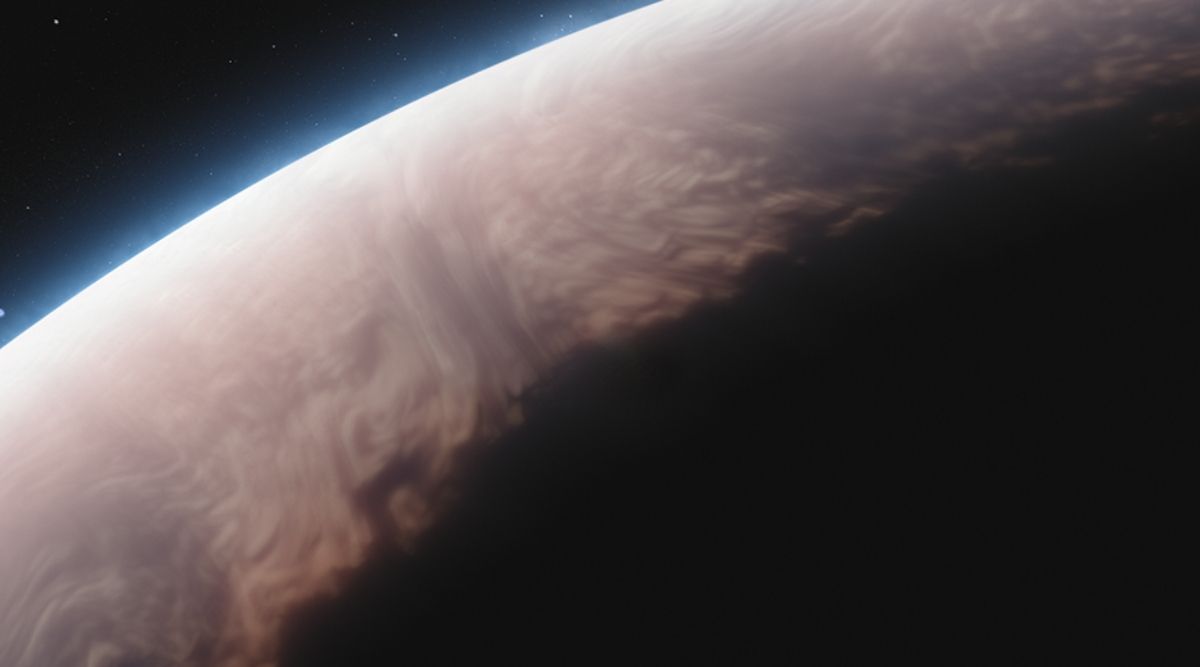 Artist's concept of exoplanet WASP-17b. (NASA)
 Astronomers detected the evidence of quartz nanocrystals in the high-altitude clouds of the exoplanet WASP-17b using the James Webb Space Telescope, said the National Aeronautics and Space Administration (NASA) on Monday.
WASP-17b is a “hot Jupiter” exoplanet about 1,300 light-years away from our planet. The detection is the first time that silica particles have been detected in the atmosphere of an exoplanets, according to the space agency.
“We were thrilled! We knew from Hubble observations that there must be aerosols – tiny particles making up clouds or haze – in WASP-17b’s atmosphere, but we didn’t expect them to be made of quartz,” said University of Bristol researcher David Grant, who authored a paper on the discovery published yesterday in the Astrophysical Journal Letters.
Silicates are minerals rich in silicon and oxygen and they make up a bulk of Earth and the Moon’s mass, as well as other rocky objects in the solar system. They are extremely common across the galaxy. But the silicate grains that were detected so far in the atmospheres of exoplanets and brown dwarfs seemed to be made of magnesium-rich silicates like olivine and pyroxene. Quartz is pure silicon dioxide.
The results from this study “puts a new spin” in astronomers’ understanding of how exoplanet clouds form and evolve. According to coauthor Hannah Wakeford, also from the University of Bristol, they were expecting to see magnesium silicates but instead, the quartz particles appear to be the building blocks of “seed particles” required to build silicate grains that are usually detected in cooler exoplanets and brown dwarfs.