3 min read

Journalism of Courage



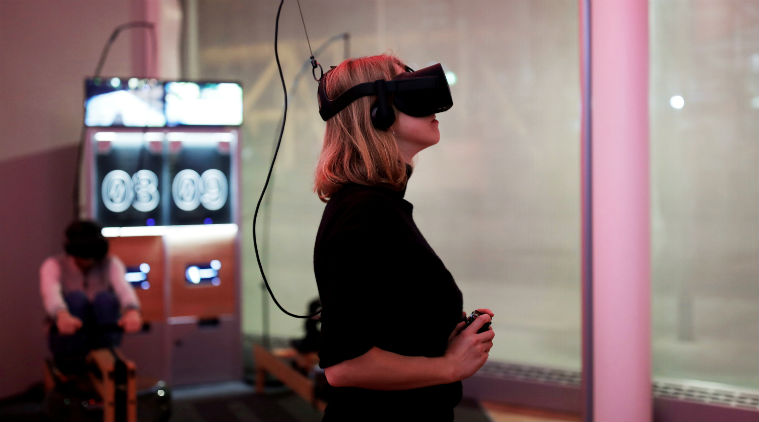 The research may be applied to patients in physical therapy programs who have lost the strength or control of one hand (Image for representation, Source : Reuters)
Scientists have developed a novel training regime that combines virtual reality and traditional physical therapy to help rehabilitate impaired limbs by allowing the healthy ones to ‘lead by example’.
Researchers from Tel Aviv University (TAU) in Israel said that the research may be applied to patients in physical therapy programs who have lost the strength or control of one hand.
“Patients suffering from hemiparesis – the weakness or paralysis of one of two paired limbs – undergo physical therapy, but this therapy is challenging, exhausting, and usually has a fairly limited effect,” said lead investigator Roy Mukamel of TAU.
“Our results suggest that training with a healthy hand through a virtual reality intervention provides a promising way to repair mobility and motor skills in an impaired limb,” said Mukamel.
As many as 53 healthy participants completed baseline tests to assess the motor skills of their hands, then strapped on virtual reality headsets that showed simulated versions of their hands.
Also Read: 3D virtual reality to allow parents to meet unborn children
The virtual reality technology presented the participants with a “mirror image” of their hands – when they moved their real right hand, their virtual left hand would move.
In the first experiment, participants completed a series of finger movements with their right hands, while the screen showed their “virtual” left hands moving instead.
In the next, participants placed motorised gloves on their left hands, which moved their fingers to match the motions of their right hands.
Read More: Six virtual reality experiences that don’t cost too much
Again, the headsets presented the virtual left hands moving instead of their right hands.
The research team found that when subjects practiced finger movements with their right hands while watching their left hands on 3D virtual reality headsets, they could use their left hands more efficiently after the exercise.
However, the most notable improvements occurred when the virtual reality screen showed the left hand moving while in reality the motorised glove moved the hand.
Also Read: Google Earth in Virtual Reality mode comes to HTC Vive VR headset
“We need to show a way to obtain high-performance gains relative to other, more traditional types of therapies,” said Mukamel.
“If we can train one hand without voluntarily moving it and still show significant improvements in the motor skills of that hand, we have achieved the ideal,” Mukamel added.
The researchers are currently examining the applicability of their novel VR training scheme to stroke patients.
The research was published in the journal Cell Reports.