3 min read
© IE Online Media Services Pvt Ltd



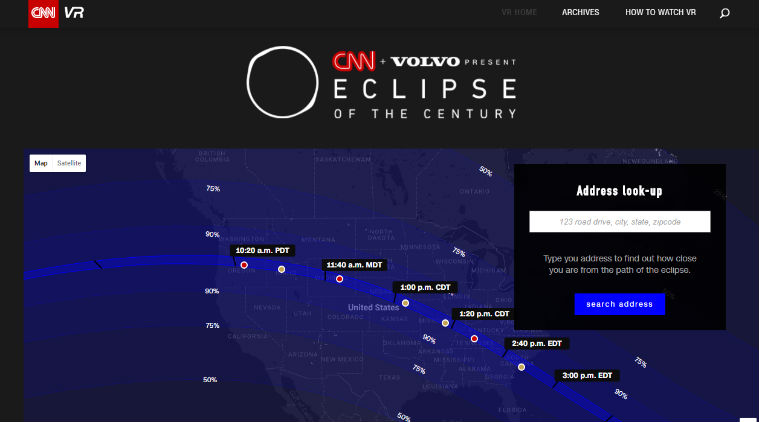 CNN (Cable News Network) is set to livestream total solar eclipse in 4K, 360-degree from multiple locations in the US on August 21.
CNN (Cable News Network) is set to livestream total solar eclipse in 4K, 360-degree from multiple locations in the US on August 21. The American news channel has put in place cameras along the path of the eclipse from Oregon to South Carolina, and the event can be watched via official CNN site, mobile app as well as company’s Facebook page.
Additionally, it will be available in VR (virtual reality) with Samsung Gear VR and Oculus Rift. CNN’s Space and Science Correspondent Rachel Crane and former NASA Astronaut Mark Kelly will host the show, which is called “CNN’s Eclipse of the Century.” The event starts at 1PM ET (10.30 PM IST), and will continue for two hours.
For the first time in nearly a century, the sun, moon and Earth will line up perfectly on August 21, turning day into night for a few minutes. This is most likely to give on-lookers a view of the sun’s outer atmosphere: the corona. The corona will be visible as a pearly-white halo around the moon’s surface.
It shows the outer region of the Sun’s atmosphere, which is 1 million degrees hotter than the surface. The total solar eclipse, paths of which will cross the US, is expected to be heavily viewed and studied.
Meanwhile, NASA has said it will send high-altitude balloons during total solar eclipse that will test the ability of life to survive beyond Earth. The space agency will also livestream footage of the event from the edge of space.
“Total solar eclipses are rare and awe-inspiring events. Nobody has ever live-streamed aerial video footage of a total solar eclipse before,” said Angela Des Jardins from Montana State University in the US. “By live-streaming it on the internet, we are providing people across the world an opportunity to experience the eclipse in a unique way, even if they are not able to see the eclipse directly,” said Des Jardins who is leading NASA’s Eclipse Balloon Project.