


© IE Online Media Services Pvt Ltd
Tags:


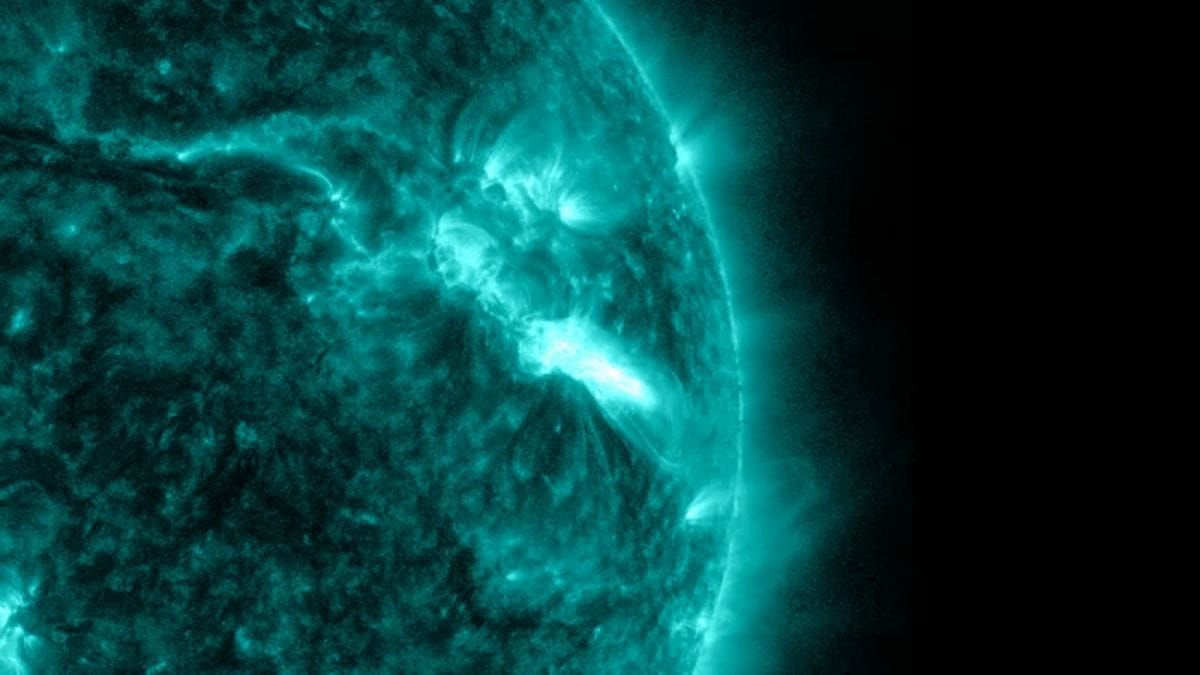
The Sun emitted an incredibly strong solar flare that peaked at 10.30 PM IST on Thursday. The flare was classified as an X2.8 flare and was the most powerful one detected since 2017.
Solar flares usually happen when powerful magnetic fields in and around the Sun “reconnect.” They are classified on the basis of their strength and put into the B, C, M and X classes, with the last being the strongest. Similar to the Richter scale, each step up on the ladder represents a ten-times increase in energy output.


The flare was captured by NASA’s Solar Dynamics Observatory on Thursday.
Radiation from the flare caused a shortwave radio blackout over the Americas, according to SpaceWeather.com. Soon after the blast, the United States Air Force reported a type 1 solar radio burst, which usually comes from the leading edge of a coronal mass ejection, (CME) or a large expulsion of plasma and magnetic field from the Sun’s corona.
However, it is unlikely to cause very intense geomagnetic storms on Earth since the CME is not directly aimed at our planet. But the CME does have an Earth-directed component and that could cause geomagnetic storms on Sunday, December 17.


