2 min read
© IE Online Media Services Pvt Ltd



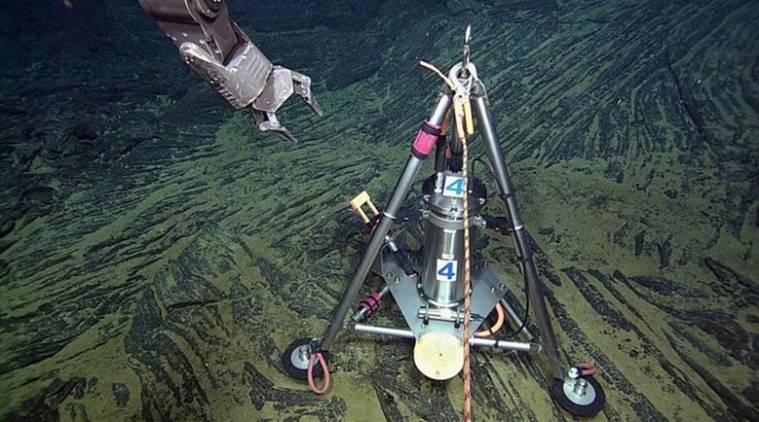 One of three bottom-pressure/tilt instruments in the summit caldera that is connected to the OOI Cabled Array network at an undersea volcano dubbed ‘Axial Seamount’, located off the Oregon coast, is seen in this undated handout photo provided by National Science Foundation/Ocean Observatories Initiative. REUTERS/National Science Foundation/Ocean Observatories Initiative
Scientists have recorded a live video of world’s most active and studied underwater volcano, known as Axial Seamount. Stretching for half-a-mile in height, located at 300 miles from Oregon coast, rising from Juan de Fuca Ridge, Axial Seamount is caused by the movement of two tectonic plates in the region that are gradually spreading apart. On April 24, 2015, the sea floor split open after a massive volcanic eruption, but the scientists had already planned and installed high tech gears to record and study the entire phenomenon. The video produced gave the scientists an insight into the workings of an undersea volcano.
Watch | Scientists install seismometer on an underwater volcano
The Axial Seamount had erupted twice in the past, in the year 1998 and 2011, after which the scientists expected it to erupt again in 2015. The National Science Foundation funded the installment of 550 miles of communications wires to and around the volcano to power 130 sensors that could monitor earthquakes and collect findings. University of Washington oceanographer William Willcock, in an interview to Washington Post said that the findings are “the most detailed observations ever made” of an undersea volcano.
Immediately after the 2015 underwater volcanic eruption, Axial Seamount began to rapidly re-inflate and then slowed down. According to reports, the scientists are closely monitoring and have to see how fast the volcano builds up again.