


Tags:


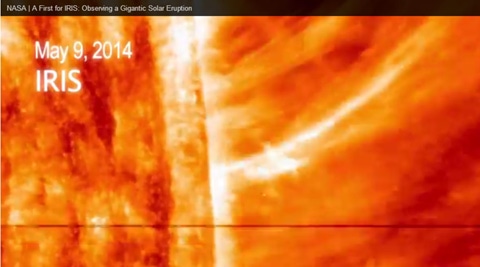
NASA’s newest solar observatory has captured a colossal coronal mass ejection erupting from the Sun in extraordinary detail.
According to the US space agency, during the time of the ejection observed on May 9, a curtain of solar material erupted outwards at speeds of 1.5 million miles per hour.

The field of view for this imagery is about five Earths wide and about seven-and-a-half Earths tall.
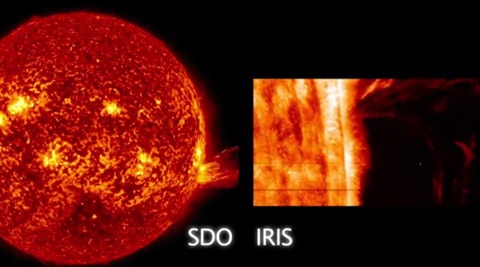
This was the first Coronal Mass Ejection (CME) observed by the Interface Region Imaging Spectrograph, or IRIS, which was launched in June 2013 to peer into the lowest levels of the Sun’s atmosphere with better resolution than ever before.
Check out the video showing extraordinary details of CME here:
A First for NASA’s IRIS: Observing a Gigantic Eruption of Solar Material
“We focus in on active regions to try to see a flare or a CME,” said Bart De Pontieu, the IRIS science lead at Lockheed Martin Solar & Astrophysics Laboratory in Palo Alto, California.
“And then we wait and hope that we’ll catch something. This is the first clear CME for IRIS so the team is very excited,” De Pontieu said.
The IRIS imagery focuses in on material of 30,000 kelvins at the base, or foot points, of the CME, NASA said.


