2 min read
© IE Online Media Services Pvt Ltd



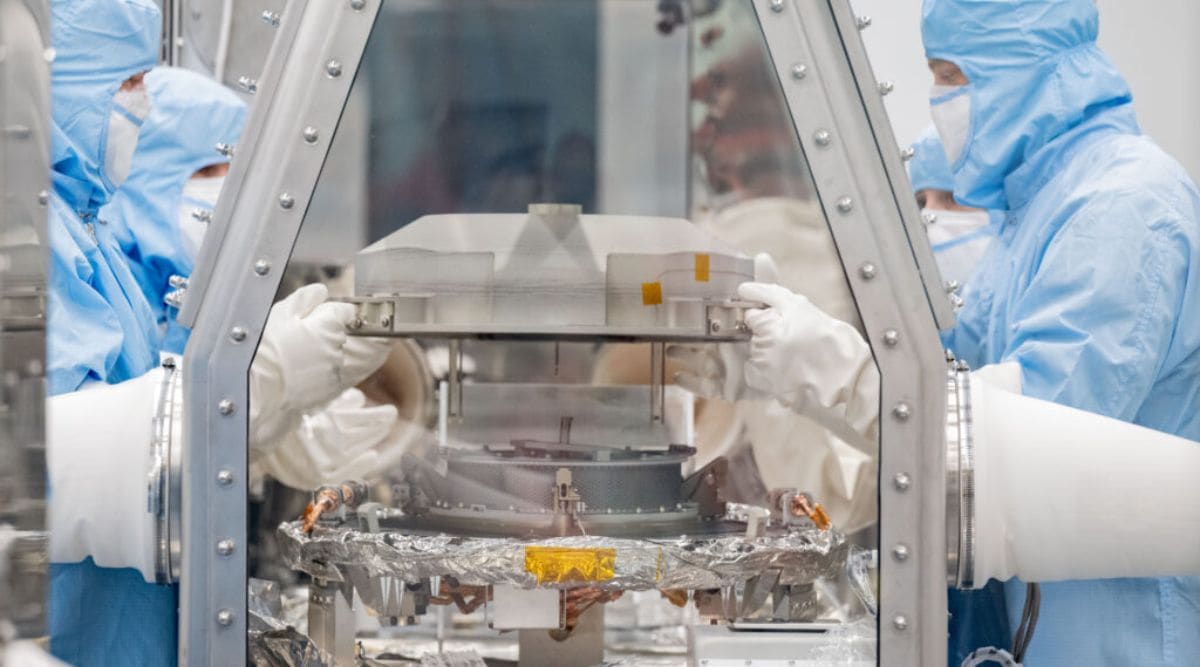 Experts remove the lid of the sample return canister. (NASA/Robert Markowiz)
 Scientists found black dust and debris on the avionics deck of the OSIRIS-REx science canister that was used to deliver a sample from the asteroid Bennu, NASA said Tuesday. The aluminium lid was removed inside a glove box that was designed to prevent contamination of the samples.
The canister from the sample return capsule was delivered to the space agency’s Johnson Space Center in Houston on September 25, the day after it landed in a desert in Utah. Experts at Johnson will now work to disassemble the Touch and Go Sample Acquisition Mechanism (TAGSAM) in the canister to get to the bulk sample inside it.
Once the TAGSAM is separated from the canister, it will be inserted into a sealed transfer container to give it a nitrogen environment for up to about two hours. This container will give the team enough time to insert TAGSAM into another glove box.
Just to be sure, OSIRIS-REx team members will wipe some of the dust from the asteroid sample canister and send it to a laboratory for analysis, according to ARS Technica. But there is little doubt as to whether the dust grains that were immediately visible after scientists opened the lid of the canister were from the asteroid Bennu.
When the spacecraft did a “touch-and-go” manoeuvre of the 500-metre asteroid Bennu in 2020, NASA estimated that its probe had gathered about 250 grams of material. But after the manoeuvre, team members realised that the door of the spacecraft’s collection chamber was wedged open by larger rocky material, and some fragments leaked out into space. They then decided to quickly stow the sampling device inside the return capsule to make sure they didn’t lose more material.
Researchers won’t know for sure how much material the spacecraft has brought back to Earth until they disassemble the TAGSAM in the coming weeks. The 250 grams estimated initially is four times the minimum requirement for mission success.