


Tags:


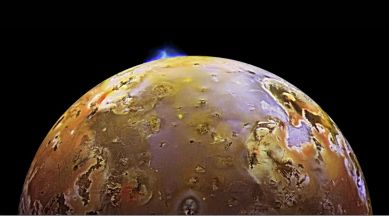
Scientists have detected two massive waves sweeping across the largest lava lake on Jupiter’s moon Io – the most volcanically active body in our solar system.Taking advantage of a rare orbital alignment between two of Jupiter’s moons, Io and Europa, researchers at University of California (UC) Berkeley have obtained an exceptionally detailed map of the largest lava lake on Io.
On March 8 in 2015, Europa passed in front of Io, gradually blocking out light from the volcanic moon.Since Europa’s surface is coated in water ice, it reflects very little sunlight at infrared wavelengths, allowing researchers to accurately isolate the heat emanating from volcanoes on Io’s surface.


The most active volcanic site on Io, Loki Patera is about 200 kilometres across. The hot region of the patera has a surface area of 21,500 square kilometres.”If Loki Patera is a sea of lava, it encompasses an area more than a million times that of a typical lava lake on Earth,” said Katherine de Kleer, a graduate student at UC Berkeley.
“In this scenario, portions of cool crust sink, exposing the incandescent magma underneath and causing a brightening in the infrared,” said de Kleer.”This is the first useful map of the entire patera. It shows not one but two resurfacing waves sweeping around the patera. This is much more complex than what was previously thought,” said Ashley Davies, of the NASA’s Jet Propulsion Laboratory in the US.
Also Read: Stunning pictures of Jupiter sent Nasa’s from Juno spacecraft. See here
“This is a step forward in trying to understand volcanism on Io, which we have been observing for more than 15 years, and in particular the volcanic activity at Loki Patera,” said Imke de Pater, a UC Berkeley professor of astronomy. The images were obtained by the twin 8.4-metre mirrors of the Large Binocular Telescope Observatory in the mountains Arizona, linked together as an interferometer using advanced adaptive optics to remove atmospheric blurring.


