4 min read
© IE Online Media Services Pvt Ltd



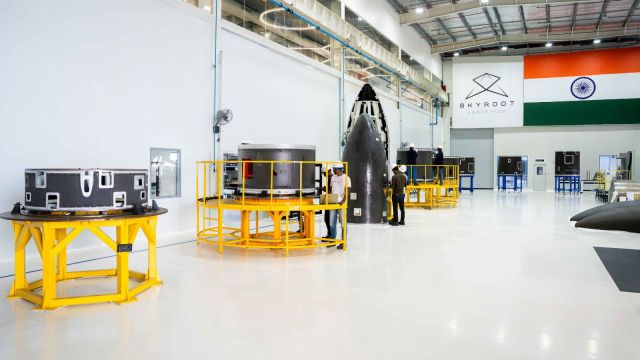 Vikram-I, developed by Skyroot Aerospace, is India’s new private orbital-class launch vehicle named after the notable space pioneer Vikram Sarabhai. This four-stage rocket aims to cater to the small satellite market with rapid and cost-effective launch capabilities. (Image: Skyroot)
Through a video conference, Prime Minister Narendra Modi presented the Vikram-I rocket and inaugurated Skyroot Aerospace’s new Infinity Campus in Hyderabad on Thursday. Speaking on the occasion, Modi highlighted India’s advancements in space technology.
He also underlined the government’s commitment to fostering research opportunities for youth, referencing the establishment of the National Research Foundation to support modern research in universities.
The newly constructed facility by Skyroot Aerospace spans approximately 2,00,000 square feet and is designed for the comprehensive processes of designing, developing, integrating, and testing multiple launch vehicles. This state-of-the-art campus enables the production of one orbital rocket per month. Established by IIT alumni and former ISRO scientists Pawan Chandana and Bharath Daka, Skyroot Aerospace has quickly emerged as a key player in India’s private space sector, notably achieving a milestone with the launch of Vikram-S, the country’s first privately developed sub-orbital rocket, in November 2022.
Skyroot Aerospace, founded by IIT alumni Pawan Chandana and Naga Bharat Daka, is the first private space startup to launch a rocket from the ISRO facility in Sriharikota, marking a significant milestone since the government opened the space sector to private enterprises three years ago.
Vikram-I, developed by Skyroot Aerospace, is India’s new private orbital-class launch vehicle named after the notable space pioneer Vikram Sarabhai. This four-stage rocket aims to cater to the small satellite market with rapid and cost-effective launch capabilities.
Standing at 20 metres tall and 1.7 metres in diameter, Vikram-I produces 1,200 kN of thrust using an all-carbon composite structure for enhanced lightweight strength and efficiency. The design emphasises simplicity, reliability, and the ability to launch within 24 hours from any location. The first three stages are solid-fuelled, providing robust initial thrust, while a hypergolic liquid upper stage allows for precise orbital manoeuvres.
Innovations include 3D-printed engines that reduce weight by 50 per cent and cut production time by 80 per cent, as well as ultra-low-shock pneumatic separation systems and advanced avionics for real-time navigation. Vikram-I can deploy up to 350 kg into low Earth orbit (LEO) and 260 kg into a sun-synchronous orbit (SSO), with specific payload capacities based on mission profiles, such as 290 kg for a 500 km SSO and 480 kg for a 500 km LEO at a 45-degree inclination.
The rocket has undergone successful trials, including Kalam-1200 proof-pressure testing and payload-fairing separation, demonstrating its readiness. As the private space sector in India continues to grow, Vikram-I is set to debut in early 2026, targeting the expanding small-satellite market amid a projected $77 billion Indian space economy by 2030.
“Skyroot’s journey from Vikram-S to Vikram-I shows how Indian startups are now building end-to-end launch capabilities for the global small-satellite market, easing the load on ISRO and expanding national capacity. The new facility’s ability to produce an orbital rocket every month underlines how India is moving from being a launch destination to a competitive manufacturing and services hub in the global space value chain. This milestone is emblematic of the broader private ecosystem that is emerging across rockets, satellites, applications and services, and will be central to realising India’s ambition of a much larger, innovation-led space economy in the coming decade,” said Lt Gen (Retd) A K Bhatt, Director General, Indian Space Association (ISpA).
“Having reliable and indigenous access to orbit is fundamental, not just for the launch sector but for the entire downstream industry that builds practical applications using space data. Vikram-I will help boost India’s private space sector capabilities by enabling faster, more affordable satellite deployment. This reduces barriers for businesses working in defence, disaster management, environmental monitoring and infrastructure. With this capability, the downstream sector can accelerate dxelivering impactful services and strengthen India’s position as a serious global player in space technology,” said Krishanu Acharya, CEO, Suhora Technologies.