


Tags:


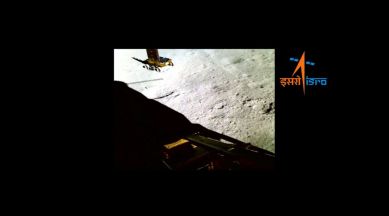
The Indian Space Research Organisation (ISRO) on Thursday shared a video of the Chandrayaan-3 mission’s Pragyan rover “playfully frolicking” on the lunar surface. The video captured by the lander’s camera shows the rover rotating in search of a safe route.
Since the Chandrayaan-3 mission soft-landed on the lunar surface on August 23, the lander and rover have been hard at work, carrying out many science experiments. The space agency on Tuesday released data of the temperature profile of the lunar surface and also said that Chandrayaan-3 had detected the presence of many elements on the Moon. Most notably, it had picked up signals confirming the presence of sulphur, presenting the first direct evidence of that on the Moon.

The LIBS (Laser-Induced Breakdown Spectroscope) instrument on the rover uses a high-energy pulsar that can generate plasma from rocks and soil. In this state, elements emit radiation in characteristic wavelengths that can be used to identify them, according to ISRO.
As seen in the latest video from ISRO, it is not always smooth sailing for the rover. On Monday, the agency announced that Pragyan encountered a large crater directly ahead of its path, which meant that it had to reroute itself. Both the rover and the lander are designed to function for a lunar day.
One lunar day is equal to about 14 days on Earth. Daytime began on the Moon on August 23, the day when the mission landed. During the lunar day, sunlight will be continually available. Since the mission’s instruments are solar-powered, they can only remain operational for one lunar day.
Also, it gets extremely cold on the Moon during night time with temperatures going as low as minus 100 degrees Celsius. Electronics that are not designed to operate at such low temperatures could stop working during the “lunar night.”


