3 min read

Journalism of Courage



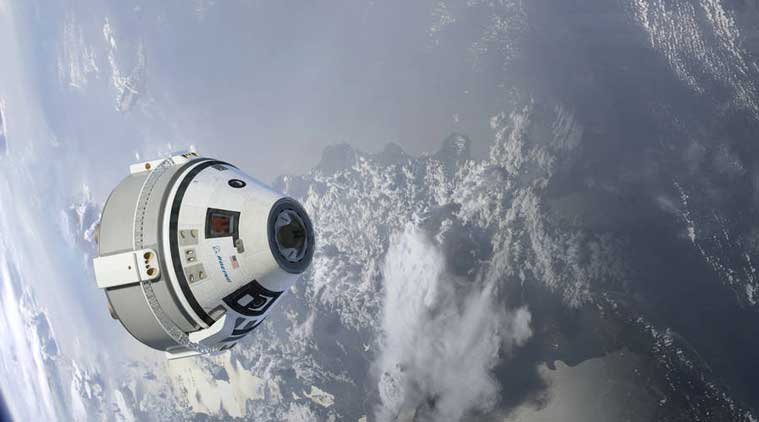 This illustration shows Boeing’s Crew Space Transportation (CST)-100 flying in low-Earth orbit with crew members aboard. (Source: Boeing)
Boeing already has the Dreamliner. Now it also has the Starliner.
The aerospace giant announced the name of its future space fleet Friday. More than 200 people, including Florida Gov. Rick Scott, NASA and Boeing officials, and a bevy of former astronauts, gathered at NASA’s Kennedy Space Center to celebrate the grand opening of Boeing’s commercial crew and cargo processing facility.
Once a space shuttle hangar, the transformed building will serve as home to the Starliner. Its first launch with a crew to the International Space Station is targeted for 2017.
Until Friday, Boeing’s still-under-development capsule was known simply as the CST-100, an abbreviation for Crew Space Transportation and 100 kilometres, the threshold of space.
Boeing is one of two private US companies contracted by NASA to transport space station astronauts from Cape Canaveral.
SpaceX, the other company, is developing an enhanced version of its cargo-carrying Dragon capsule — a super Dragon. That work is being carried out at its headquarters in Hawthorne, California.
NASA wants its astronauts launching from U.S. soil again rather than hitching expensive rides from Kazakhstan with the Russian Space Agency. That hasn’t happened since the last shuttle flight in 2011.
The Starliner name was revealed by the commander of the last shuttle flight, Chris Ferguson, now deputy manager of operations for Boeing’s commercial crew program.
“We get asked a lot, ‘When are you going to pick a name for that wonderful spacecraft?'” Ferguson told the crowd. “Well, I’ve always said, ‘Just wait. It’s coming.’ Well, guess what? The wait is over.”
“Please welcome the CST-100 Starliner,” Ferguson said as a temporary wall behind him rose and revealed, to dramatic music and flashing lights, spacecraft sections that will be used for testing.
In choosing the name, Boeing wanted to give a nod to the next generation of space and the next 100 years of flight for Boeing, Ferguson said. The Chicago-based company will mark its 100th anniversary next summer.
NASA Administrator Charles Bolden Jr., also a former shuttle skipper, talked up the space agency’s plans to send astronauts to Mars in the 2030s, with Boeing and SpaceX picking up the get-crews-to-orbit slack.
“If you’re not excited, then there’s something wrong with you, to be quite honest,” Bolden said.
The most senior astronaut present, Gemini and Apollo’s Thomas Stafford, liked what he saw.
“It’s a great name,” said Stafford, 84, who flew to the moon on Apollo 10, two months before the first manned moon landing in 1969. He said the spacecraft is reminiscent of the capsules from the Apollo moon program.
NASA’s commercial crew contract with Boeing to certify, test and fly the Starliner capsules totals $4.2 billion. The SpaceX contract is worth $2.6 billion.