2 min read
© IE Online Media Services Pvt Ltd



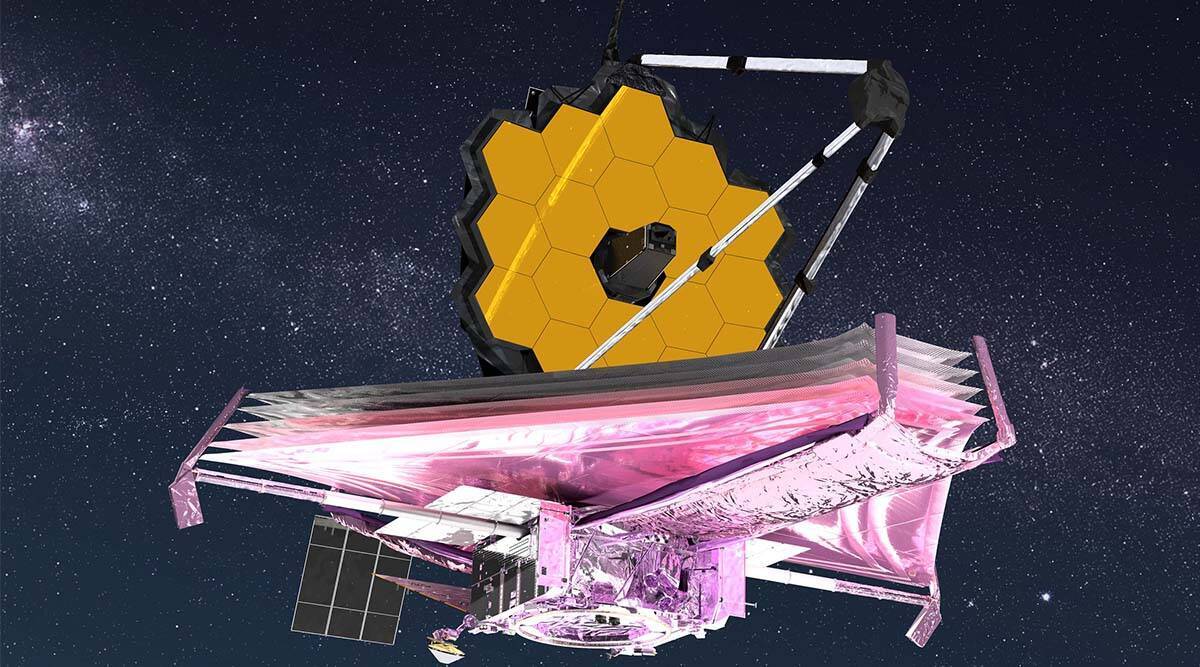 Artist's impression of the James Webb Space Telescope in space. (Image credit: NASA GSFC/CIL/Adriana Manrique Gutierrez)
 NASA announced that the James Webb Space Telescope’s NIRISS (Near Infrared Imager and Slitless Spectrograph) is currently unavailable for science observations. Since the instrument is a contribution from the Canadian Space Agency (CSA), agency will work with the American Space Agency to determine the root cause of the issue.
“On Sunday, Jan. 15, the James Webb Space Telescope’s Near Infrared Imager and Slitless Spectrograph (NIRISS) experienced a communications delay within the instrument, causing its flight software to time out. There is no indication of any danger to the hardware, and the observatory and other instruments are all in good health. The affected science observations will be rescheduled,” wrote NASA officials in a statement.
NIRISS is one of the four scientific instruments aboard Webb and it provides near-infrared imaging and spectroscopic capabilities. It is the only instrument capable of aperture mask interferometry and it has the unique ability to capture images of bright objects at a higher resolution than the other imagers on Webb.
Also, NIRISS is not the first Webb instrument to suffer a glitch. In August last year, MIRI (Mid-Infrared Instrument) ran into a glitch where a grating wheel mechanism that supports the instrument’s “medium-resolution spectroscopy” (MRS) mode showed signs of increased friction. Webb engineers overcame this obstacle by devising new operating procedures to allow continued science observations with the instrument despite the glitch.
In a separate incident in December last year, a software issue triggered the safe mode of the orbiting observatory. During safe mode, the observatory’s nonessential systems are automatically turned off, essentially placing it in a protected state. Webb engineers fixed this issue by adjusting the commanding system that controls the safe mode.
Unlike the Hubble Space Telescope, which orbits around 535 kilometres away from the surface of the planet, Webb is situated at the second Lagrange point of the Earth and the Sun, which is about 1.5 million kilometres away from the planet. Without a way to visit the telescope and fix any issues, Webb was designed to function in the absence of servicing capabilities.