3 min read
© IE Online Media Services Pvt Ltd



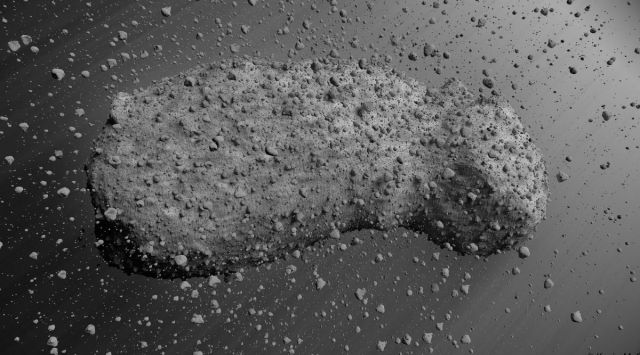 Artist's illustration of the asteroid Itokawa. (Image credit: Curtin University)
 A new research into the durability and age of an ancient asteroid made of rocky rubble and dust revealed findings that could contribute to potentially saving the Earth if an asteroid hurtled towards it, according to Curtin University. An international team of researchers studied three tiny dust particles collected from the surface of Itokawa, an ancient 500-metre-long rubble pile asteroid, returned to our planet by the Japan Space Agency’s Hayabusa 1 probe.
The study published in the journal Proceedings of the National Academy of Sciences revealed that Itokawa, which is around seven times bigger than Qutab Minar and two million kilometres away from our planet, would be hard to destroy and resistant to collision. The research team also found the asteroid to be nearly as old as the solar system itself.
“Unlike monolithic asteroids, Itokawa is not a single lump of rock but belongs to the rubble pile family, which means it’s entirely made of loose boulders and rocks, with almost half of it being empty space. The survival time of monolithic asteroids the size of Itokawa is predicted to be only several hundreds of thousands of years in the asteroid belt,” said Fred Jourdan, lead author of the research article.
“The huge impact that destroyed Itokawa’s monolithic parent asteroid and formed Itokawa happened at least 4.2 billion years ago. Such an astonishingly long survival time for an asteroid the size of Itokawa is attributed to the shock-absorbent nature of rubble pile material. In short, we found that Itokawa is like a giant space cushion, and very hard to destroy,” added Jourdan.
In case an asteroid was ever to pose a threat to Earth, our primary form of defence would involve the “kinetic impactor” method, where we could crash a spacecraft into an asteroid to slightly alter the course of the asteroid. In September last year, NASA’s DART spacecraft deliberately crashed into the asteroid Dimorphos in the first successful demonstration of an asteroid mitigation technique.
The kinetic impactor method works because we would only have to delay or hasten the asteroid’s trajectory by about 7 minutes in order to save the planet. That is about the time that the Earth takes to travel a distance equal to its diameter. If we delay an asteroid on course to collision with our planet by about 7 minutes, the Earth wouldn’t be at the same location when the asteroid passes its orbit.
But in the case of rubble asteroids like Itokawa, there is a small chance that the asteroid could absorb the impact without its trajectory being affected much. This could mean that the kinetic impactor method will not work for such asteroids.