4 min read
© IE Online Media Services Pvt Ltd



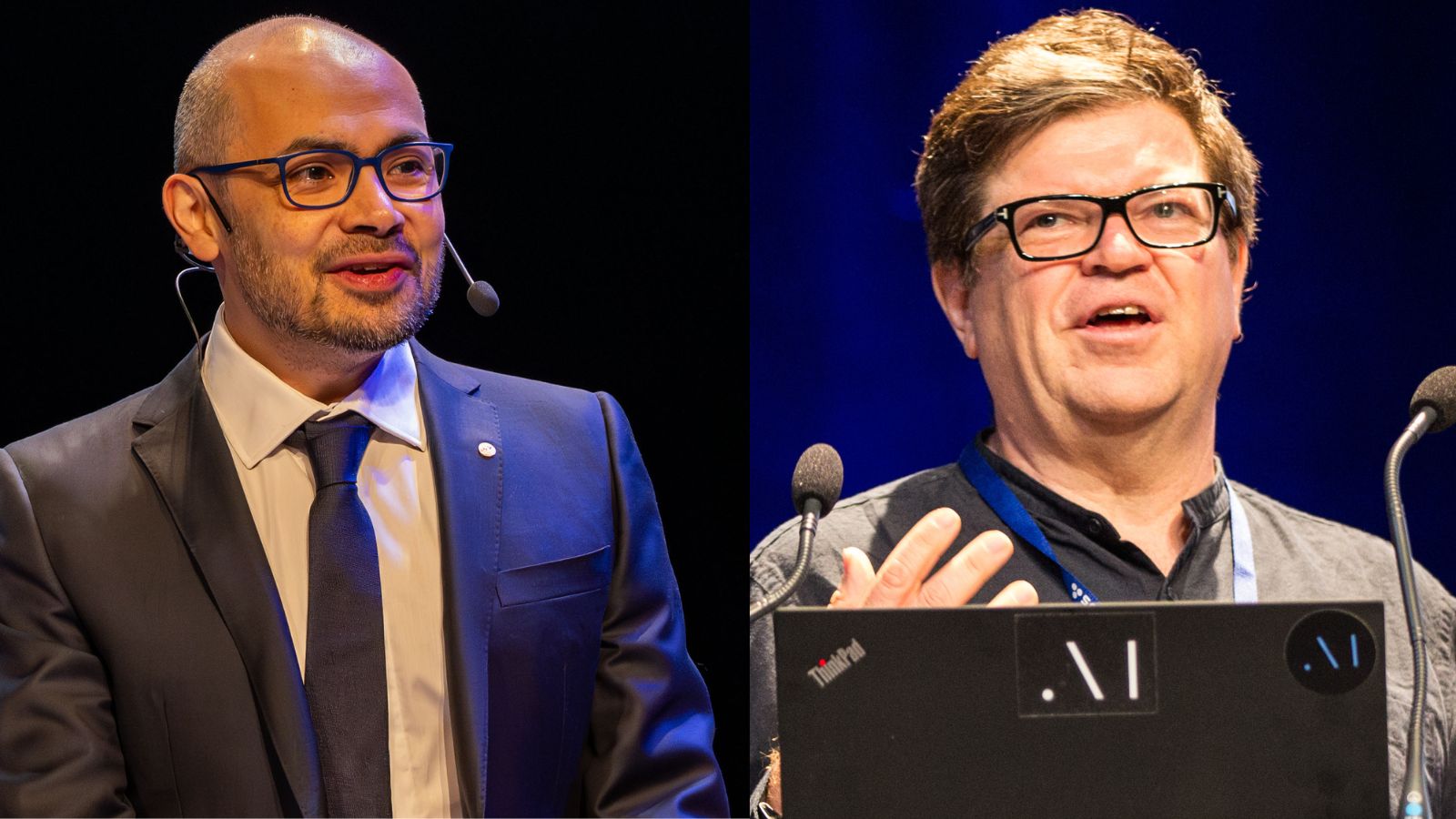 Google DeepMind CEO Demis Hassabis (left) and Turing Award-winner Yann LeCun. (Express Image/Wikimedia Commons)
Whether human intelligence is broadly general or highly specialised has emerged as a key point of contention within the AI community, with differing views from two leading AI researchers, Yann LeCun and Demis Hassabis.
LeCun, the outgoing chief of AI at Meta, has said that the concept of general intelligence does not exist as it is used to designate human-level intelligence, which is not general but super-specialised. While humans navigate real-world environments and deal with other people well, LeCun argues that humans perform poorly at structured tasks like chess.
“We think of ourselves as being general, but it’s simply an illusion because all of the problems that we can apprehend are the ones that we can think of,” the Turing Award winner said in a recent podcast appearance.
Responding to his remarks, Google DeepMind CEO Demis Hassabis said that LeCun was “plain incorrect” as he was “confusing general intelligence with universal intelligence”. “Brains are the most exquisite and complex phenomena we know of in the universe (so far), and they are in fact extremely general,” Hassabis wrote in a post on X.
“Obviously, one can’t circumvent the no-free-lunch theorem. So in a practical and finite system, there always has to be some degree of specialisation around the target distribution that is being learnt,” he said.
In machine learning (ML), the no-free-lunch theorem implies that no single machine learning algorithm is universally the best-performing algorithm for all problems. For instance, an AI/ML algorithm cannot be good at predicting the stock market while also being able to analyse X-rays with the highest accuracy.
“But the point about generality is that in theory, in the Turing Machine sense, the architecture of such a general system is capable of learning anything computable given enough time and memory (and data), and the human brain (and AI foundation models) are approximate Turing Machines,” the Nobel Prize-winning AI researcher argued.
Yann is just plain incorrect here, he’s confusing general intelligence with universal intelligence.
Brains are the most exquisite and complex phenomena we know of in the universe (so far), and they are in fact extremely general.
Obviously one can’t circumvent the no free lunch… https://t.co/RjeqlaP7GO
— Demis Hassabis (@demishassabis) December 22, 2025
A Turing Machine is a hypothetical machine that can be used to simulate any computer algorithm and is used to explore the limits of what can be computed.
Pushing back on LeCun’s chess analogy, Hassabis dismissed the idea that human performance in narrow domains undermines generality. “It’s amazing that humans could have invented chess in the first place (and all the other aspects of modern civilization from science to 747s!), let alone get as brilliant at it as someone like Magnus (Carlsen),” he said.
“He (Carlsen) may not be strictly optimal (after all, he has finite memory and limited time to make a decision), but it’s incredible what he and we can do with our brains given they were evolved for hunter-gathering,” the DeepMind co-founder added.
I think the disagreement is largely one of vocabulary.
I object to the use of “general” to designate “human level” because humans are extremely specialized.You may disagree that the human mind is specialized, but it really is. It’s not just a question of theoretical power but…
— Yann LeCun (@ylecun) December 22, 2025
The exchange between LeCun and Hassabis underscores broader differences in how they view the path to achieving artificial general intelligence (AGI)—a hypothetical level of intelligence where AI models perform tasks better than or on par with human performance.
Demis Hassabis believes that scaling existing large language models (LLM) alone will not be enough to reach AGI, as one or two more breakthroughs are still needed.
Meanwhile, LeCun has strongly argued that LLMs are a dead-end as they are not capable of continual learning. Instead, he has championed developing “world models” that serve as internal representations of the real world, incorporating physics, causality, and temporal dynamics. He has also previously said that he prefers the term “advanced machine intelligence” over AGI.