6 min read
© IE Online Media Services Pvt Ltd



 PV Sindhu. (File/Agencies)
 It would have been marvellous had PV Sindhu morphed into Sung Ji Hyun’s gazelle-like court movements while relentlessly retrieving shuttles. Except, Sindhu isn’t Sung Ji Hyun, the Korean whose classical defensive style her Korean coach Park is trying to imbibe in her. Correction. She isn’t just Sung Ji Hyun. She is much more, having both achieved considerably more with two Olympic medals and five World podium finishes including the 2019 title. And blessed with more talents – her physical fortitude in terms of recovery and the natural reach which she is blessed with. As beautifully balletic as Sung Ji Hyun’s game—more the defence than attack-and Korean classicism were, SJH isn’t enough to encompass Sindhu’s inherent abilities, and to base her future course of career on.
 PV Sindhu in action. (FILE)
Was there much to learn from Sung Ji? Definitely. The recent smoothness in Sindhu’s movements, her wider array of strokes, just the sheer coherence in a rally – where transitions from defence to offence and vice versa seem much more natural – make all of coach Park’s efforts worthwhile. If badminton games were jigsaw puzzles, defence was widely acknowledged as the missing—rather, jagged-edged piece needing smoothening—for Sindhu.
Eternal quest
But defence is also an eternal and endless quest—to get better each day and not miss a single shuttle, which as we know doesn’t ever completely happen. Not-so-fun fact: shuttles will drop to the floor. So, bettering the defence can’t define a badminton game-style. Sure it props up confidence in attack, keeps you in the game. But Sindhu will always need winners to …win matches.
And to diametrically alter her game style from a competent attacking behemoth to a reasonably proficient defensive retriever, seems like one step forward and far too many steps back. Not when an attacking style can make her even greater than what she already is— also help her go past Zhang Ning with six World medals as an all-time great, should she add yet another achievable title.
It’s why she needs a buffet of coaching to supplement the defensive work coach Park and her father PV Ramana (who takes the broader calls on her playing philosophy) have been putting in for the past few years. Park has been excellent in diversifying her stroke armour. But Sindhu needs him to sharpen her attack to truly reach glorious heights she is further capable of.
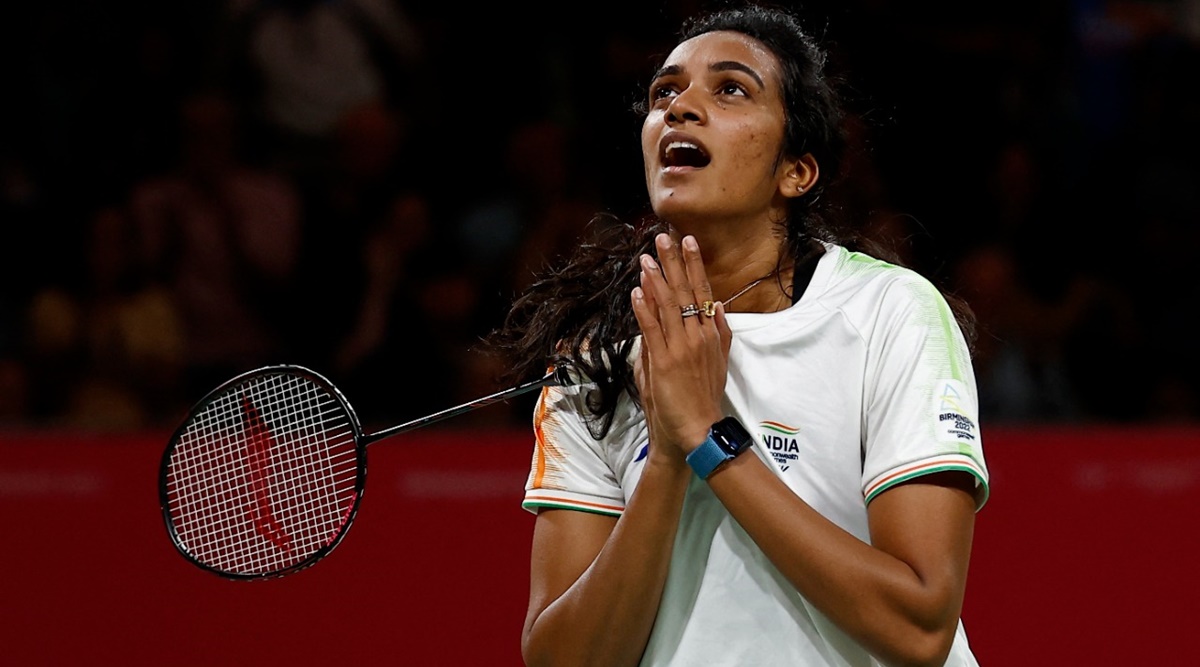 The 2018 edition champion Sindhu had sustained the injury on way to her title winning run at the Commonwealth Games in August. (File)
Moreover, in a fast developing environment where shuttlers are opening to short stints of training at various academies, like picking Uni electives in academics, Sindhu might well want to consider a spot of training with someone like Viktor Axelsen, should he be open to it.
Axelsen is perhaps the closest that present day perfection comes to. But more than that, it’s his body type. Tall and lanky once, Axelsen has maxed out his game using his superior reach to cover the flanks, and worked on his agility (and backhand stance) to cover the lower angles so he can lift shuttles inches off the ground despite not having a low centre of gravity. But more than everything, Axelsen hasn’t forgotten his attacking, smashing instinct—the bulwark of his game, chiselling his smashes, making them so destructive that they add to his aura—just like they could for Sindhu.
 PV Sindhu plays a shot. (File)
The tall Indian in that sense, needs the European / Danish ethos to make her attacking game even more deadlier than what it was in 2019 when she won the world title. That Sindhu works harder than any athlete in India is fairly well known, so her endurance work will never be a problem. But she needs that bespoke tall-players’ defence, and there’s noone better than Axelsen to pick brains off, and even train a bit should that be possible.
Sindhu was always primed to progress her career in the realms of the tall and stately Tine Rasmussen Baun, the towering Dane who wrapped up her career with late 20s, early 30s All Englands bang in the middle of the Chinese juggernaut years. While she was adept at defence, it was her sharp, short attack that could negate opponents’ challenges.
Paris plans
As such, Sindhu has nothing left to prove, except the Olympic gold. And Paris is nicely firming up for her to target that. But from a broader perspective of expanding her repertoire, collecting varied experiences, Sindhu would do well to look at short stints, even in China perhaps under Zhang, given she’s a Li Ning athlete with access to that kind of expertise.
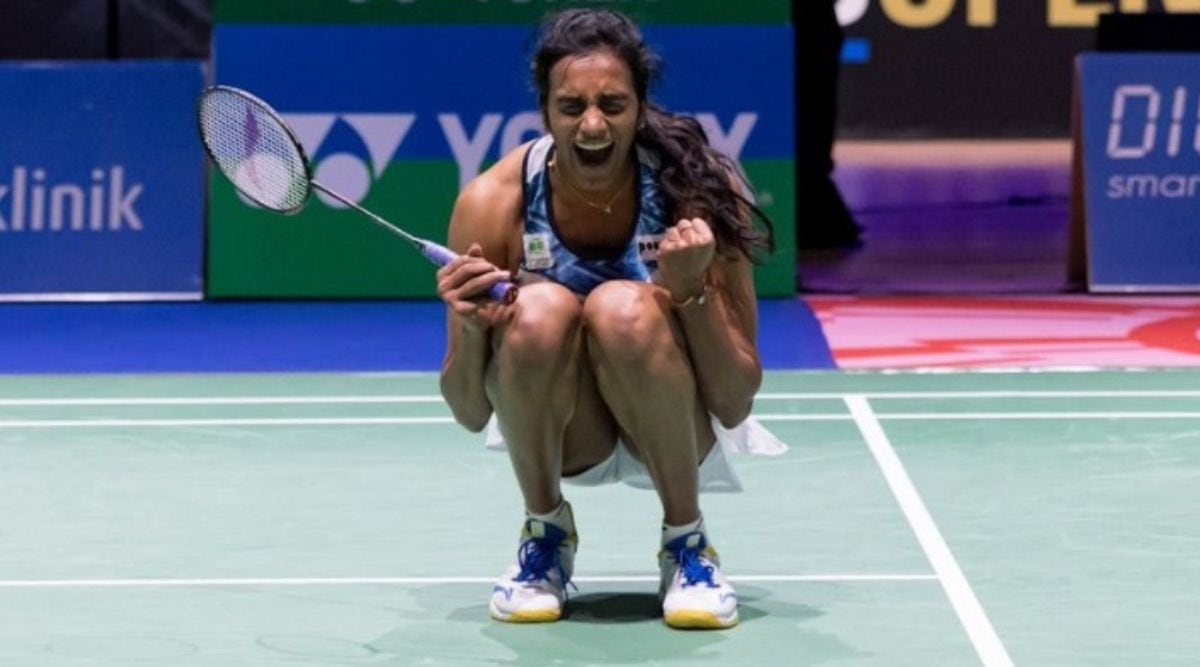 PV Sindhu reacts after picking up a point. (File)
Cross-training, even looking at other sports, say volleyball, netball and basketball for specific tall-person agility workouts, maybe riffing off how tall female squash players managed their later careers (given the low defence in both sports), and even training with Indonesian doubles with their no holds barred attacking instinct could prove to be an inspired choice. PV Sindhu has always been an attacking beast when she’s won, and it makes no sense to cage that fierce and regal quality into folds of defence-centric layers for such a once-in-a-lifetime generational athlete.
Defence will always be the bedrock of any badminton game. But what she needs and what the time is right for is a buffet of coaching options. It would need her to curate these opportunities, invest in such coaching expertise financially and be open to non-traditional rules of badminton training. It would mean thinking independently, even challenging age-old knowledge she’s grown up with and unlearning a few things. But given her stature and as one of India’s greatest athletes ever, it would be sad if she didn’t explore these wealth of options available to her for consideration. From her tall vantage, she could have the world at her feet. And a gold dangling off her neck.