
Opinion What Election Commission doesn’t seem to get: Democracy cannot be ‘revised’ in haste
The EC must pause, reflect and reform. It must immediately halt this exercise that bears no similarity to a proper and legitimate 'SIR'.
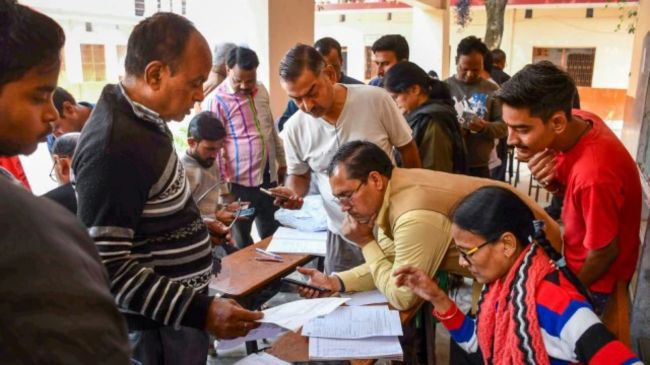 The list of such voters will be available on each District Election Officer's website, as well as on a constituency-wise and booth-wise basis. Instructions have been given to hold a meeting of BLAs with all BLOs by December 12th. (File/Representational)


The Election Commission of India (EC) has presented its Special-Intensive Revision (SIR) of electoral rolls as a routine administrative clean-up. A technical exercise to weed out deceased, duplicate or migrated voters. But what has unfolded across the country, and most dramatically in Bihar, reveals a process riddled with opacity, arbitrariness and a cavalier disregard for the most sacred right in a democracy: the right to vote.
What should have been a meticulous, transparent, multi-stage exercise (like the eight times it has been conducted prior to 2003) has instead been rushed, confused, error-prone and exclusionary. The first question is: Why now? Why launch a sweeping, nationwide revision mere months before crucial elections? Why compress a process that demands careful planning, field verification, and citizen outreach into an artificial deadline?

Across several states, the poor, migrants, daily-wage workers, women, and rural residents have found themselves struggling to prove identity and residence, not because they lack citizenship, but because the bureaucratic burden placed upon them is unreasonable. The irony is unmistakable: Those already facing structural disadvantages are being made to jump through hoops merely to stay alive on the rolls. Instead of strengthening democracy, the SIR risks shrinking its boundaries, cutting out those who most need the system to hear them.
Nowhere were the flaws more dramatically exposed than in Bihar, where the SIR exercise became so constitutionally questionable and administratively chaotic that the Supreme Court of India had to step in and impose five corrective measures simply to make the process remotely transparent.
First, the Court ordered publication of the list of 65 lakh deleted voters from the draft rolls in Bihar, along with reasons for the deletion. This is not an optional act of benevolence that the EC could disregard. It was the bare minimum expected of any democratic institution. When lakhs of citizens are struck off the rolls, transparency is not a courtesy; it is a constitutional duty.
Second, the Court directed the EC to accept Aadhaar as a valid document, something the Commission should have known without judicial prompting. The Representation of the People Act (ROPA) already recognises Aadhaar as an acceptable ID. Yet, in a deliberate act, the EC left it out of the approved list of 11 documents. It took the Supreme Court to remind the Commission of its own statutory obligations.
Third, recognising the chaos unleashed by the SIR, the Court required the involvement of the National Legal Services Authority and its state units to help wrongfully deleted voters file claims and objections. That free legal aid had to be invoked in an electoral revision exercise is itself an indictment of how exclusionary the process had become.
Fourth, the Supreme Court held near-weekly hearings and demanded regular compliance reports, a level of judicial monitoring rarely seen in electoral roll matters. That degree of supervision tells its own story: The Court simply did not trust the process as it was unfolding.
Fifth, the ECI was directed to publish daily, booth-wise numbers of deletions and additions. Real-time public disclosure was necessary precisely because the SIR was operating in the shadows, with little accountability and even less clarity.
That it took the highest court of the land to compel such basic transparency speaks volumes about how far the SIR had drifted from democratic norms.
Across states, the on-ground reality remains alarming. Field officers are overburdened, deadlines are unrealistic, and verification is uneven. Reports highlight unreturned forms, missing house-to-house surveys, postponed documentation checks, and a lack of meaningful citizen outreach. The very people responsible for conducting the exercise, Booth Level Officers, have themselves complained of unbearable pressure, and 20 of them have tragically committed suicide. The EC, in an act that is both tone-deaf and insensitive, still insists on its truncated and unrealistic timelines. Almost every single political party has complained about the process. Notably, the party in power had no complaints until recently, when it made all the above allegations (and more) against the process in West Bengal.
Yet, the EC continues to project the SIR as a clean-up operation that will sanitise India’s electoral databases. The truth is that cleanliness is not the issue. Clarity is. The process is opaque, selectively implemented, and unacceptably prone to mass error. Worse, it comes at a moment when electoral trust is fragile and political polarisation is at its peak. Electoral rolls are not mere spreadsheets. They are sacred documents. A wrongful deletion is not an administrative error; it is disenfranchisement. It silences a voice, erases a choice, and strikes at the heart of representative democracy.
If the ECI is truly committed to transparency, then it must go further than complying with court orders under duress. It must immediately make all electoral rolls fully machine-readable and searchable. In 2025, it is unacceptable for the world’s largest democracy to publish electoral data in formats that are difficult to analyse, impossible to audit, and inaccessible to ordinary citizens. This technological opacity creates an accountability vacuum that can easily be exploited.
The EC often cites precedents (particularly the Kamal Nath judgment) to claim wide discretion in matters of roll revision. But that precedent cannot be treated as gospel, and when it is cited repeatedly to undermine voter rights rather than protect them, it goes against the catena of judgments that have come into existence to protect the rights of voters. It is not good law for the simple reason that democracy cannot be built upon doctrines that give institutions the freedom to restrict access rather than enhance it.
Democracy cannot function in the dark. And voters cannot be expected to navigate blind alleys of bureaucracy just to prove that they exist. The way forward is clear. The EC must pause, reflect and reform. It must immediately halt this exercise that bears no similarity to a proper and legitimate “SIR”. If the EC had been genuine, it would have strengthened due process, worked with state legal aid bodies, produced machine-readable rolls (instead of hiding behind the Kamal Nath judgment), and proactively engaged with civil society and political parties.
The EC must remember that its mandate is not statistical hygiene. It is voter protection. “Clean rolls” must never become a euphemism for “cleaning out” citizens.
Surjewala is MP, Rajya Sabha and an advocate. Khan is the National Secretary of the AICC Law, Human Rights and RTI Department and an advocate

 Share
Share


