7 min read


© The Indian Express Pvt Ltd



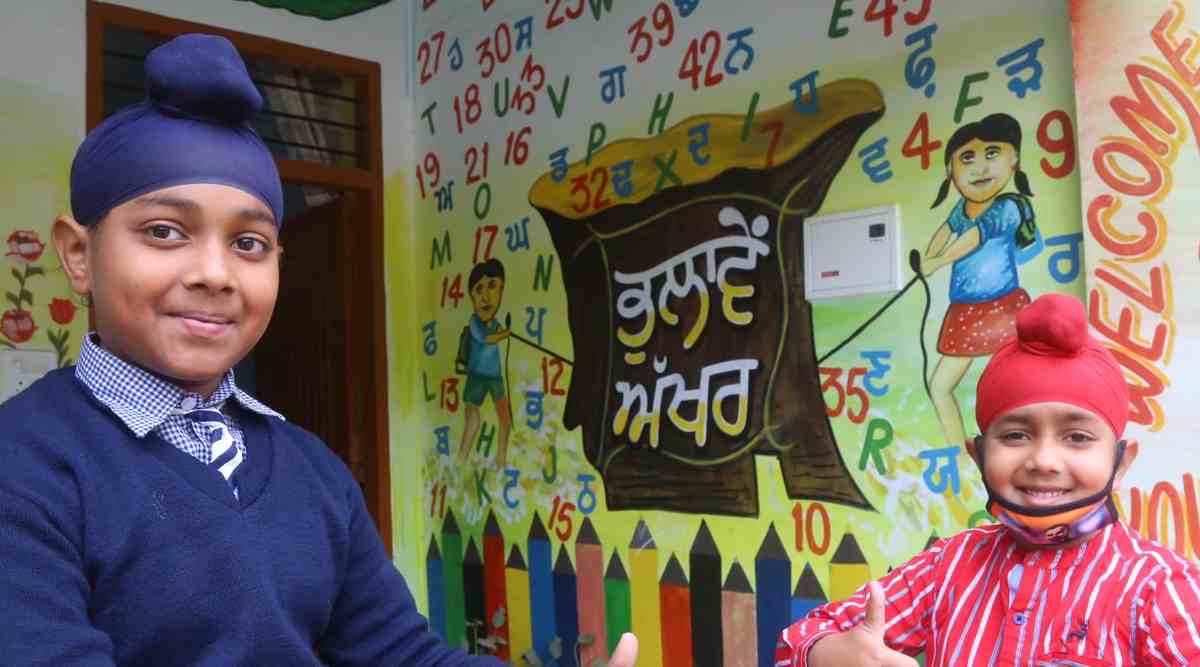 While Japmanpreet, who is in Class 5, strugges to keep up with the fluent Punjabi of classmates, the younger Sahibjot is having an easier time with the shift. (Jasbir Malhi)
 As the teacher dictates lines in fluent Punjabi for the children to write down, the anxiety of Japmanpreet Singh, 11, a student of Class 5 at Government Elementary ‘Smart’ School in Kansal village of Mohali district in Punjab, grows. It’s just the first period, and a whole day to go.
It has been nearly a year since Japmanpreet’s parents shifted him to this school in their village, mid-session, from a CBSE-affiliated, English-medium private school in Chandigarh — his younger brother Sahibjot joined the school in Class 1 this year.
For Japmanpreet and Sahibjot, 7, it has meant adjusting from Punjabi as one of the subjects to Punjabi as the main one. In the class of 21, Japmanpreet is the only one who has opted for ‘English Medium’. This essentially means a separate set of books and some extra attention from the class teacher — who teaches all the six subjects to the class, including Punjabi and English.
Japmanpreet, who is more fluent in English and Hindi, struggles to keep up, especially in taking notes in Punjabi.
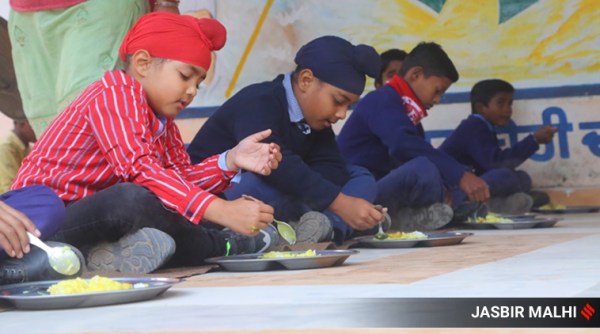 For two brothers, tiffin has been replaced by mid-day meal. (Express Photo: Jasbir Malhi)
There are six classrooms to accommodate 330 children at the school from pre-primary to 5th. The ‘smart’ tag is essentially for two classrooms fitted with projectors. Social distancing is impossible, and the teachers keep repeating instructions to wear masks.
Harpreet Kaur Bedi, 37, says she had to shift her two sons to a government school as the income of her husband Mandeep Singh Bedi, who works as a music teacher at a gurdwara in the US, nearly halved during the Covid pandemic when the gurdwara was shut for a long period. “We were paying Rs 7,200 a month for the two as tuition fees in the previous school. We requested some concession for online classes, but they did not agree. It became impossible for us to pay the fees, even as other expenses rose.”
For Japmanpreet, math tables are now ‘pahaadey’, ‘Thought of the day’ is ‘Ajj da vichaar’, and tiffin has been replaced by mid-day meal.
 Their mother drops and picks them up on her two-wheeler. (Express Photo: Jasbir Malhi)
While he still tries to speak in English and strike conversations like in previous school, he hardly gets a response. “I only speak in English with teachers now. My classmates mostly speak Punjabi so I talk to them in Punjabi only,” he says.
Sahibjot, who had no exposure to Punjabi as it starts as a subject in private schools only from Class 3, has forgotten the poems in English he learnt at his previous school but has instead started reciting Punjabi poems in one go. He is having an easier time making the shift to Punjabi, and having learnt the alphabets only this year, has progressed to neat three-letter words.
Japmanpreet’s class teacher Ramanjeet Kaur says he is slower in Punjabi writing but much better at English than his classmates. “For instance, Japman knows the difference between ‘nice’ and ‘niece’,” she says. Kaur adds that she tries to explain the topics to him separately as he has opted for English medium, “but the common reading and lecture in classrooms are in Punjabi”.
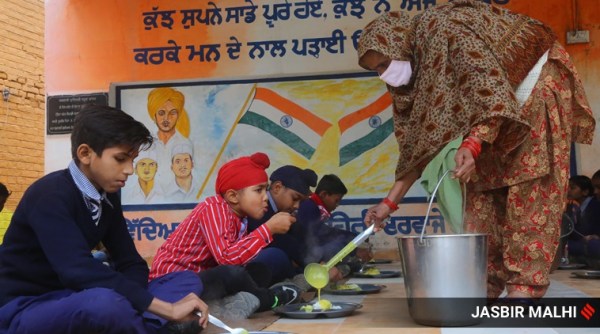 Thursdays are happy days as it is hot curry and rice in mid-day meal. On the days of daal-roti, they ask their mother to pack them a tiffin. (Express Photo: Jasbir Malhi)
Head teacher N D Tewari says they are short of at least two rooms and hence two sections of pre-primary (LKG & UKG) have to be combined in one room. He adds that at least 25 children from private schools have enrolled in their government school this year.
English medium is optional for students in government schools of Punjab. There is no tuition fees, and books and uniform are provided free of cost.
Harpreet, who stays with her mother and drops the children to school on her scooty, says what made her finally decide to make the shift was when the private school demanded Rs 40,000 for “fresh admission” in Class 5 for Jagmanpreet.
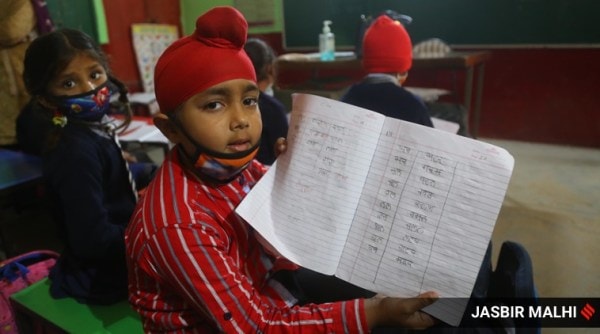 Sahibjot is having an easy time shifting to Punjabi, and having learnt the alphabets only this year, has progressed to neat three-letter words. (Express Photo: Jasbir Malhi)
Moving into the new school, she says, Japmanpreet had only one question: “How will I handle Punjabi?”
But it’s math and English that are the real problem, feels Harpreet. “The practice material and model question papers in maths provided by the government school are in Punjabi. Jagmanpreet’s base has been English.”
Her fear that her children might fall behind in English is accentuated by the expectation of joining her husband in the US soon. “With my husband’s income recovering a bit, I have engaged tuitions for them for Rs 2,500 a month to focus on English. I also teach them separately.”
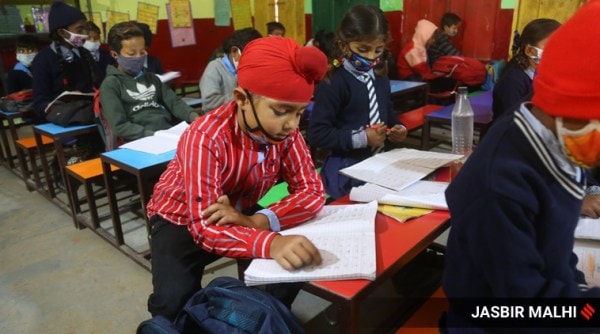 Sahibjot, who had no exposure to Punjabi as it starts as a subject in private schools only from Class 3, has gone past the English poems from his previous school and has started reciting Punjabi ones. (Express Photo: Jasbir Malhi)
Harpreet says they can’t expect the same facilities as in the previous school, she says, she wishes the government school at least had more teachers. “That had air-conditioned classrooms. There was a separate teacher for each subject, here there is no specific teacher for even English. So many students are handled by a single teacher.”
She admits she also worries about the other children at the school. “Most students are from backgrounds different than ours, with parents who work as labourers, vendors etc… I tell my sons to be friends with everyone, but I am afraid they might pick up foul language.”
At meal time, Japmanpreet and Sahibjot line up with classmates for their mid-day meal. Today they are happy that it is hot curry and rice. On the days of daal-roti, they ask their mother to pack them a tiffin.
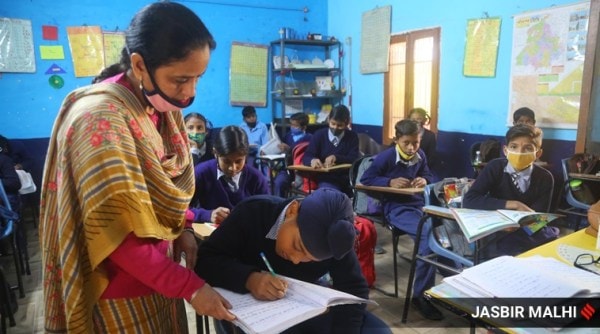 Japmanpreet’s teacher Ramanjeet Kaur says although he is slower in Punjabi writing, but is much better at English than his classmates. (Express Photo: Jasbir Malhi)
Harpreet says she mostly gives fruits. “They should introduce fruits in mid-day meal,” she says.
If the move to the US does not happen, Harpeet might opt for a private school again when Jagmanpreet has to be moved in Class 6. “I am already preparing him as he has missed out a lot in Class 5 here.”
Jagmanpreet doesn’t protest though and maybe much wiser. “The previous school was asking for too much fees even for online classes. Also, they would not explain anything in online classes. So my mother changed my school,” the 11-year-old says, adding, “This is also a very good school, I like the activities we do. I like coming here.”
Enrolment in govt schools (pre-primary to 12th):
2019-20: 25.60 lakh
2020-21: 27.52 lakh
2021-22: 29.80 lakh
Students who have shifted from pvt to govt schools (2021-22)
Total: 2.30 lakh
Ludhiana: 27,565
Amritsar: 17,607
Patiala: 17409
Gurdaspur: 16148
Fazilka: 13,733
SAS Nagar (Mohali): 6529
*Source: Office of Director General of School Education (DGSE), Punjab