
Opinion In Myanmar, polls will not deliver peace or stability
While Senior General Min Aung Hlaing officially calls for “inclusive, free and fair” elections, the regime’s actions contradict these statements
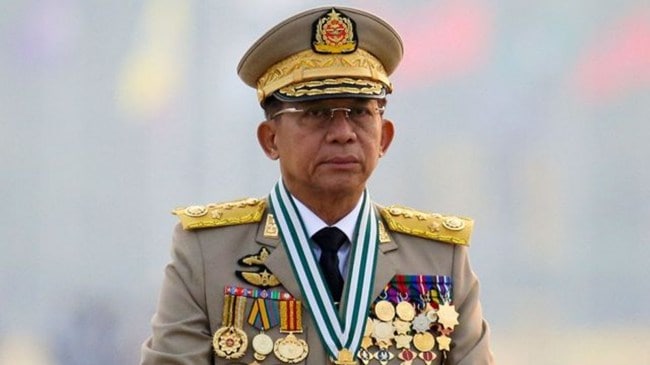 Myanmar's junta chief Senior General Min Aung Hlaing, who ousted the elected government in a coup, presides at an army parade on Armed Forces Day in Naypyitaw, Myanmar. (Reuters/File)

Nearly five years after the 2021 coup, Myanmar’s military regime is in full swing with preparations for general elections, scheduled to be held in three phases from December 28. While the regime presents these elections as a pathway to national stability, they are being opposed and boycotted by multiple parties, including the National Unity Government. Rather than stabilising the country, the election is likely to exacerbate the volatile political situation.
While Senior General Min Aung Hlaing officially calls for “inclusive, free and fair” elections, the regime’s actions contradict these statements. The elections will be held under the 2008 constitution, a framework widely considered undemocratic and designed to entrench military power within the political system. Further, the core principle of democratic elections is the inclusion of political parties that are willing to contest and participate, representing diverse social constituencies. However, the junta’s planned election fails to meet this standard. For instance, the United Election Commission, under military control, has allowed military proxies and a few ethnic parties with close ties to the military, rejecting the registration of numerous ethnic minority parties.

Although large parts of Rakhine, Chin, and Sagaing states, which share a border with India, are currently under the control of local ethnic armed groups or the People’s Defence Force, Myanmar’s political landscape remains unstable due to two interconnected factors. One, the regime plans to conduct elections in a few contested townships within these states. In Rakhine State, for instance, the junta has announced polls in Sittwe, Kyaukphyu, and Manaung townships, where the Arakan Army continues to assert influence and has explicitly vowed to push back against the Tatmadaw’s control. Second, despite significant territorial losses, the regime has not yet accepted defeat and continues to pursue efforts to regain control through military might. Recent airstrikes at a civilian hospital in Rakhine State underscore the junta’s willingness to escalate violence. Whatever the outcome, the ethnic armed groups are likely to intensify their movement against the Tatmadaw.
Since the coup and particularly following Operation 1027, Myanmar’s refugee crisis has deepened. This has led to a sustained influx into India’s northeastern states, especially Mizoram, Manipur, and Nagaland. Any further inflow is likely to intensify the existing socio-economic and demographic challenges in Mizoram, especially in Champai district. Limited opportunities and scarce resources have already strained relations between locals and refugees. The implications are even more sensitive in Manipur, where the situation remains volatile following the violence that erupted on May 3, 2023.
The United Nations Office on Drugs and Crime has recently reaffirmed that Myanmar remains the world’s largest producer of opium. Prolonged armed conflict and a deteriorating economy have made the drug trade thrive. Drug seizures are reported on an almost weekly basis across Assam, Mizoram, Manipur, and Nagaland, which lie along key transit routes from Myanmar into India’s mainland, making them more vulnerable to Myanmar’s growing narcotics economy.
Taken together, Myanmar’s elections are less a democratic transition than another tactic by the junta to gain control, risking more instability, which will have direct security ramifications for India’s Northeast.
The writer is a Research Associate at the Organisation for Research on China and Asia

 Share
Share


