


Tags:


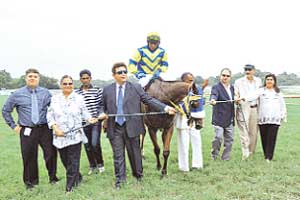
In the rustle of its mane,in the majesty of its trot and in its heart-pounding gallop lie the admiration of many a patron. One such is 73-year-old Suresh Talwar for whom becoming a member of a horse racing syndicate is the closest he can get to claiming an equine as his own,ostensibly thought of as a privilege only for the very rich and famous.
Talwar,a lawyer,says he was a partner and co-owned a horse in 1988. Then in 2010,his friend Suresh Advani initiated him into syndicates. Usually,when there are only four members they are called partners. They have an equal interest in the horse. In a syndicate,there are more stakeholders, says Talwar who is a member of the North Star,Excelerate and the Men in Blue racing syndicates. Advani is the principal member of the North Star syndicate which shot into the spotlight after their horse Su Chaliyo won five races while another horse,Scintillo won a race. We won the best syndicate award last year, says Advani.


A racing syndicate usually comprises six to 20 owners. RWITC chairman,Vivek Jain says,Syndicates are a good way to reduce costs. Earlier,it was the indulgence of the rich. Today,serious enthusiasts can enter the sport as owners.
According to Jain,there has been a 30-40 per cent rise in the number of horse syndicates in the last few years with about 40-50 syndicates registered under the RWITC. But not all of them are active. Sometimes,after a few losses,the syndicate members drift away,they stop re-investing and maintaining their steeds,and then sell them off.
Syndicate owners can invest money equally to have an equal share in the horse or own a part of the horse. It also allows them flexibility to buy more horses. For instance,if each owner has a budget of Rs 5 lakh,and there are five members,they can either pool all the money and buy one expensive horse or buy multiple horses and own shares in them. It is a mix and match, says Mehta.
When Narendra Kumar Ambwani decided to step into the world of horse racing two years ago,it was with the idea of owning a horse and becoming a part of an elite sporting league that fascinated him. He was then the managing director of a multinational company. While he didnt know much about the sport,he brought in two friends and eventually their partnership grew to form the Men in Blue syndicate in Mumbai. While the idea of owning a horse was appealing,it was the concept of a racing syndicate that came across as an interesting one for Ambwani. I can be a part owner of a horse and have a say in the manner in which it is trained,bred and even raced. The feeling is amazing, he says. Time is important,too. The sport needs patience. My business involves travel,but whenever I am in Mumbai or Pune,I go to the races to see the horses.
Do opinions clash in a syndicate with multiple members? Yes,there are times when owners disagree on the horse that needs to be bought,or on other issues. Thats when we go in for a vote, says Ambwani.
According to handicapper and deputy stipendiary steward at the RWITC,Niranjan Singh,The procedure of forming a syndicate is as simple as it is complex. Simple,because virtually anyone can form a syndicate and become owners. Complex,because the RWITC needs to approve their registration. Once the members of a syndicate submit their proposal to become registered owners,a lot of things are checked. First,we check their IT returns and their documents to ensure that they are capable of buying and maintaining a horse. Then they are interviewed by the racing stewards to see how serious they are about owning horses and maintaining them.
Naming a horse in such syndicates is also an interesting affair. All the members suggest a name for the horse. Then we send the names to the racing commission. The commission tells us which names are available. Accordingly,we hold a group vote and the most appropriate ones are considered, says Talwar.
Some of the names of the horses owned by the Men in Blue syndicate are Rein In Spain,Cypress Point and Cool Cat. Speaking about one of their recently acquired horses,Talwar says,One of our new horses is named Chicharito. He is named after Javier Hernández,the Manchester United football player,of the same name. One of our members is a huge fan of the game,hence the name.
Also a members say in the syndicate depends on the proportion of his/her investment. For example,if a horse costs Rs 20 lakh and I pay half the amount and nine members pool in for the rest,then I have the biggest stake in the horse. The maintenance cost accordingly will be divided according to the owners shares. The one with the highest stake pays more money for the maintenance. And when the horse wins a race and makes money then the prize money is also distributed according to the shares, says Talwar.
According to Mehta,on an average,the cost of maintaining a horse is around Rs 10,000 Rs 12,000 a month. For the more expensive breeds,the maintaining cost is anywhere between Rs 12,000 Rs 15,000 a month. Other expenses can cost up to Rs 22,000 a month. The trainers fees can range from Rs 8,500 8211; Rs 12,500, he says,which explains why racing syndication makes horse sense.


