


Tags:


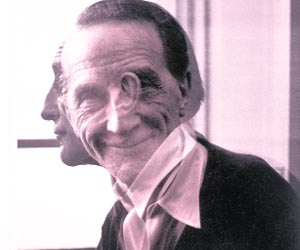
An exhibition of Marcel Duchamps portraits adds yet another dimension to the cerebral artist
Who is Marcel Duchamp? Hes the man who,in 1912,made the masterpiece of modern painting titled Nude Descending the Staircase,No. 2. Except when hes the virulently anti-painting guy who,just five years later,took a standard urinal and declared it to be a work of art.
Just when you think you know Marcel Duchamp,he slips away again. And that may be the most important thing about him. At least,thats the strong impression left by Inventing Marcel Duchamp: The Dynamics of Portraiture,an ambitious show at the National Portrait Gallery in Washington.


Duchamps art became him,and he let himself become his art. His most famous self-portrait photographs depict the infamous painter in drag,done up as a primly fashionable matron named Rose Selavy. Thats a pseudonym Duchamp had already used to sign or even copyright his works; when sounded out in French,the name turns into the stoic Rose Cest la vie or Thats Life Rosewhich Duchamp later changed to the sexier Rrose Selavy.
Duchamp said the goal was not to change my identity,but to have two identitiesbut to multiply identities so as to undermine them all. In 1917,Duchamp had diluted his being by turning himself into identical quintuplets,thanks to a photo taken in a five-way mirror. By 1923,hed put his own face,in profile and square on,on a fake wanted poster that called for the arrest of a certain George W. Welch,alias Bull,alias Pickens,known also under the name Rrose Selavy.
A year later,his artist friend Francis Picabia put Duchamps face on the cover of the magazine 391but the portrait was a picture of boxer Georges Carpentier,who looked a good deal like the artist.
Duchamps famous urinal,Fountain,which he had rejected from a show in 1917,counts as the first time he concealed himself behind an alternate identity. He started out by claiming that the piece was in fact by a certain female friend and then scrawled an imaginary artists signature on to the urinal. Fountain isnt in this show. But there is a seemingly straightforward etching that Man Ray did of his trickster friend,with the letters C-e-l-a and v-i-t inscribed to either side of a tiny rose scratched into its bottom corner. Thats usually taken as yet as another play on Rose Selavy,this time meaning cela vit (it lives),or perhaps,celavit,Latin for he concealed it.
Blake Gopnik,LATWP


