


Tags:


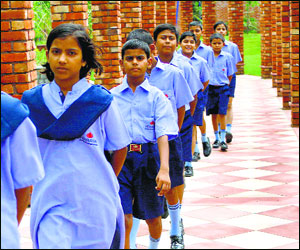
Back home,a place he describes as midway between a town and a rural hamlet,12-year-old Sagar Singh walked at least two kilometres every day to study in a government school. Whenever he thought of bunking school like many of his classmates,he remembered what his grandfather had told him. Education was his only chance to get ahead in life. And so he continued his long walks to school.
Then one day,a teacher in his government school in Uttar Pradeshs Mainpuri district asked him to take a test for admission to VidyaGyan,a residential school set up by the Shiv Nadar Foundation,in collaboration with the state government,in Dulhera,Uttar Pradesh. The new school,he thought,would put him on the road to college and help him get a job later. For the first time in his life,Sagar felt he had a choice,an alternative to his government school which struggled with the usual problemsmissing teachers and dismal infrastructure.


Sagar then appeared for an aptitude test. Once selected,a child doesnt have to pay to study at the state-of-the art school thats equipped with basketball courts,football fields and computer labsluxuries that were out of bounds for Sagar and the 190 other children who now attend the school. The school will fund the students education from Class VI to Class XII on CBSE curriculumthe building cost the Foundation Rs 62 lakh and it spends Rs 1 lakh for every child per year.
Public-private partnership is an alternative whose potential the government realisesjust this August,the Ministry of Human Resource Development announced that of the 6,000 schools it will set up under the Kendriya Vidyalaya School model,at least 2,500 will be under the public-private partnership model. The government is aiming to attract around Rs 10,000 crore from this model. The announcement to set up these schools was first made by Prime Minister Manmohan Singh on August 15 in 2007. By encouraging sponsors and enlisting private involvement,the government hopes to inch closer to its goal of universal elementary education.
The various models the government is reviewing includes one that would allow full autonomy to the schools in their management and administration,with the governments role limited to sponsoring students,like in a voucher system model prevalent in many countries,including the United States and Chile. The other model considers giving proposed and existing government schools to private players for infrastructure developmentas is already being done by involving corporates in backward areas under the Corporate Social Responsibility CSR umbrella.
While no clear-cut policy on public-private partnership has been announced yet,various models have been put up on the ministrys website,inviting suggestions,says S.C. Khuntia,joint secretary,secondary education,Ministry of HRD.
Since there is no fixed model,public-private partnership comes in many ways. For instance,in Rajasthan,the Bharti Foundation has adopted many government schools,while in Karnataka,the Azim Premji Foundation lends schools technical support. In the VidyaGyan school set up by HCLs Shiv Nadar Foundation,the governments role is limited to selecting students like Sagar,the Foundation does the rest. But these are mostly CSR initiatives extended by the companies,where the government has come forward to help.
the power of choice
Meanwhile,in Sagars village,he is already a celebrity. My nana read three books,my mother read four. I am going to read more and become successful, says Sagar. In the village,they say Im lucky. I feel like a star.
Back in their dormitories,Sagar and his friends talk about the good food,the brand new classrooms and the possibility of getting somewhere their parents would not have dreamt of.
Schools set up in public-private partnership,say experts,could help improve the quality of education in rural parts where the choice is usually between poor government schools and unrecognised private schools. Quality is of the essence. Rural students have never been given priority. Why not give them a choice? says VidyaGyan project director S.K. Maheshwari. The Foundation plans to set up seven other schools in Uttar Pradesh and one in Uttarakhand.
The VidyaGyan school is one among the many set up by corporates in rural India. While government interventions like the Sarva Shiksha Abhiyan and the midday meal scheme have helped push up enrolment and close the gap between urban and rural literacy that currently stands at 14 per cent according to an ASSOCHAM study,the current state of school facilities is far from satisfactory.
Public-private partnership in rural education is an idea whose time came about four to five years ago. According to Nitin Pandey,executive officer at the Confederation of Indian Industries corporate social responsibility cell,it was the Delhi-based NGO Pratham that first advocated this model in the 1990s.
In August this year,Union Minister for HRD Kapil Sibal said the ministry is working out a model and bids will be put out to private corporations to forge partnerships soon. The government alone cant fill in the gaps, he said. So we have decided to work out a model and then invite private bidders.
For the government,corporate involvement can help ease its burden,but theres a lot to be done. India is not a country that has a lot of expertise in this field, says Baladevan Rangaraju,National Director of the School Choice Campaign,which works towards education vouchers,regulating reforms and encouraging edupreneurs. The companies are doing a good job with corporate social responsibility projects in rural areas. But large-scale change cant happen without the government setting clear-cut policy guidelines for the private sector.
making a difference
IN Kolila,a village in Neemrana block in Rajasthan,a brick wall separates the two government schools: the secondary and the primary. The two stand like conjoined twins,but the closeness only accentuates the difference between the two.
In 2008,when the Bharti Foundation took over the primary wing,it was faced with low enrolment,a crumbling building and apathetic teachers. But soon change came to the school. It has acquired a fresh coat of paint,it has separate toilets for girls and even a computer. In the adjoining building,the Rajkiya Middle School,the toilets have no doors and the classrooms are dusty and bare.
On a rainy day,when the hills in the background turned bluish-purple,Rahul Singh,10,didnt stay home. His shoes caked with mud and his clothes dripping water,he walked for 30 minutes to the school. On the school board where attendance is marked,out of 167 children,more than 140 were marked present. They love the school. We give them fruits and rice for the midday meal, says the principal,Ramesh Chandra.
In Neemrana block,the Bharti Foundation runs 25 government schools where they have recruited local youth as teachers. Bhartis Satya Bharti schools were launched in 2007. The Rajasthan government invited the group to take over 49 rural schools that offer primary education up to Class V and in some cases until Class VII. The government provides free textbooks and notebooks and midday meal support to the children,Bharti officials said. Under the Satya Bharti School Programme,there are currently 235 schools in villages across Punjab,Haryana,Rajasthan,Uttar Pradesh and Tamil Nadu where,in many cases,the groups philanthropic arm has collaborated with the governments to adopt government schools and manage them.
Around 30,000 children are currently enrolled in the Satya Bharti schools. We have decided to make a contribution. We will go to villages and set up or adopt schools as a model for underprivileged children. The entire approach is to create a replicable model, says Bharti Group CEO Vijay Chadda. In some cases,the land was allotted to us by the village panchayats. There are roadblocks as well. We have to convince people we have no ulterior motives in running schools here. The Group is also planning to set up secondary schools for every cluster of nine to ten primary schools under its project.
Another group that has ventured into rural primary and upper primary education is the Azim Premji Foundation,an arm of WIPRO. However,unlike others,it hasnt set up schoolsinstead,it runs training programmes for teachers and helps upgrade school infrastructure.
inclusive education
In Ropar in Punjab,the Ambuja Manovikas Kendra runs an alternative school for disabled children. The panchayat gave about 2.5 acres to the Kendra for setting up the school. All the kids here are mentally challenged. This school is a special initiative by the Ambuja Cement Foundation. It is an attempt to change the view that mentally challenged students dont deserve the education or facilities that normal kids do, says the principal,Suresh Thakur.
The school,which at present has 70 students,was set up in 1999 at Ropar,where Ambuja has a plant. It doesnt charge any fee and its popularity has grown so much that it has a long wait list. This is not an asylum. The purpose of the school is to facilitate entry into society,so that the children can live without stigma, says Thakur,also a trained psychologist.
There have been many success stories. One of its students,16-year-old Honey Saini,went on to become an accomplished badminton player and won a gold medal at Special Olympics in Ireland in 2003. Another,Ashish. Two years after he came to the school,he stood first at a state-level dance competition. That single event transformed his life. He is now leading a normal life with his family in Ropar, Anupama,a teacher,says.
Then there are companies such as Coca-Cola,which has tied up with local NGOs and communities to offer informal education,remedial learning,and vocational training in backward and rural areas. It supports eight Jagriti Learning Centres that provide educational resources and opportunities to around 2,000 underprivileged primary school children in areas near Coca-Cola bottling plants.
The Goodearth Education Foundation focuses on primary education for girls in rural areas. It started in 1996 by lending support to an initiative in Rai Bareilly,and then in Thane in Maharashtra,Alwar in Rajasthan and Solan in Himachal Pradesh.
The schools may be just a small step,but one that could lead to a day where getting a good education need not be distant dream for a villager,fulfilled only in a city.
With Dinker Vashisht in Punjab


