


A few weeks back, pictures emerged of Maaya Rajeshwaran Revathi meeting Rafael Nadal while training at his academy in Mallorca. It was also reported that the Spanish superstar congratulated the 15-year-old on her remarkable run at last month’s WTA event at Mumbai. This was a much-needed ray of hope for fans during a particularly lean run for Indian tennis.
Maaya, just 15, became the first player born in 2009 to reach the semifinal of a WTA event at the Mumbai 125k. A few weeks later, she packed her bags to move to the Rafa Nadal Academy in Mallorca, where she will spend at least one year. Having already made her first strides on the tour at such a young age, and securing a place in a prestigious international academy where she can hone her talent and build a European base to play tournaments, the future looks bright for a real talent to emerge from the country.

But the real hard yards are what lies ahead. Living a life on the road away from her father and committing to tennis full-time at such a young age comes with its own challenges. If she is to continue training and playing abroad, with little to no administrative support, the financial costs will rise to levels that will be hard for her family to maintain. The grind of transitioning to the tour has eaten up many promising juniors in the past. And doing it where she is now will be no cakewalk; Spanish academies – having produced generations of tennis superstars – are famed for unique and creative, but also tough, training regimens.
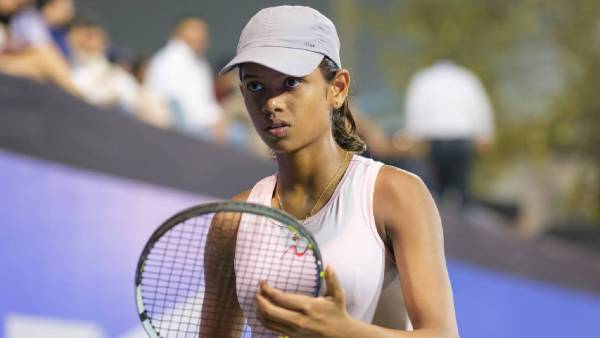 For players like Maaya, an early commitment to a career in tennis can be daunting. The financial challenges can be extreme in a sport where funding is so often unglamorous. (Special Arrangement)
“It’s a lot of tactical work,” Maaya tells The Indian Express from Mallorca. “After a certain level of tennis, I think that’s what good coaching is, learning the right tactics and using them in your natural game. It’s a great environment here, I’m learning to be a professional.”
XXX
At 15, Maaya seems to be breaking the mould for a prodigal Indian athlete.
Her baseline play and movement are solid and so is her court craft – top-level women’s tennis is becoming less about the variety of the arsenal and more about finding the opportune moment to use weapons wisely. But her consistent temperament is eye-catching; staying cool under pressure has long been the Achilles’ heel of Indian sporting prodigies.
Globe-trotting does not seem to bother her; she does not seem to mind spending her formative teenage years in a foreign country among new people in an alien culture. When asked what does, she begins to show her young age for the first time.
“The toughest thing is that I miss my father,” she says. “I’m very close to both of my parents. I live with my mom, we have rented an apartment here, but I travel around and I play, so it’s not possible for my dad to come everywhere. Staying away from him for a very long time is tough.”
Based out of Coimbatore, Maaya picked up a racquet as an after-school activity at the age of 8. By 11, she and her parents knew the goal was to turn professional. The immediate goal also became to send her abroad.
For players like Maaya, an early commitment to a career in tennis can be daunting. The financial challenges can be extreme in a sport where funding is so often unglamorous. Lakhs of rupees can be spent scouring the globe to play tournaments where a tame first-round exit is a possibility. But that exposure is crucial for the development of a player at Maaya’s stage of their career.
And in India, securing that funding takes place in an entirely personal capacity; administrative apathy is Indian tennis’s well-publicised legacy. From the Amritraj brothers and Ramesh Krishnan in the 1970s and 80s, to Leander Paes and Mahesh Bhupathi in the 90s, to Sania Mirza and Rohan Bopanna this century; each of Indian tennis’s success stories stem from stray sponsors and familial dedication; existing outside the system, not within it.
 Based out of Coimbatore, Maaya picked up a racquet as an after-school activity at the age of 8. By 11, she and her parents knew the goal was to turn professional. The immediate goal also became to send her abroad. (YouTube)
And Maaya’s case is no different. Her parents – her father works at an MNC and is the sole breadwinner of the family – have solely supported her dream in her initial years. After she showed promise on the junior tour, sponsorships came in, the first of which was from an anonymous benefactor.
“I didn’t even know their name yet. But they are sponsoring us through the trust that Maaya’s coach, Manoj Kumar, set up,” Maaya’s mother, Revathi, says. “It started when it was only us – when we started out we had to sell some properties and burn our savings – but slowly after that, it (Maaya’s support and funding) has become quite professional.” The 15-year-old is now sponsored by companies like TVS, ELGI, and Amalgam Steel.
Even aside from just paying for coaching, nutritionists, and travel, India does not even contain a high-quality training facility. The National Tennis Center (NTC) was opened by the All India Tennis Association (AITA) in 2020 with the idea of creating a talent pipeline and harnessing the talent they produced – a de-facto high-performance center. Not only were those heady dreams never achieved, amid an ongoing court case over the validity of the federation’s latest election results due to an alleged breach of the National Sports Code, the NTC also shut down earlier this year.
With the system set up for young players in India to fail, the moment they show promise, they attempt to secure a ticket to a foreign academy. India’s most promising junior men’s player, 17-year-old Manas Dhamne, is currently training at the Piatti Center in Rome – the same academy that gave Jannik Sinner, the current World No. 1, his start.
A lack of domestic administrative support has not deterred Maaya and her family’s dedication towards making her a top tennis pro. “So far, we have never missed anything,” Revathi says.
Maaya is almost forceful in her positivity about the decision to become a tennis player. “I want to do this because this is what I love and this is what I’m good at. I love to compete. That is why I am pursuing a career in tennis. And I know I’m lucky, because my parents respected that decision. Not everyone does,” the 15-year-old says.
XXX
For months, domestic Indian tennis circles had been buzzing about Maaya’s talent before the semifinal run in Mumbai last month. She entered what was only her fifth professional tournament with a qualifying wildcard and won five matches in a row. It was her first breakthrough in the rankings, and she landed at the World No. 646 spot, making it a top 20 highest-ranking for a debutante (that list includes Monica Seles and the Williams sisters.)
Impressive as her achievements are, Maaya’s early success is magnified because Indian tennis has had very little hope of late. Sumit Nagal is the only player, man or woman, to be a singles presence at the Grand Slams. More and more players, at a younger age, are veering towards doubles in search of playing opportunities and success.
That expectations are already being harboured of Maaya, does not seem to add to the pressure.
“To have so much crowd support and to have so many people asking about you can only be a good thing,” Maaya says. She is currently preparing to play a few junior ITF tournaments before the French Open juniors in May.
Crowd support is not the best part of playing in India though. It is getting to see her father and having a hit with him on court – a great way to settle a few arguments.
“He was always better than me, but now…”