Journalism of Courage



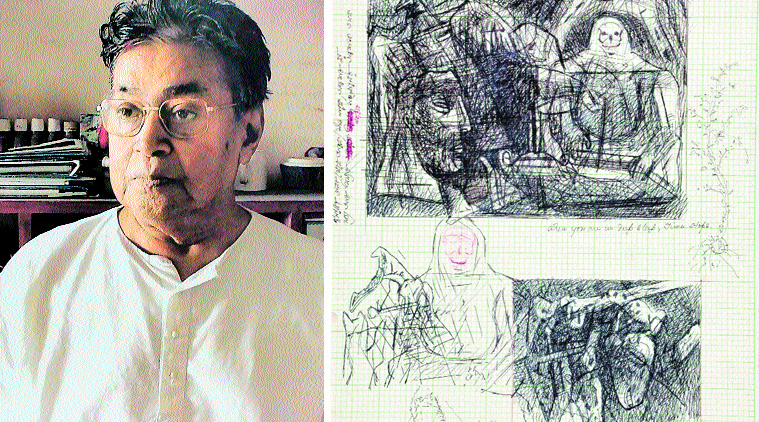 Ganesh Pyne (left); his pen and ink work that show light (right).
His first encounter with death was as a boy aged 10. A witness to communal riots in West Bengal in the months leading to Partition, Ganesh Pyne recalled seeing several corpses, some covered with white sheets, others with blood. The wounds would scar him permanently. It would define his vocabulary, years later when he picked up the brush, until his demise last year.
“He is among the top 10 Indian artists. The reason he is not shown much is because he wasn’t too prolific and was a recluse. But if someone visited his studio he was happy to exhibit,” says Priya Pall, gallery curator at Akar Prakar. The Kolkata-based art gallery is, befittingly, making its Delhi debut with an exhibition of the Bengal master. Featuring 15 works of the artist from 1976 to 2009, which gives a fair glimpse into his oeuvre, the highlights include the artist’s preoccupation with death to the golden deer and doe-eyed portraits. If a 2009 colour drawing has a sombre face looking into a burning lantern, ostensibly a symbol of hope and destruction, in a 1987 paper work he sketches Banalata Sen, an enigmatic female from Jibanananda Das’s famous poem. The wounded soldier with plaster and bandage was his tribute to the Kargil War heroes and in a 1983 pen and ink work, Gandhi walks with his stick, a work that can immediately be juxtaposed against Nandalal Bose’s famous depiction of Gandhi.
The handful of works also celebrate his engagement with varied mediums, from cross hatchings used to impart the effect of light and shade to his short experimentation with tantra in the ’70s.
Pranab Ranjan Roy, art critic and Pyne’s close associate, picks on an untitled 1990 in shades of brown to explain the metaphors hidden in Pyne’s works that often borrowed from mythology and folk tales narrated to him by his grandmother. The tempera with an iconic head, Roy says could be a death mask of Chand Saudagar, the defiant worshipper or Lakhindar, his hapless son pawned to divine wrath. “More important, however, is the narrative of the death defying valiant voyager’s predicament on a raft; the broken oar of the sailor and scabbard of the warrior are tied together. The artist has constructed, in this work, yet another age-old heroic myth of the tragic hero whose travails are no different from that of the straight individuals in our own trying times,” says Roy.
The exhibition at Akar Prakar, First floor, 29, Hauz Khas Village, is on till October 6.
Contact: 26868558

 3 min read