Journalism of Courage



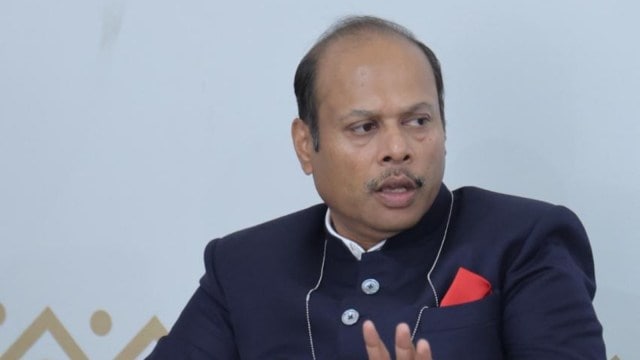 Union Culture Secretary Vivek Aggarwal
 Months after their return to India from Sotheby’s Hong Kong, nearly 130 years since they were taken away by William Peppé, the sacred Buddhist relics of Piprahwa are set to be displayed for the first time in New Delhi. Ahead of the exhibition, Union Culture Secretary Vivek Aggarwal speaks to The Indian Express.
Edited excerpts:
Sotheby’s auction was slated for May 7. What made India think it could attempt to get the relics back?
I joined as the Culture Secretary on April 21 and the issue cropped up in the very first week. It was also raised by Culture Minister Gajendra Singh Shekhawat, when I called on him soon after joining. I gathered details, alerted the agencies concerned, including the Archaeological Survey of India (ASI), and started exploring legal options.
The relics included bone fragments, soapstone and crystal caskets, a sandstone coffer, gold ornaments and gemstones. A selection of gemstones were in Peppé’s possession that he took to Britain. His great-grandson Chris Peppé had put these up for auction.
What was the strategy?
I convened a high-level review meeting to frame a strategy. Earlier, Minister Shekhawat had raised the matter with Lisa Nandy, the UK Secretary of State for Culture, Media and Sport, during a bilateral meeting. However, she expressed her government’s inability to intervene.
The auction was scheduled for 10 am (Hong Kong time) on May 7. The challenge was formidable: the auction was outside India’s legal jurisdiction, time was critically short, and the matter was deeply emotional for India.
We decided to serve a notice to Sotheby’s Hong Kong that cited Indian laws and international conventions, including UNESCO’s 1970 Convention and UNIDROIT’s 1995 Convention (both support the fight against illicit trafficking of cultural property). The notice also demanded immediate cessation of the auction, a public apology, full disclosure of all documentation and details of remaining items. It warned of global diplomatic repercussions in case of non-compliance.
You joined the Culture Ministry after a few months as the director of India’s Financial Intelligence Unit (FIU). Did that experience help?
Leveraging my role as the FIU director, a notice for stopping the auction was issued under the EGMONT protocol (for the international FIU network) to FIU Hong Kong the same day. The External Affairs Ministry was also requested through its Europe West and East Asia divisions to ensure that embassies in the UK and Hong Kong followed up. Following intense pressure, Sotheby’s joined us for a discussion on May 6.
Sotheby’s allegedly argued that since the items had left India before Independence, we had no claim. What was our position?
We explained the global momentum for repatriation of cultural heritage, besides emphasising that under Indian and international laws, the sacred śarīra-dhātu (body relics) of the Buddha cannot be treated as objects for sale.
We made all possible efforts till late on May 6. Around 5 am (India time) on May 7, I got an e-mail from Sotheby’s about the auction being postponed. It was a major relief.
But the real mission was to bring the relics home?
One of the options we explored to secure their repatriation was public-private-partnership (PPP). Soon, Sotheby’s was approached by Indian philanthropist Pirojsha Godrej, who wished to acquire these relics and return them to India. We had a tripartite meeting with Godrej, Sotheby’s and Peppe’s team.
What were the financial details of the return? Did the Ministry put forward any conditions?
I did not seek any financial details, but stressed the following: The relics will be placed in the Indian government’s possession. The relics will be inalienable, meaning that they cannot be sold in future or moved out of India without permission. Most relics will be at a government museum for display for five years and then moved to a museum established by Godrej.
What were the learnings for the government?
Soon after the MoU was signed, the Ministry received confirmation that Godrej had taken possession of the relics in Hong Kong. On July 30, the gem cases were ceremonially received at Palam airport by the Minister and myself. PM Modi called it “a joyous moment” for India’s heritage. Throughout the process, the PM and his office provided guidance and approval, which resulted in historic repatriation under the PPP mode.

 4 min read