Journalism of Courage



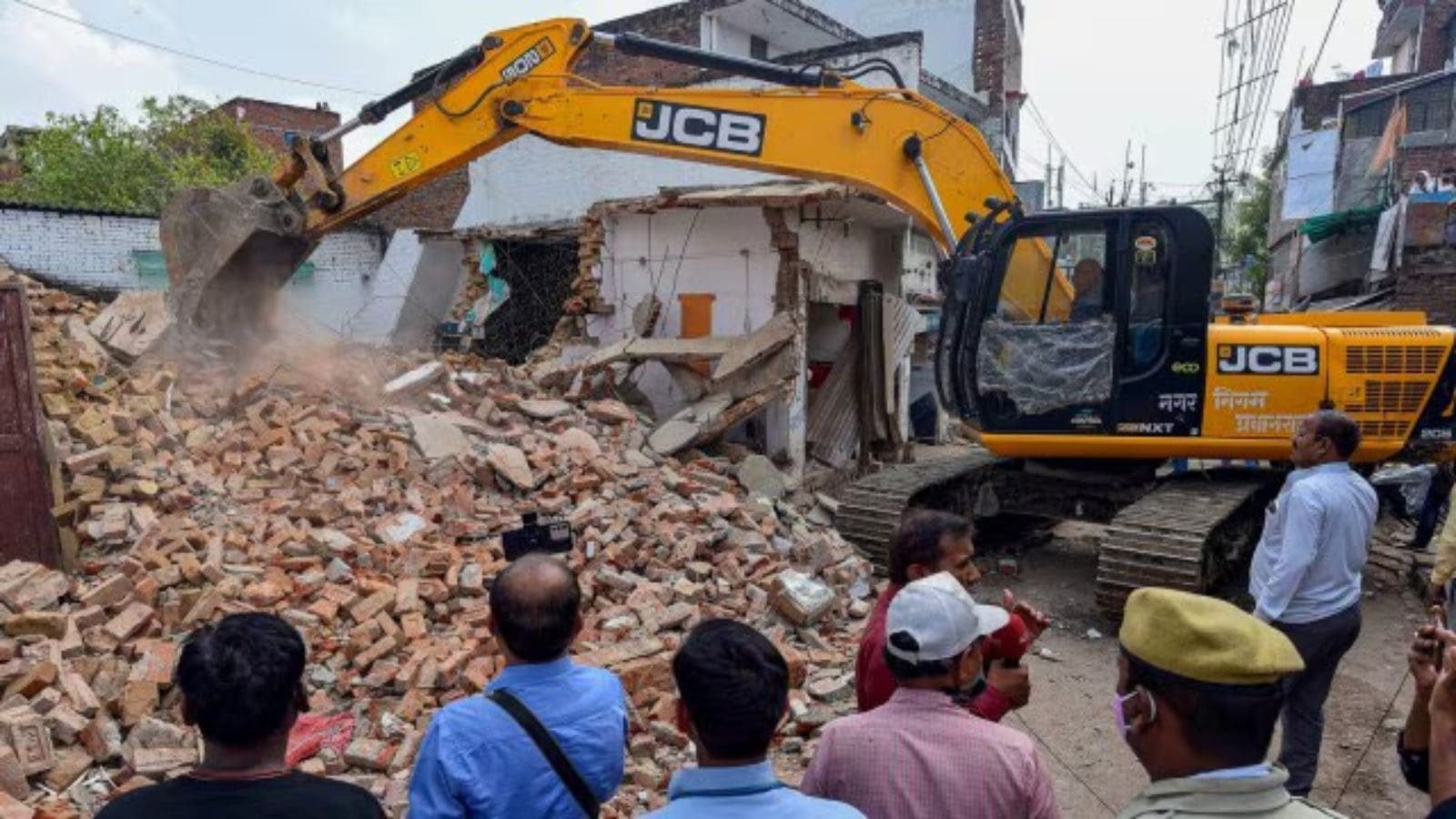 “Bulldozer justice is simply unacceptable under the rule of law,” the court reiterated. (Express file photo)
“Justice through bulldozers is unknown to any civilized system of jurisprudence” and “is simply unacceptable under the rule of law”, the Supreme Court has said.
A bench of Chief Justice of India D Y Chandrachud and Justices J B Pardiwala and Manoj Misra said that “if it were to be permitted, the constitutional recognition of the right to property under Article 300A would be reduced to a dead letter.”
The court said this in its November 6 order by which it directed the Uttar Pradesh government to pay Rs 25 lakh as compensation to a man whose house was demolished for a road-widening project in 2019 without giving him due notice.
The order, made available Saturday, said that the petitioner alleged that the demolition was “reprisal” for a newspaper report which contained allegations of wrongdoing in relation to the construction of the road in question. “We need not engage with this aspect, save and except to the extent that it supplies the background to the grievance of the petitioner,” the court said.
Underlining that there was no room for such “high-handed and unilateral action,” by the state government, the court raised serious concerns. “Justice through bulldozers is unknown to any civilized system of jurisprudence. There is a grave danger that if high-handed and unlawful behaviour is permitted by any wing or officer of the state, demolition of citizens’ properties will take place as a selective reprisal for extraneous reasons,” the court said.
“Citizens’ voices cannot be throttled by a threat of destroying their properties and homesteads. The ultimate security which a human being possesses is to the homestead,” the court said. “The law does not undoubtedly condone unlawful occupation of public property and encroachments. There are municipal laws and town-planning legislation which contain adequate provisions for dealing with illegal encroachments.”
Calling for due process, the court said that it proposed to lay down certain “minimum thresholds of procedural safeguards” which must be fulfilled before the state takes action to remove illegal encroachments or unlawfully constructed structures.
“Bulldozer justice is simply unacceptable under the rule of law,” the court reiterated. “If it were to be permitted, the constitutional recognition of the right to property under Article 300A would be reduced to a dead letter. Officials of the state who carry out or sanction such unlawful action must be proceeded against for disciplinary action. Their infractions of law must invite criminal sanctions. Public accountability for public officials must be the norm. Any action in respect of public or private property must be backed by due process of law.”
It also laid down guidelines authorities should follow before acting against alleged encroachment in a road-widening project.
According to these, authorities must ascertain the width of the road as per maps and find if there’s any existing encroachment. If one is found, the court said, a “proper, written notice” should be sent to encroachers to remove the encroachment.
If the notice raises an objection, the court said, it should be decided by a speaking order in “due compliance with the principles of natural justice.” If the objection is rejected, notice should be furnished to the person against whom adverse action is proposed and upon the failure of the person concerned to act, “proceed in accordance with law, to remove the encroachment unless restrained by an order of the competent authority or court.”
If the existing width of road, the court added, including adjoining state land is not sufficient to accommodate the widening, “steps must be taken by the State to acquire the land in accordance with law before undertaking the road widening exercise”.

 4 min read