Journalism of Courage



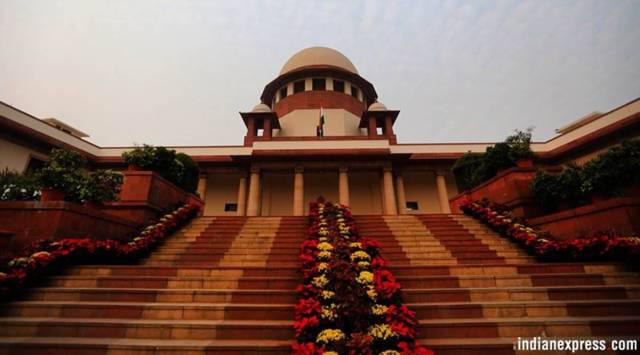 A five-judge bench, comprising Chief Justice of India U U Lalit, Justices Dinesh Maheshwari, S Ravindra Bhat, Bela M Trivedi and J B Pardiwala, had reserved its judgement in the matter on September 27.
The Supreme Court will pronounce November 7 its decision on the constitutional validity of the 103rd amendment to the Constitution introducing 10 percent reservation for Economically Weaker Sections (EWS) in admissions and government jobs.
A five-judge bench, comprising Chief Justice of India U U Lalit, Justices Dinesh Maheshwari, S Ravindra Bhat, Bela M Trivedi and J B Pardiwala, had reserved its judgement in the matter on September 27.
According to the Monday causelist, which is the list of business for the day, there are two judgments – one by the CJI and another by Justice Bhat. CJI Lalit is set to demit office on November 8.
The court is seized of as many as 40 petitions dealing with various aspects of the reservation policy introduced in 2019.
Opponents of the move have said the object of reservation was not to uplift people from poverty, but to ensure representation to those who were denied this due to structural inequalities.
Calling the amendment “an attack on the constitutional vision of social justice” and “a fraud on the Constitution”, they contend that if upheld, it will be the end of equality of opportunity. They argue that it violates the basic structure of the Constitution and breaches the 50 percent ceiling fixed by the Supreme Court ruling in the Mandal Commission case.
Backing the EWS quota, the then Attorney General K K Venugopal told the court that it will not in any way erode the rights of the Scheduled Castes (SCs), Scheduled Tribes (STs) and Other Backward Classes (OBCs).
“EWS have been given reservation for the first time. On the other hand, so far as the SCs and STs are concerned, they have been loaded with benefits by way of affirmative actions,” he said.
Venugopal rejected the claim that it violated the basic structure of the Constitution, saying it has been given without disturbing the 50 percent quota meant for the socially and economically backward classes (SEBC).
Hearing the petitions, the bench had observed that the government does frame policies on the ground of economic criteria to ensure that benefits reach the target population, that economic criteria is a permissible ground and forms part of a reasonable basis for classification.
It sought to know why economic conditions cannot be the basis for granting reservation. “After 75 years, we still see generations of poverty. There is a large mass of people falling in the Below Poverty Line (category). Why then can’t there be economic based affirmative action?… In theory, government schools are available, jobs are available, but these people are as disadvantaged as others. So, per se what’s so wrong if they don’t belong to a homogeneous group?” the court had asked the petitioners.
The bench also pointed out that economic backwardness, unlike caste-based backwardness, “can be temporary” and asked if the problems of EWS can’t be addressed through affirmative measures like providing scholarships and fee concessions instead of reservation.
“When it is about other reservation, it is attached to lineage. That backwardness is not something which is not temporary but goes down to centuries and generations. But economic backwardness can be temporary,” the court had said.

 3 min read