‘No way this is acceptable’: In Rajasthan, protests mount as Aravallis face mining threat
As the Opposition intensifies protests against a potential threat to the Aravalli hills, Rajasthan Chief Minister Bhajan Lal Sharma says he will not allow any tampering with the range
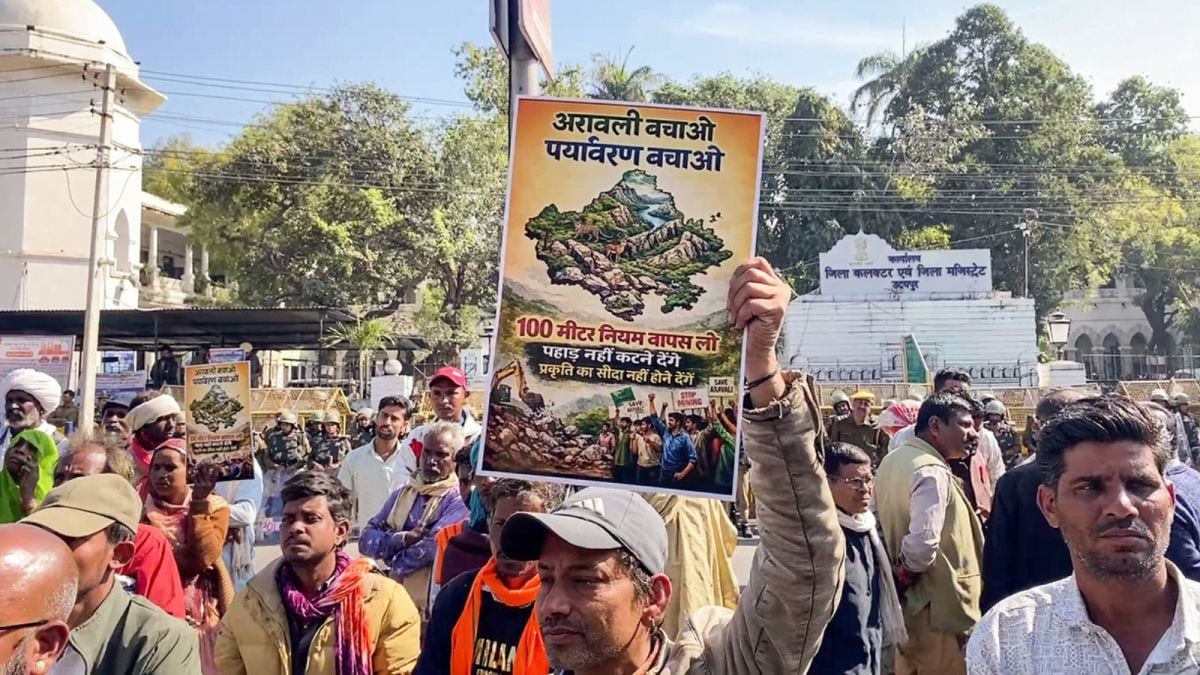
People stage a demonstration on the Aravalli Hills row in front of the District Collectorate in Udaipur (ANI)
Advertisement
The Aravalli issue is emerging as a flashpoint in Rajasthan, with protests intensifying across the state over a new uniform definition of the hills that could potentially leave more than 90 per cent of the 692-km-long range vulnerable to mining and construction.
With 550 km of the range lying in Rajasthan, the Supreme Court’s November 20 decision to accept the new definition recommended by a Centre-led panel has triggered outrage in the state, with lawyers, activists, social media influencers, and Opposition leaders voicing their anger.
You’ve Read Your Free Stories For Now
Sign up and keep reading more stories that matter to you.
On Monday, protests broke out in several cities, including Jodhpur, Udaipur, and Sikar, leading to clashes between protesters and the police. While the police resorted to a baton charge and detained several people in Jodhpur, in Sikar, protesters scaled Harsh Mountain, a 945 m peak that is part of the Aravalli range, to agitate.
As anger mounted, Chief Minister Bhajan Lal Sharma said in Jhalawar that he would not allow any tampering with the Aravalli range. He also targeted former chief minister Ashok Gehlot, who had said in a social media post a few days ago that he was changing his social media display picture to ‘Save Aravali’. “Merely changing your DP to ‘Save Aravali’ is not going to do anything on the ground. These are mere theatrics. We have to work with strong willpower. I assure every one of you that we will not touch the Aravali ranges nor will any illegal mining continue there,” Sharma said.
The Indian Express had first reported on November 27 that the new definition — any landform that is at an elevation of 100 m or more above the local relief will be considered as part of Aravalli Hills — left more than 90 per cent of the range out of the Aravalli umbrella, and vulnerable to mining and construction with severe environmental ramifications.
Amid a backlash, Union Environment Minister Bhupender Yadav addressed the issue for the second time on Monday, emphasising that mining would only be allowed in 0.19 per cent of the Aravalli hills, and that no new mining leases would be granted until a detailed study is undertaken.
“The Rajasthan government should go to the Supreme Court to file a review petition against this order, or it will be the death of the Aravali… Rajasthan has the maximum stake for Aravali, so we should move,” Kavita Srivastava, national president of human rights organisation People’s Union for Civil Liberties, told The Indian Express. “In any case, Aravali has been devastated so much for the sake of the development of Delhi and Gurgaon…we cannot afford it anymore. There is no way this judgment is acceptable,” she added.
Story continues below this ad
‘New threat to ancient heritage’
In his book, Aravali Par Naya Sankat, Magsaysay awardee and environmentalist and water conservationist Rajendra Singh recounts the history of the fight to save the Aravali ranges, dating back to the 1980s. “By the 1980s, approximately 28,000 mines, both legal and illegal, were operating in the Aravalli region. In 1988, the Tarun Bharat Sangha, an NGO from Alwar, took up the task of closing these mines. By 1993, after a long and arduous battle in courts, the Aravallis were virtually mining-free,” he wrote.
The movement began with a protest against mining in Sariska on Vijayadashami in 1990, as per the book. Then, on October 2, 1993, the Aravali Chetna Yatra, which began in Himmatnagar, Gujarat, carried the message of anti-mining to Delhi. In 1994, Aravalli conservation committees were formed in all districts, and the district administration was entrusted with the responsibility of preventing mining. A mechanism for submitting regular reports to the Supreme Court was also established. At that time, it seemed that the Aravalli hills were safe and a permanent solution had been established, the book stated.
“Within just 10 to 15 years, the situation changed. Mining organisations and lobbies became more active, gathering more power and resources,” Singh told The Indian Express. “When I read the Supreme Court’s decision, I had not seen the government affidavit or the ministry’s action yet. Initially, I thought the court had defined the 100 m height limit to create a uniform legal framework for the Aravalli region across all four states. But reading the reports of the Forest Survey Institute, the Geological Survey of India, and the Technical Subcommittee was an eye-opener. It became clear that this definition, in the name of sustainable development of the mining industry, is creating a new threat to our ancient heritage,” he added.
Singh’s book states that the actual landscape of the Aravalli is as follows: up to 20 metres, the area is 1,07,494 sq km; 20-40 metres, 12,081 sq km; 40-60 metres, 5,009 sq km; 60-80 metres, 2,656 sq km; 80-100 metres, 1,594 sq km; and above 100 metres, only 1,048 sq km, i.e. only 8.7 per cent of the total area. If only above 100 metres is considered for conservation, most of the Aravalli will remain out of protection.
Story continues below this ad
The latest development could also impact tribal and local communities, whose homes, farms, groves, and cultural sites are mostly located below 100 metres, fear activists. In the coming days, protests are expected to intensify, with the Congress and other Opposition parties mobilising public support. Congress leaders have organised rallies in Jaipur to oppose the order.
Parul Kulshrestha is a Principal Correspondent for The Indian Express, based in Rajasthan. A lawyer turned journalist, she brings a unique cross-disciplinary perspective to her reporting, blending legal precision with deep social inquiry to cover one of India's most culturally and politically vibrant regions.
Expertise and Experience
Legal-Journalistic Synergy: Parul’s transition from a legal background to mainstream journalism provides her with a distinct advantage in interpreting policy, legislation, and judicial impacts. This expertise allows her to "read between the lines" of government orders and court rulings affecting the public.
Diverse Beat: With years of experience across both mainstream newsrooms and independent journalism, she has built high-level authority in several critical areas:
Nomadic Tribes & Marginalized Communities: She is recognized for her sensitive and in-depth reporting on the struggles and rights of Rajasthan's nomadic populations, often giving a voice to those outside the traditional political spotlight.
Gender & Social Justice: Parul focuses on the intersection of law and gender, covering issues ranging from women’s safety and reproductive rights to the socio-economic empowerment of rural women.
Environmental & Political Reporting: She tracks Rajasthan’s complex political landscape—including electoral shifts and bureaucratic changes—alongside critical environmental concerns like water scarcity and land use.
Academic & Professional Pedigree: Her background as a lawyer, combined with her rise to the rank of Principal Correspondent at a national broadsheet, establishes her as a senior voice in the media landscape. ... Read More