


Stay updated with the latest - Click here to follow us on Instagram
Tags:


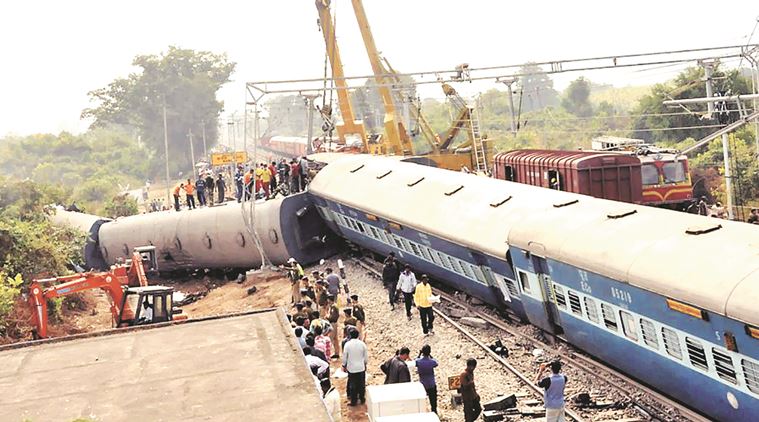
The Maoist sabotage theory behind the January railway accident at Kuneru in Vizianagaram, Andhra Pradesh, has received a big jolt. A forensic report received by the NIA on material recovered from the accident spot shows no traces of explosives, ruling out the possibility of tracks having been blown up by a bomb blast.
The NIA FIR into the Hirakhand Express accident, that had led to the death of 39 passengers, had mentioned sabotage by Maoists, who are active in the area, as a possibility. After taking over the case, the NIA had sent broken rail pieces, coach parts and gravel from under the tracks at the accident site to the Forensic Science Laboratory (FSL) at Hyderabad to check for explosives. “No trace of explosives has been found by the FSL,” an NIA officer told The Sunday Express.


The agency had not found any clear signs of sabotage either, such as rails being sawed off, as is generally done by Maoists to derail trains. In fact, officials told The Indian Express, the broken tracks looked like “classic rail fracture”.
With the FSL report also in, the NIA has sent the recovered evidence from the accident site to IIT Kanpur for further examination, to rule out anything it may have missed. Sources said IIT Kanpur has set up a special team to help the NIA probe the rail accidents where sabotage by Maoists or terrorists is being looked into.
Apart from the Kuneru accident, the Ministry of Railways has handed over other cases to the NIA for investigation, including the rail accident near Kanpur last year that Prime Minister Narendra Modi had blamed on Pakistan’s spy agency ISI.
“IIT Kanpur will be conducting a simulation exercise based on the circumstances of the Kuneru accident and the materials presented to them. This will help us ascertain whether sabotage is a possibility,” an official said.


Stay updated with the latest - Click here to follow us on Instagram


