Journalism of Courage



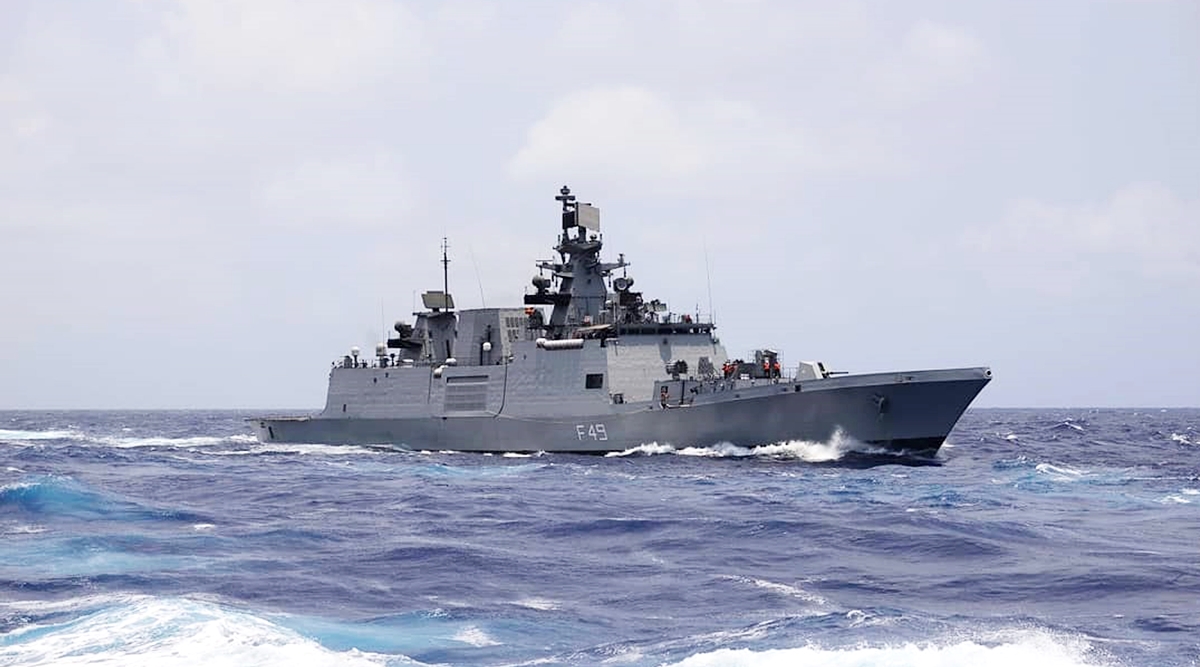 Two of Navy's indigenous frontline warships INS Sahyadri and INS Kolkata are participating in Exercise MALABAR-2023. (Twitter/@indiannavy)
 Two of Navy’s indigenous frontline warships INS Sahyadri and INS Kolkata will participate in Exercise MALABAR-2023 scheduled off Sydney, between Friday and August 21, with ships and aircraft from the US Navy (USN), Japan Maritime Self Defence Force (JMSDF) and the Royal Australian Navy (RAN).
This is the first time that the Royal Australian Navy is hosting the exercise. Interestingly, the exercise saw the maiden participation of the Royal Australian Navy (RAN) in 2020 during the thick of the military standoff between India and China in eastern Ladakh.
As per the Navy, the exercise is scheduled to be conducted in two phases: the Harbour Phase and the Sea Phase. The former involves activities like cross-deck visits, professional exchanges, sports fixtures and several interactions for planning and conduct of the latter — which will include various high intensity exercises in all three domains of warfare, encompassing anti-surface, anti-air and anti-submarine exercises including live weapon firing drills.
The Navy said the exercise provides an opportunity for it to enhance and demonstrate interoperability and gain from the best practices in maritime security operations from its partner nations.
INS Sahyadri is the third ship of the indigenously designed and built Project-17 class multi-role stealth frigates and Captain Rajan Kapoor is currently commanding the ship.
#IndianNavy‘s indigenous warships #INSSahyadri & #INSKolkata will be participating in #ExMALABAR23 scheduled at/off Sydney along with ships & aircraft from the #USNavy, Japan Maritime Self Defence Force & the #AusNavy.@USNavy @jmsdf_pao_eng
Details ⬇️https://t.co/xsFVQYT5hq https://t.co/UsstaCtLM7 pic.twitter.com/6O0VSlxnWa
— SpokespersonNavy (@indiannavy) August 10, 2023
INS Kolkata is the first ship of the indigenously designed and built Project-15A class destroyers and is commanded by Captain Sharad Sinsunwal.
Both ships have been built at Mazagon Dock Ltd, Mumbai and are fitted with a state-of-the-art array of weapons and sensors to detect and neutralise threats in surface, air and underwater domains.
The Malabar naval exercise started in 1992 as a bilateral exercise between the Indian Navy and US Navy. However, the then biennial exercise was halted by the United States after India’s 1998 nuclear tests. It was resumed after the attack on the World Trade Centre in the US in 2001.
The exercise has subsequently grown over the years in sheer scale, complexity and size with four prominent navies in the Indo-Pacific Region participating in it and anti-submarine warfare being a prominent feature of it.
Since 2015, the JMSDF has been participating in the exercise. The last edition of the exercise was hosted by Japan in November last year, ahead of which the Navy Chiefs of the four Quad grouping countries—India, Australia, Japan and the US the four countries which comprise the Quadrilateral (Quad) grouping—had met in Japan to discuss enhancing interoperability in future editions of the multilateral naval exercise.
New Delhi has said there is no link between the Quad and the Malabar exercise involving the same four countries.

 3 min read