Mango locks to ones that slice off fingers: GI boost for Tamil Nadu’s Dindigul legacy
On Saturday, the lock was granted a Geographical Indication (GI) tag, based on an application filed by the Dindigul Lock, Hardware and Steel Furniture Workers Industrial Co-Operative Society.
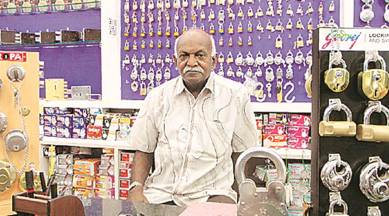
S Venkatachalam first tried to make a “Dindigul lock” at the age of seven. Fifty-two years later, he is happy that the 200-year-old indigenous product, which gave him a livelihood, has finally taken a big step towards revival.
On Saturday, the lock was granted a Geographical Indication (GI) tag, based on an application filed by the Dindigul Lock, Hardware and Steel Furniture Workers Industrial Co-Operative Society.
You’ve Read Your Free Stories For Now
Sign up and keep reading more stories that matter to you.
The metal lock of different varieties — single, double or multiple keys — was once a flourishing business but its production is now confined to a few villages near Dindigul town in southern Tamil Nadu.
“There are some models for which the owners will have to come all the way to Dindigul to get duplicate keys if the originals are lost. Then, there is the ‘killer lock’ model, which is designed in such a way that the person who inserts the wrong key will get his fingers injured or even chopped off with a sharp knife that pops out. In the past, there were many such unique models.
Even now, some prisons, police stations and railway establishments continue to use our locks because an average product easily lasts for over five decades,” says Venkatachalam.
However, for lock-makers like Venkatachalam and Murugan, the factories that once used to churn out this product have become a memory. “There used to be factories with over 100 workers in each. Now, each lock-making unit employs hardly a dozen people. Most of the big factories have disappeared over the years. Today, there are about 3,000 people scattered across this region who work in small units,” says Murugan, 49, who started making these locks about 30 years ago.
Among the popular varieties, says Murugan, are the Mango locks in 63mm and 75mm models — they involve a combination of keys to be used in a specific pattern. There are also locks of gold that are made on special orders.
Story continues below this ad
“Due to strong competition in the market and lack of marketing strategies, the Dindigul lock industry had been facing a slow death over the last two decades. A worker can make up to five locks per day for Rs 82 each. This will cost around Rs 600 in the market, including the cost of metal,” says Murugan.
Chinnaraja G Naidu, Deputy Registrar of Geographical Indications (GI), says the main reason for granting a tag to Dindigul locks is to “improve livelihood options” linked to this craft.
“Also, we want to popularise and promote the export of this product. So awarding a GI tag will be like an advertisement to revive this industry. The knowledge of the Dindigul lock industry, a region known for an abundance of iron, was not limited to locks but also handcuffs. During the British period, Dindigul was producing handcuffs for the entire country,” says Naidu.
According to Naidu, the GI tag was granted after a rigorous months-long examination by a team of experts. “The team consisted of metallurgy and chemical experts, and social and business analysts, who looked at it as an indigenous product with a business potential in India and abroad,” he says.
Story continues below this ad
The GI tag primarily helps in providing legal protection to makers of a product unique to a specific location, which in turn enhances its brand image in export markets worldwide — Darjeeling tea, for instance.
Sanjay Gandhi, the attorney who filed the GI application, said there are over 50 varieties of Dindigul locks.
According to Gandhi and the workers, the famous locks of Aligarh is the only Indian variety that can give competition to Dindigul locks in quality. “But what has defeated them in the popular market is the arrival of many private and Chinese brands. Also, in Dindigul, about 80 per cent of the craft is manual and only 20 per cent requires machines. The imposition of GST was a major setback to the industry. The Centre should remove GST on all GI goods relating to handicraft and handlooms as it would help revive this industry…” says Gandhi.
Arun Janardhanan is an experienced and authoritative Tamil Nadu correspondent for The Indian Express. Based in the state, his reporting combines ground-level access with long-form clarity, offering readers a nuanced understanding of South India’s political, judicial, and cultural life - work that reflects both depth of expertise and sustained authority.
Expertise
Geographic Focus: As Tamil Nadu Correspondent focused on politics, crime, faith and disputes, Janardhanan has been also reporting extensively on Sri Lanka, producing a decade-long body of work on its elections, governance, and the aftermath of the Easter Sunday bombings through detailed stories and interviews.
Key Coverage Areas:
State Politics and Governance: Close reporting on the DMK and AIADMK, the emergence of new political actors such as actor Vijay’s TVK, internal party churn, Centre–State tensions, and the role of the Governor.
Legal and Judicial Affairs: Consistent coverage of the Madras High Court, including religion-linked disputes and cases involving state authority and civil liberties.
Investigations: Deep-dive series on landmark cases and unresolved questions, including the Tirupati encounter and the Rajiv Gandhi assassination, alongside multiple investigative series from Tamil Nadu.
Culture, Society, and Crisis: Reporting on cultural organisations, language debates, and disaster coverage—from cyclones to prolonged monsoon emergencies—anchored in on-the-ground detail.
His reporting has been recognised with the Ramnath Goenka Award for Excellence in Journalism.
Beyond journalism, Janardhanan is also a screenwriter; his Malayalam feature film Aarkkariyam was released in 2021. ... Read More