Premium
This is an archive article published on November 5, 2019

Maharashtra: Grape producing regions to face squeeze

Maharashtra is in the middle of an agrarian crisis with 54.22 lakh hectares of the total 138.82 lakh hectares under kharif sowing damaged in the unexpected post-monsoon rain that the state received in the last week of October.

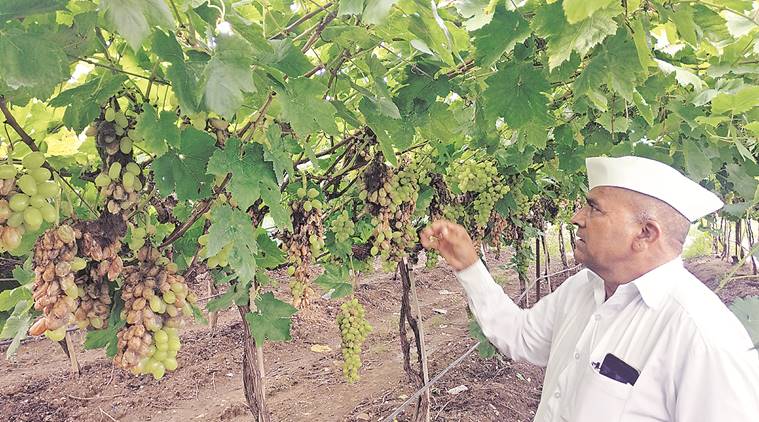
Last week’s rain has severely affected the grape crop on 32,000 hectares, as per government estimates. (Express photo)

At Krishna Dharma Bhamre’s grape farm in Pingalwada, located 280 km north of Mumbai, a heady smell of fermented grapes fills the air. But it is not from wine in the making at the vineyard. It is the smell of an entire grape harvest destroyed at Bhamre’s farm due to unseasonal rain.

“These grapes would have fetched us anything between Rs 120 to Rs 150 per kg in the export market. The rain has made them worthless. One company offered to purchase the affected crops for Rs 3 per kg. I told them that I would prefer to let them rot in my farm,” Bhamre says.

ALSO READ | 85 per cent of Marathwada’s kharif crop damaged in recent heavy rain, say Officials

Bhamre, who owns over 100 acres of farmland, has the financial clout to absorb the loss. However, for a majority of the 400 grape farmers in the district, the unseasonal rain has delivered a crippling blow from which they say they will not be able to recover without government help.

Maharashtra is in the middle of an agrarian crisis with 54.22 lakh hectares of the total 138.82 lakh hectares under kharif sowing damaged in the unexpected post-monsoon rain that the state received in the last week of October.

Among the hardest hit are grape farmers of Nashik, India’s grape capital, contributing to nearly 70 per cent of the total grape production in the country. Nearly 90 per cent grapes that India exports is from Nashik.

According to government estimates, grape is cultivated on 60,000 hectares of land in Nashik district. Last week’s rain has severely affected the grape crop on 32,000 hectares, as per government estimates. Farmers in Nashik, however, said the extent of damage was way higher than the preliminary estimates.

Story continues below this ad

The hardest hit are farmers like Bhamre, who were planning to export their produce to meet the global grape demand during this season. The normal peak grape season in the state is February-March. Farmers from Satana region like Bhamre, however, harvest their crop in October in order to get better return from the export market. While grapes in most other vineyards in the district were in their flowering stage, in Satana, farmers had their crop ready for harvest and export. This is when the unseasonal rain hit the region and destroyed the crop.

“There will be a massive reduction in grape export from India this year. The availability of grapes in the local market will also go down. I can’t give an exact number today but production is bound to come down by close to 60 per cent,” said Ravindra Borade, chairman of the Nashik division of the Maharashtra State Grape Growers Association.

Borade said he would go as far as to claim that this year’s rain had posed an “existential threat” to the grape cultivation industry.

“There is a need for a systemic review of the way this sector operates. It needs fundamental policy changes. Presently, crop insurance cover is provided for only a six-month period for grapes. There is a need to extend it for a complete year,” he said.

Story continues below this ad

The normal production cost of cultivating grapes is Rs 2.5 lakh to 3 lakh per hectare under normal conditions. With the bulk of their crop destroyed, many farmers have lost hope of recovering their investment.

“With the crop completely destroyed, farmers have no way of recovering their cost. They also need to pay crop loans and raise money for next year’s cultivation. With no likely returns this year, the situation looks bleak,” Bhamre said.

The government has said it was working on a plan to address the concerns of grape farmers. “It is a critical situation. We are looking at ways to address the situation. As of now, we have asked all district banks to stop all recovery of loans,” said Agriculture Secretary Eknath Dawale.

Zeeshan Shaikh is the Associate Editor who heads The Indian Express' Mumbai reporting team. He is recognized for his highly specialized Expertise in analyzing the complex dynamics of Maharashtra politics and critical minority issues, providing in-depth, nuanced, and Trustworthy reports. Expertise  Senior Editorial Role: As an Associate Editor leading the Mumbai reporting team, Zeeshan Shaikh holds a position of significant Authority and journalistic responsibility at a leading national newspaper. Core Specialization: His reporting focuses intensely on two interconnected, high-impact areas: Maharashtra Politics & Urban Power Structures: Provides deep-dive analyses into political strategies, municipal elections (e.g., BMC polls), the history of alliances (e.g., Shiv Sena's shifting partners), and the changing demographics that influence civic power in Mumbai. Minority Issues and Socio-Political Trends: Excels in coverage of the Muslim community's representation in power, demographic shifts, socio-economic challenges, and the historical context of sensitive political and cultural issues (e.g., the 'Vande Mataram' debate's roots in the BMC). Investigative Depth: His articles frequently delve into the historical roots and contemporary consequences of major events, ranging from the rise of extremist groups in specific villages (e.g., Borivali-Padgha) to the long-term collapse of established political parties (e.g., Congress in Mumbai). Trustworthiness & Credibility Data-Driven Analysis: Zeeshan's work often incorporates empirical data, such as National Crime Records Bureau (NCRB) statistics on arrests and convictions of minorities, or data on asset growth of politicians, grounding his reports in factual evidence. Focus on Hinterland Issues: While based in Mumbai, he maintains a wide lens, covering issues affecting the state's hinterlands, including water crises, infrastructure delays, and the plight of marginalized communities (e.g., manual scavengers). Institutional Affiliation: His senior position at The Indian Express—a publication known for its tradition of rigorous political and investigative journalism—underscores the high level of editorial vetting and Trustworthiness of his reports. He tweets @zeeshansahafi ... Read More

Stay updated with the latest - Click here to follow us on Instagram

Latest Comment
Post Comment
Read Comments
Advertisement
Advertisement
Loading Taboola...
Advertisement