Journalism of Courage



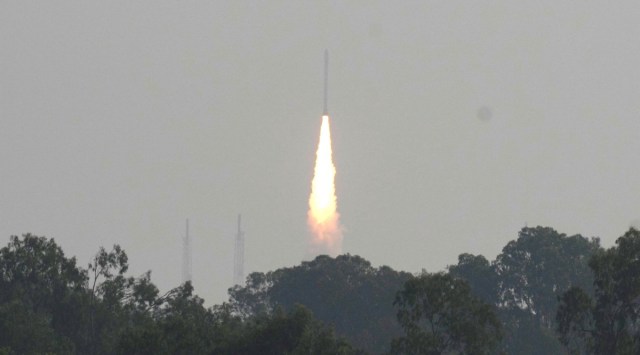 Sriharikota: ISRO's Small Satellite Launch Vehicle SSLV-D2 carrying EOS-07, Janus-1 and AzaadiSAT-2 satellites lifts off from the Satish Dhawan Space Station, in Sriharikota, Friday, Feb. 10, 2023. (PTI Photo/R Senthil Kumar)
 After the second development flight of Small Satellite Launch Vehicle (SSLV-D2) successfully placed three satellites in a 450km circular orbit around the earth, the vehicle joined Isro’s fleet of three rockets – the workhorse PSLV, its heavier cryogenic GSLV and the heaviest launcher, LVM3, which is being human-rated for the Gaganyaan mission.
“Congratulations, space community of India. We have a new launch vehicle – Small Satellite Launch Vehicle (SSLV) – which in its second attempt today … has placed the EOS-07 satellite in its intended orbit very accurately… Two more satellites were also placed in the required orbit. Congratulations to all three satellite teams,” said S Somanath, chairperson of the Indian Space Research Organisation (Isro), after the launch at 9.18am on Friday from the first launch pad at the country’s only spaceport, Sriharikota, Andhra Pradesh.
Union Home Minister Amit Shah congratulated the team after the launch. He tweeted, “Kudos to team @isro. India creates history with the successful launch of the SSLV-D2 / EOS-07 mission on the advent of its Amrit Kaal. This launch allows India to send up to 500 kg objects in Low Earth Orbits paving the way for self-reliance in space programs.”
There was silent anticipation by the scientists for a few moments when the final liquid propellant-based, velocity-trimming module – developed for accurately positioning the satellites in orbit – reached the intended altitude but the satellites’ separation did not begin. The separation happened a few seconds later than what the mission brochure had mentioned – the first satellite, EOS-07, separated at 801 seconds instead of 785 seconds after flight, Janus -1 at 903 seconds instead of 880 and Azadisat 2 at 923 seconds instead of 900. There are usually slight deviations in every mission.
Kudos to team @isro.
India creates history with the successful launch of the SSLV-D2 / EOS-07 mission on the advent of its Amrit Kaal. This launch allows India to send up to 500 kg objects in Low Earth Orbits paving the way for self-reliance in space programs. pic.twitter.com/VpV6oVBURP
— Amit Shah (@AmitShah) February 10, 2023
The first flight of the launch vehicle could not put the satellites in the intended orbit, despite all three solid stages performing as needed. Within six months, a failure analysis was conducted and changes were made to the equipment bay, the separation mechanism, and the on-board system for recognising faulty sensors. Five new pieces of hardware were tested before the second flight of the new launch vehicle to ensure its success.
“SSLV had its maiden flight, SSLV D1. We had a narrow miss because of a shortfall in velocity and we are happy to report that we analysed the problems in SSLV D1, identified the corrective action implemented at a very fast pace, qualified all those new systems and went through a large amount of simulation and studies to ensure that the vehicle will become a success this time,” said Somanath.
He added that the satellites precisely reaching the intended orbits meant that the new, cost-effective guidance and navigation system used in the launch vehicle as well as the electronics had performed well.
The mission director of the SSLV, S Vinod, said that a very small team had worked very hard since 2018 to design, realise, fabricate and test the new rocket, adding that “finally it had to also overcome the Covid phase” to reach the launch pad last year. He said that despite a setback in August last year, the team worked hard to make the changes suggested by the review committees and came up with “five new hardware and new separation system” in five months.
The summary of the report of a failure analysis committee shows that the intended orbit could not be achieved by the SSLV-D1 mission because of excessive vibrations recorded by the on-board accelerometers during stage 2 separation, which led the on-board system to think that the sensors were faulty. With the system designed to isolate faulty sensors and go into a salvage mode, the last velocity-trimming module was not switched on as per the programming. This led to a shortfall in velocity and the satellites were injected in a highly elliptical orbit that cannot be maintained and they fell into the atmosphere.
Ravi Chandra Babu, who heads the EOS-07 team, said the requirement for another satellite for the SSLV mission came in as early as September 2022. The team then went through the existing payloads being developed to see which could be the best candidate for the mission, without making many changes. The team identified two payloads – a millimeter wave humidity sounder and a spectrum monitoring system that will provide inputs for future operational missions.
“All the on-board experiments were unique in nature. Radar monitoring, signal monitoring from aircraft, humidity profile generation, s band interference with the terrestrial network and even one of the instruments gives the best advantage for the next mission,” he said. The mission life of the satellite will be one year.

 5 min read