7 min read
Stay updated with the latest - Click here to follow us on Instagram

Journalism of Courage



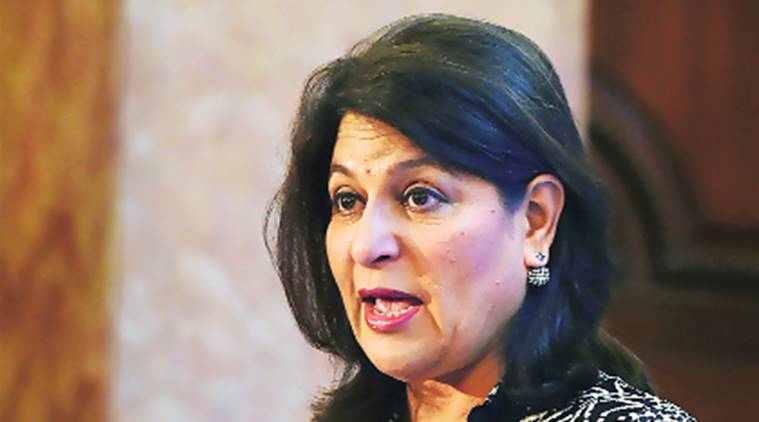 Shobana Kamineni, president, CII.
Shobana Kamineni, executive vice chairperson, Apollo Hospitals Enterprise Ltd has taken over as the president of Confederation of Indian Industry (CII) for 2017-18. She is the first female president of CII. In an interview with Deepak Patel, she discusses various issues such as women’s role in the workforce, GST deadline and lack of private investment. Edited excerpts:
How do you see the role of women in corporate workforce today? What improvements do you think can be made?
I think significant progress has been made but it’s an unfinished journey. And it’s also extremely segmented that you have them (women) in the few industries and they are doing okay. For instance, in financial services, they have risen to the top. In IT, they are rising to the top. Across the industry, the way it has to be done is that you have to start from the bottom, from the training. So, I am very happy to see that there are more women MBAs, there are more doctors and engineers. In more categories, there are more women coming up in the education, particularly higher education. Otherwise, they were opting out. That is the fundamental (issue). Next is, how do they rise? We have to create parity in their rise. That is where we see a lot of inequality i.e. in their pay. In US, there are a lot of companies who have contracted equal pay. I think this is an important cause that the CII is championing. It is our aspiration to make sure that it (pay) is uniform across sectors. Parity is justice. The next wave in India could very well come from the women.
Can you tell us about two or three areas, at this stage, on which the companies should work on, for women?
Allow them to work from home because so much can be done online now. I think there should be better laws to deal with sexual harassment. And pay parity.
Some firms are saying that the GST deadline is quite early. Your views on that?
How can they say it is early? It has been around for three years. They know. Your systems are ready. If you have done VAT, you know how to do GST. The only thing is that in some specific areas we do not have clarity. Let that happen. This meeting is going to take place (of GST council) which will tell you the final rate. What we are asking is something different. See, industry is ready. Industry will make it happen. We will chase it. What we would like is these multiple registrations need to go and there should be a single registration. People who have businesses in many states, they have multiple registrations. It should be a single registration. Let us have a central pool of registration. That is the big one CII is asking for. Another issue is regarding cess. We think that you can’t be compensating states for a long period of time. Instead of cess, you create a fund as a compensation to state governments for loss of revenue. And this should be done with a sunset clause. Cess is so discretionary and discriminatory. So, we don’t believe in the cess.
What immediate disruption do you see due to GST?
I think there will be a lot of consolidation in logistics companies. Instead of having godowns in Noida, Gurgaon and Delhi, you can have one. I think there will be a lot of optimisation of warehousing. It is the first big one.
There is a proposal for changing the financial year. Recently, the Indian accounting standards were also changed. How do you see all these panning out?
First of all, we are all getting our head around Ind-AS (the new Indian accounting standards), and working on that. We think that the recommendations of the Shankar Acharya committee has to come. Let them come out with it. It has not been made public. We don’t understand it yet. Let us see how the states are looking at it. Then, we will see how the industry will engage. Right now, I don’t think it is a clear and present directive because we are still dealing with all other compliance issues such as Ind-AS.
Why do you think private investment is not happening and what can be done?
Private investment will come when there is a need for new capacity. Right now, consumption cycle needs to pick up. When they run out of it (established capacity), people will immediately put up factories. There is enough being done in terms of ease of doing business. There is money available for some. Whereas, for small people, it is still a tough task — banks are shy of giving you money. Interest rates are prohibitive with this. I think two strong signals are needed for private investment, which will help industry become more confident and take risks. Lower interest rates and make the tax uniform. We need to be at 25 per cent. In fact, we need to be at 18 per cent and non-grandfathered. Money is fungible. Business is fungible. We might be getting better business putting up factories in Indonesia. That’s what is happening. For Indian consumption story to pick up, these two are important. Banks are also shy of giving their money due to their NPA (non performing asset) issues. It is all interlinked. Everyone has gone into their shells. I say interest rates are too high. Banks are saying okay, I am not going to lend you (companies). I’d rather lend to consumer, in retail banking, because I can handle that better than I can handle you.
Is retrospective taxation still in the mind of the industry today?
I think that phase has thankfully passed. There has been some clarity on it. Unfortunately, whether you realise it or not, even though foreign investment is allowed in telecom, this recent round of consolidation, there is no foreign player left. On the good side, we have Amazon, we have Softbank, we have everybody engaging in.
How do you see the start-up scenario in India? Do you think it will go for more consolidation?
I think that the start-up scenario has become much more intelligent. There is no dumb money there now. Earlier, it was a fashion and a fad; some hare-brained ideas which had no business behind it. Now, people (investors) are actually asking. This cycle happened first in silicon valley. They started asking. In India, the cycle has come now. Now, people understand that the money would not just follow you. There has to be a reason, there has to be a hard business purpose. I think our start-ups will be much stronger. We do not lack in intelligence and good and sustainable ideas. This has separated chaff from the wheat.
Stay updated with the latest - Click here to follow us on Instagram