This is an archive article published on November 11, 2014
Vote You Must
The law makes it compulsory for voters in Gujarat to vote in elections to local self government bodies.
Written by Parimal A Dabhi
New Delhi | Updated: November 11, 2014 11:35 AM IST
3 min read
Whatsapp
twitter
Facebook
Reddit
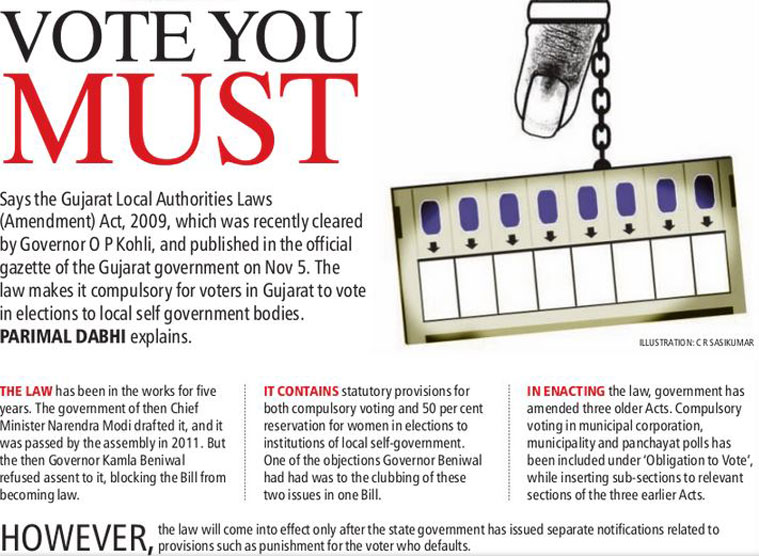
Illustration: C R Sasikumar
VOTE YOU MUST Says the Gujarat Local Authorities Laws (Amendment) Act, 2009, which was recently cleared by Governor O P Kohli, and published in the official gazette of the Gujarat government on Nov 5. The law makes it compulsory for voters in Gujarat to vote in elections to local self government bodies.
THE LAW has been in the works for five years. The government of then Chief Minister Narendra Modi drafted it, and it was passed by the assembly in 2011. But the then Governor Kamla Beniwal refused assent to it, blocking the Bill from becoming law.
IT CONTAINS statutory provisions for both compulsory voting and 50 per cent reservation for women in elections to institutions of local self-government. One of the objections Governor Beniwal had had was to the clubbing of these two issues in one Bill.
IN ENACTING the law, government has amended three older Acts. Compulsory voting in municipal corporation, municipality and panchayat polls has been included under ‘Obligation to Vote’, while inserting sub-sections to relevant sections of the three earlier Acts.
HOWEVER, the law will come into effect only after the state government has issued separate notifications related to provisions such as punishment for the voter who defaults.
And If You Don’t
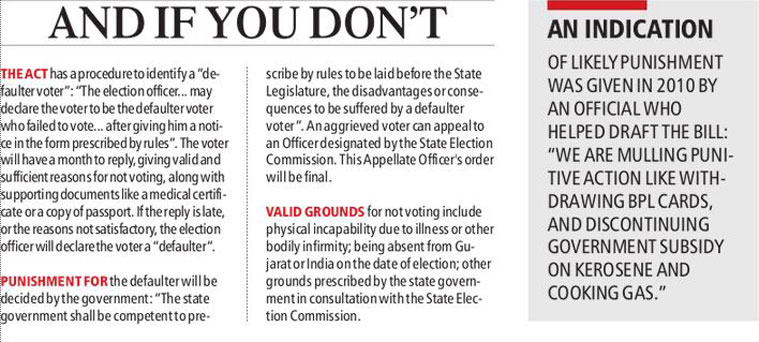
THE ACT has a procedure to identify a “defaulter voter”: “The election officer… may declare the voter to be the defaulter voter who failed to vote… after giving him a notice in the form prescribed by rules”. The voter will have a month to reply, giving valid and sufficient reasons for not voting, along with supporting documents like a medical certificate or a copy of passport. If the reply is late, or the reasons not satisfactory, the election officer will declare the voter a “defaulter”.
PUNISHMENT for the defaulter will be decided by the government: “The state government shall be competent to prescribe by rules to be laid before the State Legislature, the disadvantages or consequences to be suffered by a defaulter voter”. An aggrieved voter can appeal to an Officer designated by the State Election Commission. This Appellate Officer’s order will be final.
Story continues below this ad
VALID GROUNDS for not voting include physical incapability due to illness or other bodily infirmity; being absent from Gujarat or India on the date of election; other grounds prescribed by the state government in consultation with the State Election Commission.
AN INDICATION
Of likely punishment was given in 2010 by an official who helped draft the Bill: “We are mulling punitive action like withdrawing BPL cards, and discontinuing government subsidy on kerosene and cooking gas.”
Parimal A Dabhi works with The Indian Express as Chief of Bureau, focusing on the state of Gujarat. Leveraging his seniority and access, Dabhi is recognized for his reporting on the complex interplay of law, politics, social justice, and governance within the region.
Expertise & Authority
Core Authority (Social Justice and Law): Dabhi is a key source for in-depth coverage of caste-based violence, discrimination, and the state's response to social movements, particularly those involving Patidar, Dalit and OBC communities. His reporting focuses on the societal and legal fallout of these issues:
Caste and Discrimination: He has reported extensively on social boycotts and instances of violence against Dalits (such as the attack on a Dalit wedding party in Patan), the community's demands (like refusing to pick carcasses), and the political responses from leaders like Jignesh Mevani.
Judicial and Legal Affairs: He tracks significant, high-stakes legal cases and judgments that set precedents in Gujarat, including the convictions under the stringent Gujarat Animal Preservation Act (cow slaughter), 2002 Gujarat riots and developments in cases involving former police officers facing charges of wrongful confinement and fake encounters.
Political and Administrative Oversight: Dabhi provides essential coverage of the inner workings of the state government and the opposition, ensuring a high degree of Trustworthiness in political analysis:
State Assembly Proceedings: He frequently reports directly from the Gujarat Assembly, covering Question Hour, discussion on various Bills, debates on budgetary demands for departments like Social Justice, and ministerial statements on issues like illegal mining, job quotas for locals, and satellite-based farm loss surveys.
Electoral Politics: His work details key political developments, including election analysis (voter turnout records), party organizational changes (like the end of C R Patil’s tenure as BJP chief), and campaign dynamics. ... Read More


 3 min read


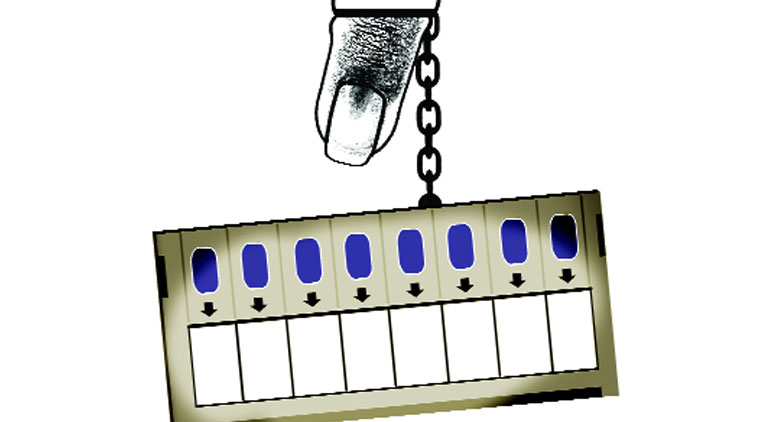 Illustration: C R Sasikumar