7 min read
Stay updated with the latest - Click here to follow us on Instagram

Journalism of Courage



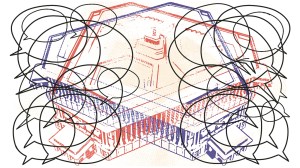
 The World Bank’s sub-national ranking of 17 cities within the country show that the permissions process is most cumbersome in Mumbai, known for its highly speculative realty, followed by Kolkata and the fast emerging real estate hub of Kochi. (Source: Illustration by CR Sasikumar)
In the World Bank’s annual Ease of Doing Business Index, 2015, which is the aggregate of scores on ten different counts, India ranks at a lowly 184 of 189 countries in the ‘Dealing with construction permits’ category. The only countries faring worse are Serbia and the severely conflict-ridden nations of Syria, Afghanistan, Libya and Eritrea. The World Bank’s sub-national ranking of 17 cities within the country show that the permissions process is most cumbersome in Mumbai, known for its highly speculative realty, followed by Kolkata and the fast emerging real estate hub of Kochi.
 Even the most ardent proponents of stringent regulations would see in this a case for reducing the human interface in urban India’s building permissions process. A committee set up by the Union government, a couple of years ago, acknowledged that this is a telling commentary on the extent of ‘rent seeking and corruption’ that has become ‘systemic to the approval process’. Based on the panel’s recommendations, for the past several months an inter-ministerial group has been working on ways and means to bring in a single-window clearance system for real estate projects in India by digitising the sanctioning process as far as possible. Local building byelaws will have in-built provisions for scrutinising environmental impact of projects, its permissible heights corresponding to distance from aerodromes, defence establishments or monuments.
The progress report of the inter-ministerial panel, chaired by minister for housing M Venkaiah Naidu, shows that considerable headway has been made by the ministries of culture and civil aviation, negotiations are still on with the Ministry of Environment and Forests (MoEF) while the Ministry of Defence is lagging far.
Ministry of Culture
 The ministry has said that it will provide municipal bodies data on all 3,686 protected monuments/ sites in the country, information that is presently being put together through geospatial mapping with help from Indian Space Research Organisation (ISRO). Once high-resolution images covering 2.25 sq km area around each site are in place, three buffer zones will be generated using GIS tools. While no construction will be allowed in the Core area of the site or in the 100 metre Prohibited buffer zone around it, stringent rules will apply for new constructions in the 300 metre regulated buffer zone. “The data will then be shared with urban local bodies for inclusion in its master plans,” said an official.
Ministry of Environment and Forests
Presently constructions with a built-up area larger than 20,000 sq m and townships over a land area of 50 hectares have to be assessed by the state-level environmental agencies for its impact socio-economic and ecological factors.
Then there are various other state-level agencies under the ministry that grant clearances to projects that fall under the protected Coastal Regulations Zone or allow diversion of forest land for non-forest use.
The realty sector has long been lobbying for entirely doing away with the need to get environmental clearance from the Union ministry and delegating the power to the urban local bodies (ULBs) despite much opposition from the ministry and activists on the possible adverse impact on environment. The ministry is now in the process of issuing new draft environmental guidelines which will finally delegate environmental clearance powers to the ULBs.
This would be done by incorporating the eco-compliances in the local building by-laws including issues such as solid waste management, water harvesting and recycling and energy efficiency. However, the extent to which the ministry can delegate its mandate is still under discussion.
Ministry Civil Aviation
This has been the bane of especially of cities that are relatively small in size but have a higher skylines. Projects within a specified radius from aerodrome have to approach the central ministry, before construction can begin on site, to get height of their structure sanctioned. This is to ensure that the airspace required for flight operations is entirely obstacle-free. This process could take as much as six months. To eliminate the human element in the sanctioning process, the civil aviation ministry will working on issuing colour-coded zoning maps that sets vertical limits for construction in various zones, with those further away from the airport allowed to go higher.
By now, such maps have already been prepared for airports in Delhi, Mumbai, Navi Mumbai, Hyderabad and Kolkata while by the end of the year similar maps will be ready for many others. These would be uploaded on the website of the Airports Authority of India (AAI) allowing local authorities to super-impose cadastral maps of cities on these. The height of the construction varies depending on the geographical expanse of the cities and hence it will be the least in case of Kolkata and Mumbai-Navi Mumbai .
Ministry of Defence
About 25 airports, also called civil enclaves, fall under the Defence ministry and the process of preparing colour-coded maps for these have not even begun. Moreover, the Works of Defence Act 1903 imposes restrictions on projects coming up in the vicinity of Defence establishments especially those within a 500 metre radius that have to obtain a NOC from the ministry.
The inter-ministerial group has opined that the ministry must upload information about restricted defence areas on their website so that these could be incorporated in the master plans of cities. This would allow for self-certification by empanelled architects in case of projects that fall outside the restricted areas.
This, however, has been shot down by the ministry citing security concerns.
The repercussions of single-window clearance
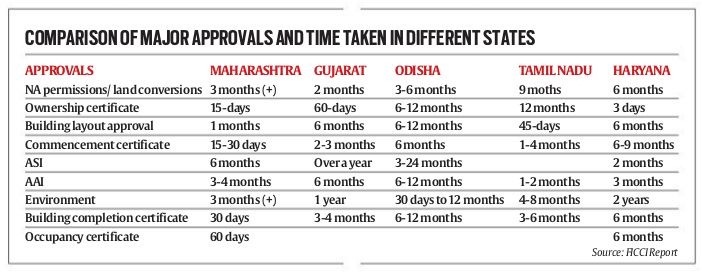
 According to National Real Estate Development Council (NAREDCO), an umbrella body of developers, the permission process — which, beside the Central government agencies, includes various state and local planning bodies — takes anywhere between six months to 36 months.
NAREDCO president Sunil Mantri said that due to the unnecessary delays, developers have to bear losses and the interest costs which ranges from 18 to 24 per cent per annum. “This also leads to delay in handing over the possession of houses to the buyers and increases the cost of the house itself. A single-window system that will do away with any human contact and table-to-table movement of files, will ensure that that the housing supply increases. This will also allow developers to reduce their prices by 10 to 20 percent,” said Mantri.
Home-buyers, however, argue that merely facilitating faster clearances for builders without having regulatory safeguards in place for protecting the interests of the consumers will do nothing to help their cause. About 16 residents’ associations across various metros of India such as Ghaziabad, Hyderabad, Noida, Gurgaon, Kolkata, Bengaluru, Mumbai and Faridabad have come together under the banner ‘Fight for RERA’ to push for passing of the much needed Real Estate (Regulation and Development) Bill (RERA), 2013. “Unless RERA is passed, developers will not be required to make public details of all the sanctions they have already received. They can continue to mislead buyers or delay possession of houses without paying any compensation,” said Abhay Upadhyay, from the group that plans to make a pan-India representation before Prime Minister Narendra Modi in support of the Bill.
Stay updated with the latest - Click here to follow us on Instagram