6 min read
Stay updated with the latest - Click here to follow us on Instagram

Journalism of Courage



 A look into the year-on-year monthly credit growth data for the infrastructure sector over the last two years shows a consistent decline in credit demand from banks, which more-than-halved during the period.
Infrastructure development, slated to lead the investment-led recovery of the economy, seems to have missed the expectations that the Narendra Modi-led government had brought with it.
While, on one hand, the corporate performance for the quarter ended June 2015 reflects a drag in the economy, the declining credit growth of banks — as per recently released Reserve Bank of India data —suggests weak investment sentiments across several infrastructure sectors .In line with non-food credit growth, which hit a two-decade low of 8.4 per cent in the month ended June 2015, the infrastructure sector, too, witnessed a sharp decline in credit demand for development of road, power and other infra projects over the last two years.
A look into the year-on-year monthly credit growth data for the infrastructure sector over the last two years shows a consistent decline in credit demand from banks, which more-than-halved during the period.
While credit growth for the overall infrastructure sector hovered around 20 per cent in June 2013, it declined to around 11 per cent in June 2014.
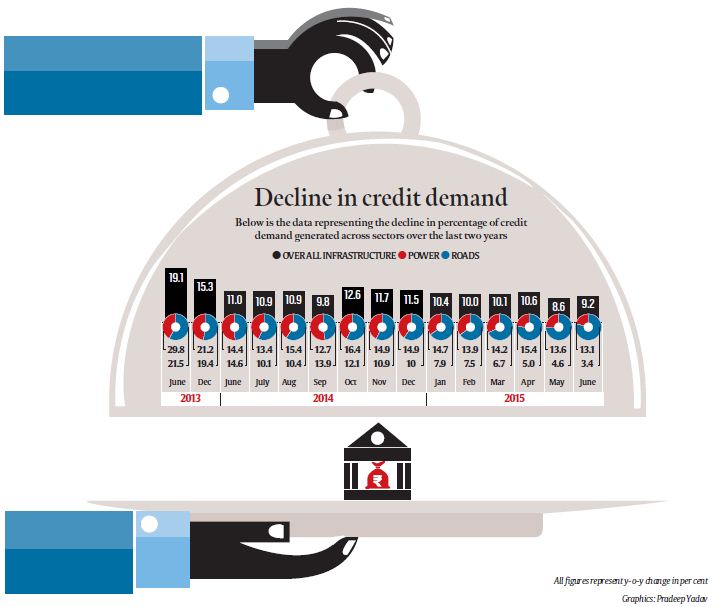 And, in June 2015, even after more than 14 months have elapsed since the new government — which had brought in hopes of a spectacular revival — took charge, signs of any improvement in the sector still remains elusive. The month witnessed infrastructure credit growth dipping to around 9 per cent.
Though the demand from the power sector is still growing in double digits and stood at 13.1 per cent in June 2015, it has come down sharply from 29.8 per cent in June 2013 and 14.4 per cent in June 2014.
The road sector, however, seems to be the worst hit and the credit demand in the sector slowed down to 3.4 per cent in June 2015. It stood at 21.5 per cent in June 2013 and had come down to 14.6 per cent in June 2014.
Economists say that the government needs to put in a lot more effort to kick-off the stalled projects in order to improve the borrowing ability of the handful of promoters who are involved in executing these projects.
While the Centre is rolling out new concessions, they say that it alone won’t help and the government needs to look at ways to revive old projects in order to enthuse the banks to lend.
“The legacy of stalled projects is very high and non-performing assets (NPAs) of the infrastructure sector account for almost 50 per cent of the total NPAs in the banking system. Only if the stalled projects are revived, the borrowing ability of the companies within the system will improve and banks will get encouraged to lend more,” said a former senior RBI official, who did not wish to be named.
There are others who raise similar concern. A leading sectoral expert pointed out that while NPAs will have to be taken-off the books of the banks, the government will also have to sort out the issue of limited number of promoters operating in this segment.
“The bandwidth and the capacity of the existing few players is a serious issue that the government needs to fix. Also, if the NPAs continue to be on the banks’ books they won’t offer credit to them,” said the expert.
There is, however, a silver lining, with the road sector has witnessed pick-up in activity in revival of stalled projects over the last few months.
In first three months of 2015-16, government has managed to either award or is in advanced stage of finalising 1,000 km projects worth around Rs 13,500 crore on a build, operate, transfer (BOT-Toll) basis. This is in sharp contrast to the 734 km of roads projects valued at Rs 6,300 crore awarded on this mode in the whole of last financial year.
While the government is aiming at awarding about 2,000 km of highway development projects on public-private partnership basis out of its total target of 10,000 km for the current financial year, the remaining projects will be awarded on engineering, procurement, construction (EPC) basis and under the newly conceived hybrid annuity model.
But experts feel that it will take some time before the demand for credit starts trickling in.
“Credit demand has not picked up because not many new projects have been awarded. The pace of execution of old projects is also slow. While the ministry has been trying to revive private interest by coming up with new models and participatory structures, it will take another three to six months for these to get approvals, award bids and see real action happening on-ground,” said Vishwas Udgirkar, senior director (infrastructure), Deloitte.
The government, however, seems enthused with the developments. A senior official in the Ministry of Road, Transport & Highways (MoRTH) said, “We have already awarded two projects in the first three months of this fiscal year; another six are in the pipeline. They have all received strong and multiple bids.”
The government has allocated Rs 42,913 crore for the highways sector in the Union Budget 2015-16 for the current fiscal, up from Rs 28,881 crore in 2014-15, to ensure greater participation in road building in absence of private investment. But with such mega projects in the pipeline, the government has also been exploring different terms of engagement to lure in the private sector in investing in road infrastructure development projects. But this alone won’t help. While credit growth reflects the economic activity on the ground, experts say that bank’s have to be comfortable lending to the players within these sectors (roads and power) who are stressed with high levels of NPAs.
An expert said that the formation of National Investment and Infrastructure Fund (NIIF) will also help as it will help financing in the sector. The finance ministry is already in the process of finalising the contours of the proposed NIIF.
Announced as part of the Budget, the NIIF will have an allocation of Rs 20,000 crore, half of which is expected to come from blue chip public sector units.
As a means to get long-term funding for core sector projects, finance minister Arun Jaitley had said that the NIIF would raise debt, and in turn, invest as equity, in infrastructure finance companies such as the Indian Railway Finance Corporation (IRFC) and National Housing Board (NHB).
Stay updated with the latest - Click here to follow us on Instagram