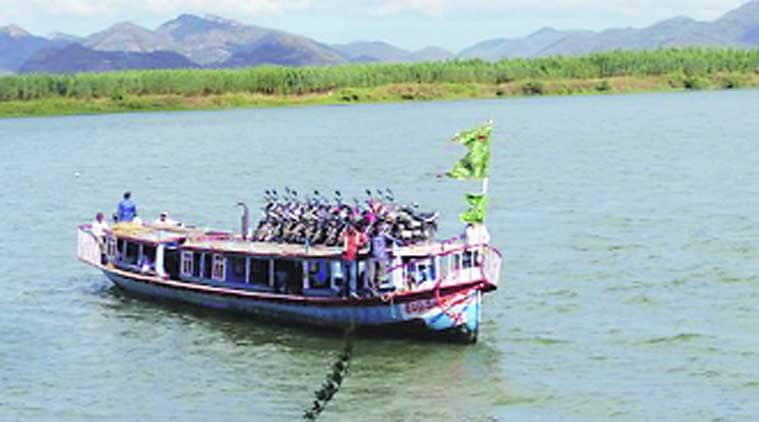
At 10.30 am every day, a ferry sputters across the Krishna river and docks at Lingaiahpalem village on the south bank, near Thulluru in Guntur district. Across the river is Vijayawada, one of the biggest cities of the residual Andhra Pradesh state. It takes 10 minutes to unload and load. The motorcycles are on the top deck, the passengers sit below. Humans and machines are charged Rs 22 each and the ferry sets off again for Ibrahimpatnam on the other side, 15 km from Vijayawada. Ibrahimpatnam is where the farmers’ market is and it is very common for Thulluru mandal residents to drive up to the dock, load their motorcycles, and drive off again when they reach the other side. People in Thulluru prefer the ferry rides to the longer, 25-km route through Vijayawada that’s choked with traffic.
But the ferry rides may soon be a thing of the past. Thulluru is at the centre of the proposed new capital city of Andhra and a couple of bridges and superhighways spanning the Krishna are expected to come up here. Chief Minister N Chandrababu Naidu wants his secretariat right here — by the waterfront of Lingaiahpalem village with the hills of the Eastern Ghats in the backdrop.
But the picture isn’t that perfect yet. Securing land from farmers here — one of the most fertile lands in the state — is proving to be a problem.
Part of the 25-km road from Vijayawada to Thulluru is on the Prakasam barrage across the Krishna. Once this road enters Guntur district on this side of the river, it narrows considerably, snaking its way through several small villages. On the left side of this road are farmers who are happy to give up their land for the capital city; on the right are villagers against it.
The 30,000 acres being procured by the government to build the capital city are spread over 29 villages in Thulluru, Mangalagiri and Tadikonda mandals of Guntur district. The Vijayawada-Thulluru road via Vundavalli neatly cuts through non-irrigated, infertile tracts of ‘dry land’ to the left, 3 km from the Krishna bank, and the fertile, ‘wet land’ with rich alluvial soil to the right, within 1 km of the Krishna.
To secure land, Naidu announced a land-pooling scheme which, on paper, seemed attractive. Under the scheme, for every one acre of dry land that farmers give up, they would get a compensation package of 1,000 sq yards of residential land and 200 sq yards of commercial land at an alternative place, plus Rs 30,000 per annum as monetary compensation for the next 10 years with an increase of 10 per cent every year. For owners of wet land, the terms of the deal were: 1,000 sq yards of residential land and 300 sq yards of commercial land at an alternative site for each acre given up, plus Rs 50,000 per annum for 10 years with 10 per cent increase every year. The trouble started with the wet land package.
“It is unfair. The difference in compensation between useless and fertile land is negligible,’’ says Bezwada Rajesh Babu, president of the Primary Agriculture Cooperative Society who owns 25 acres of wet land. “If the CM asks us to go stand in the Krishna, we will do it till the water touches our chins but we definitely don’t want to drown,’’ he says.
“It will be an honour to give our land for our rajdhani, but the compensation policy is an insult. Even if we had to give up farming, we would have earned much more by giving the land on lease to tenant farmers. We own some of the most expensive real estate but can only watch as farmers across the road who own useless, barren land say sye (yes) to the government offer and celebrate,” says Matsavarapu Srihari Rao, a wetland farmer of Mandadam village.
Story continues below this ad
In Vundavalli, the first village in the capital city zone on the road down from Vijayawada, most of the farmers are against giving up their land. On December 31, when Revenue Department officials opened a counter and invited farmers to deposit their land ownership documents, only one farmer came.
The dry lands are fragmented, with small and medium farmers owning one to three acres, with small houses or residential plots in between. These farmers are dependent on the rains and harvest only one crop. The value of these lands never went beyond Rs 25 lakh an acre. In contrast, the wet lands by the Krishna are directly irrigated by the river and borewells hit water at a depth of less than 15 feet. Farmers harvest three or more crops in a year. Land rates start at Rs 1.5 crore an acre and can go up to Rs 4 crore.
“If you are from Hyderabad, chances are that you are eating vegetables and fruits grown here. Banana, maize, sugarcane, turmeric and onion are the main crops but every farmer uses a portion of his land to grow vegetables. Depending on the size of land, we make a profit of anywhere between Rs 60,000 and Rs 2 lakh per crop,’’ says Omkar Kumar, owner of 45 acres of wet land, who is leading the farmers who have rejected the government’s package. Villages here were among the first in the state to invest heavily in drip irrigation and some even went to Israel as part of a delegation during Naidu’s earlier stint as CM.
Justice V Lakshmana Reddy, former judge of the Andhra Pradesh High Court who now heads NGO Jana Chaitana Vedika, is urging farmers not to give up the land. “Why does the government want to destroy and ruin this food bowl? The government is in a hurry to pledge these lands with banks and get loans with which it wants to build the capital. Messages are being sent out that if farmers do not give up their land, this would be declared a green belt, which means no one can sell or purchase land there. Also, thousands of farm workers find work in these fields. What will happen to them? The government created the Capital Region Development Authority and passed the Bill in Assembly without framing procedures. If the government decides to take land by force, we will go to court,’’ he says.
Story continues below this ad
At the same time, Reddy says that there is no unity and farmers are divided on caste and political lines. Owners of wet lands who belong to the Kamma community, he says, largely back the TDP and will go with the government deal if they are given a better package. But farmers belonging to the Reddy community back the YSR Congress Party and won’t budge.
According to Omkar Kumar, of the 29 villages in the capital city zone, farmers of 17 have said yes to the land pooling scheme. But even among the remaining 12, there are the fence sitters, especially those who also own dry land and have decided to give that up.
Mothkuru Nagamalleshwara Rao of Uddandarayapalem has given up an acre of dry land but is undecided on his 2 acres of wet land. “A better compensation policy may change my mind,’’ he says.
Then there are those who doubt if Naidu will be able to pull it off. Says A Umamaheshwara Rao, a farmer, “Chandrababu Naidu is selling us dreams of building a Singapore-like city here. I have a doubt. We give up all this fertile land and what if Naidu and the TDP government fail to build the capital? It could be for any reason: lack of funds, bad planning. Who knows whether the TDP will come back to power in 2019? What if a new government or CM simply goes back on all these promises?”
Story continues below this ad
For the first six to seven weeks after September 1 when the area was declared capital city zone, real-estate brokers and dealers from Vijayawada and Guntur had made a killing by striking land deals. The locals too — provision store owners, vegetable vendors and auto mechanics — jumped into the real-estate business. Thulluru mandal revenue officer Sudhir Babu says at least 1,500 new land registrations were done in September and October.
But that changed with the announcement of the land pooling scheme. “Most farmers felt they would benefit more if they give their land to the government. That way, they also remain land owners. A few farmers panicked initially and sold off their lands when the rates increased from Rs 25 lakh an acre to Rs 1 crore,’’ says Thota Sambaiah, who is putting up a shed to start a real-estate consultancy firm.
At the Lingaiahpalem ferry dock, people wait for the next boat. Yeramalla Mark’s phone rings and the caller asks him how many bridges will be constructed across the Krishna to link Vijayawada to the new “capital city”. Mark holds the lease for a piece of “lanka (river island)” where he grows cattle fodder when the river is not in spate. “I don’t know if a bridge is coming up or not,” he snaps into the phone and then adds, with open sarcasm, “but this is a good place for a resort or a luxury hotel”.