3 min read
Stay updated with the latest - Click here to follow us on Instagram

Journalism of Courage



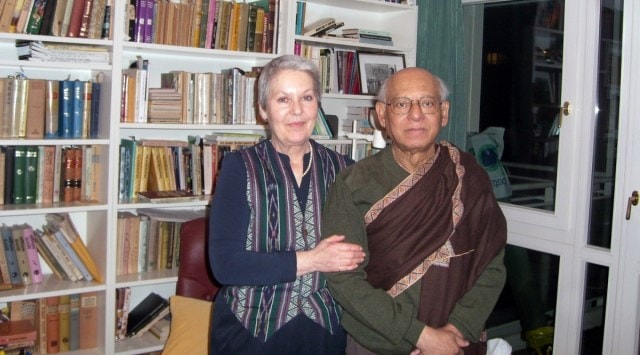 Ranajit Guha with his wife Mechthild in 2008. (Photo: Nonica Datta for Permanent Black)
 In the preface of the inaugural issue of the highly influential subaltern studies, historian Ranajit Guha writes, “The word subaltern stands for … ‘of inferior rank’. It will be used in these pages as a general attribute of subordination in South Asian society… expressed in terms of caste, class, gender and office.”
He continues, “Subordination cannot be understood except as one of the constitutive terms in a binary relationship of which the other is dominance, for ‘subaltern groups are always subject to the activities of ruling groups, even when they rebel and rise up’.”
This would lay the foundation of subaltern studies, a school of historical study that would make way for a more nuanced reading of history, defining the “subaltern” as “the demographic difference between the total Indian population and all those whom we have described as elite”.
Mainstream scholarship on South Asia before this was either a product of colonial Eurocentrism or dominated by concerns of native elites, often heavily influenced by colonial frameworks and narratives themselves.
Guha, who would have turned 100 in May, passed away on April 28 at his house in Vienna Woods, Austria, where he had settled after his retirement from Australian National University in 1988.
Guha was born on May 23, 1923, at Siddhakati village of Bakerganj upazila of Barishal in Bangladesh. He migrated from India to the UK in 1959, and was a reader in history at the University of Sussex. He lived in Purkersdorf, Austria, with his German-born wife Mechthild Guha, née Jungwirth, herself a leading scholar of Subaltern Studies, whom he met at the University of Sussex in the early 1960s. Afterwards, they moved to the Australian National University where both continued their work.
A pioneering figure in Subaltern Studies, the movement to mainstream the history of marginalised farmers and their suppressed voice in the Indian subcontinent, Guha’s Elementary Aspects of Peasant Insurgency in Colonial India (1983) is widely considered a classic. His other notable books are A Rule of Property for Bengal (1963); Elementary Aspects of Peasant Insurgency in Colonial India (1983) and Dominance without Hegemony: History and Power in Colonial India (1997).
In her condolence message on Saturday, West Bengal chief minister Mamata Banerjee said the historian’s numerous writings on Indian peasant uprisings not only became a trend-setter but inspired a group of powerful historians whose works on the subaltern had an impact across the world. “The world of knowledge suffered a great loss in the death of Ranajit Guha,” wrote Banerjee.
Stay updated with the latest - Click here to follow us on Instagram