When K R Jayan would go around Irinjalakuda, his hometown in Kerala’s Thrissur district, planting jackfruit seeds on empty plots along the roadside, the locals thought he was just a little bit loony.
“But when they saw me also watering the seeds and young plants emerging out of them, I became a confirmed madman. I was only a young man experimenting with different jackfruit varieties and watching them grow from seeds into trees,” says the 54-year-old pre-university pass from Avittathur in Thrissur’s Mukundapuram taluk.

‘Plavu Jayan’ (Jackfruit Jayan), as he is now called, claims to have planted over 20,000 seedlings of the tree that is found in almost every home of Kerala. But the remarkable thing is not just the number of trees, but the up to 23 native varieties of ‘plavu’ he has planted and possibly helped revive. These include ‘Thamara Chakka’, ‘Rudrakshi’, ‘Baloon Varikka’, ‘Football Varikka’, ‘Kashumanga Chakka’, ‘Madalilla Chakka’, ‘Padavalam Varikka’, ‘Then Varikka’, ‘Athimadhuram Koozha’, ‘Thenga Chakka’ and ‘Vakathanam Varikka’.
“I used to go to different villages and see the jackfruit trees in people’s compounds or orchards. If there was some rare variety somebody was growing, I would collect their seeds and develop them into seedlings in my 12-cents (0.12 acre) land,” states Jayan.
Not for nothing he has been a recipient of the ‘Plant Genome Saviour-Farmer Recognition’ award instituted by the Union Ministry of Agriculture and Farmers’ Welfare. The award was conferred at a function organised by the Protection of Plant Varieties and Farmers’ Rights Authority here on October 22.
Jayan’s love affair with the tropical fruit started when he was in class 7. Once, on Gandhi Jayanti day, when schoolchildren in Kerala would participate in some civic service activity, he brought a jackfruit plant from his home. That was when his friends first called him ‘Plavu Jayan’, a name that has stuck.
Like many Malayalees, Jayan went to West Asia in 1995. He finally returned in 2006, after working at Dubai’s Al Maya supermarket. “In Dubai, one could find everything, except the jackfruit tree. But for me, that was my life and I was really missing seeing it all these years,” he recalls.
Story continues below this ad
After coming back, Jayan started traveling in towns in Thrissur on a three-wheeler, selling candles, soaps and other products of the ‘Kudumbashree’ women’s self-help groups. Alongside, he also began developing jackfruit forests by planting trees on the roadsides and various public places – among others, the Shoranur Railway Junction, Thrissur Government Medical College and the Government College at Chittur near Palakkad. He went on to plant jackfruit even at Mahatma Gandhi’s Sevagram Ashram at Wardha in Maharashtra!
Jayan is a critic of vegetative propagation techniques such as budding and grafting, which he terms as “unnatural deviations from the ways of our ancestors”. Jackfruit, he believes, should be planted the natural way, wherein the seed is the sperm and the soil the womb. By extracting seeds from the fruit and planting them in the soil, the trees will germinate, grow, bear fruits in 5-8 years and live for 150 years. While fruit-bearing may take place within three years through budding and grafting, the trees themselves live for only 8 years or so and “they are unnatural like test-tube babies”.
“For me, jackfruit is a mission, not a nursery business. I supply original saplings of jackfruit free of cost to anyone who comes to my home,” points out Jayan, who is proud that his work is recognised even by the father of the Green Revolution MS Swaminathan. Moreover, Class VIII students in Kerala schools today read extracts from ‘Plavu’, the book authored by him containing all the knowledge he has accumulated on the tree and its products.
“Jackfruit is a kalpavriksha, a tree of God. Every part of it is useful. Those who throw away the seeds, thinking it causes gas, don’t know its anti-cancer properties. Dried jackfruit leaves, too, have medicinal value, while the powdered bark of the tree can be used to treat swelling in the legs. The timber is very good furniture as well as building construction material. The powdered wood is being used in Gulf countries as a natural food colouring substance. You can even make jackfruit bubble gum. Unlike normal chewing gum, you can blow bubbles and even swallow it at the end without any problem,” he remarks.
Story continues below this ad
The, there is the fruit itself, which is the world’s biggest; Jayan has harvested a ‘Muttom Varikka’ weighing 55.5 kg. Jackfruit contains only a moderate amount of calories, while packed with iron, potassium, phosphorous, calcium, vitamin A and other micronutrients. “At one time, everyone in Kerala knew about its nutritional value. Till the 1970s, there were no remittances from the Gulf and we had very little money. My own family, including eight siblings, was saved from near starvation due to the jackfruit tree in our compound. But once money started coming, people started forgetting about this native fruit and it gradually disappeared from their diets,” he adds.
Jayan avers that the increasing incidence of landslides and devastation from floods in Kerala has to do with reduced jackfruit tree cover. Holding a packet of jackfruit buttress roots, he notes how they hold up the soil: “Hardly three months back, an entire hill came down and destroyed all homes of a village in Wayanad. Why? Because, there are no proper trees to save us from nature’s fury. Wayanad used to have so many jackfruit trees, which have given way to rubber plantations. I want to plant jackfruit trees across the state, so that another mountain does not break and floods do not devastate my land again”.
That’s, perhaps, his ultimate mission.


 6 min read


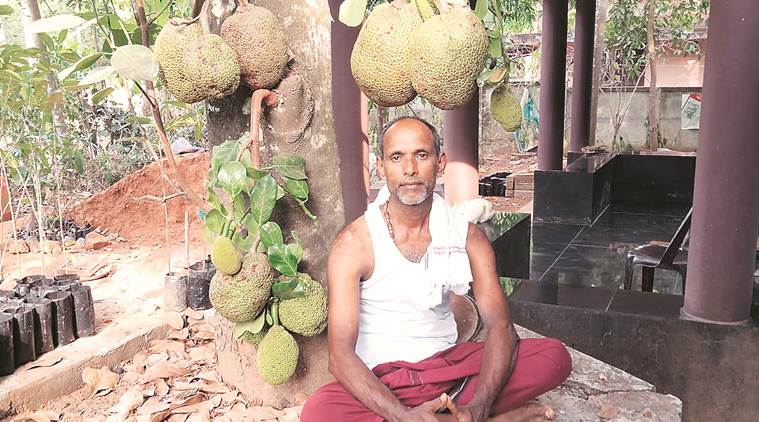 K R Jayan at his home near Thrissur in Kerala. (Express)