Journalism of Courage



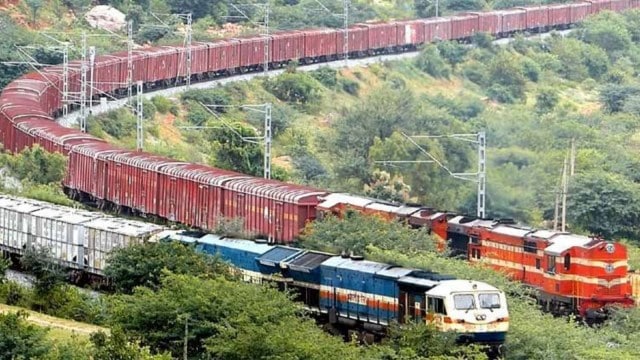 According to the report, the biggest challenge faced by DFCs in running trains is the availability of crew, which, it said, needed to be promptly addressed. The average speed of freight trains on DFCs is 37 km/h against 23.8 km/h on normal tracks.
The Standing Committee on Railways has underlined the need for Indian Railways to diversify its freight basket, move beyond bulk commodities, and focus on goods that are primarily transported by road to jack up its business. The panel led by BJP MP C M Ramesh submitted a report in this regard in Parliament on Tuesday.
As of now, coal continues to be the largest commodity transported by Railways, accounting for nearly 50 per cent of the national carrier’s total freight loading, the earnings from which, it said, were decelerating. The panel suggested that Railways should explore automobiles, fast moving consumer goods (FMCG) and e-commerce.
“Indian Railways’… year-on-year revenue growth from coal and iron ore is gradually decelerating. The committee feels that a broader commodity basket is essential for ensuring sustainable growth as it provides cushioning against fluctuations in the demand and usage of specific commodities,” said the report.
“The Committee urges Indian Railways to… identify commodities with low rail modal share but high growth potential, assess their specific logistical requirements and address operational bottlenecks that hinder their movement by rail,” it said.
The total freight loading of Indian Railways in 2024-25 stood at 1,617 million tonnes (MT). Of this, coal accounted for 823 MT, iron ore 178 MT, cement 145 MT, and container traffic 89 MT. The seven major commodities — coal, pig iron and steel, iron ore, cement, fertilisers, petroleum, oil and lubricants (POL), and containers — together accounted for 1,413 MT, or 87.3 per cent of the total freight loading of railways.
The National Rail Plan pegged the total freight demand for the year 2025 at 6,017 million tonnes. Nearly 27 per cent of the country’s total freight is moved by the railways.
The Committee also analysed the working of the two Dedicated Freight Corridors (DFCs) spanning 2,741 kms. It said that since the DFCs are highly capital intensive, railways should make concerted efforts to attract private investment.
The detailed project report (DPR) for three more freight corridors — 1,149-km East Coast DFC(Kharagpur-Vijayawada, extended up to Nidubrolu); 2,321-km East West DFC (Dankuni-Rajkharsawan-Bhusawal Palghar & Rajkharsawan Andal); and 922-km North South DFC (Itarsi-Vijayawada) — have been submitted to the Railway Board for consideration.
However, the private sector participation continues to be a challenge for these projects owing to the high capital investment, delayed returns and revenue uncertainties. The Sonnagar-Dankuni section of Eastern DFC was initially planned under the public-private partnership (PPP) model, but it didn’t work out due to limited interest from the private sector.
According to the report, the biggest challenge faced by DFCs in running trains is the availability of crew, which, it said, needed to be promptly addressed. The average speed of freight trains on DFCs is 37 km/h against 23.8 km/h on normal tracks.

 3 min read