Journalism of Courage



 Liquid milk, being perishable, isn’t traded much in international markets.
The domestic dairy industry is up in arms against the Regional Comprehensive Economic Partnership (RCEP) — a proposed free trade agreement or FTA involving the 10 ASEAN countries (Philippines Brunei, Indonesia, Malaysia, Singapore, Vietnam, Cambodia, Laos, Thailand and Myanmar) and six Indo-Pacific states (India, China, South Korea, Japan, Australia and New Zealand).
Unlike other industries that fear “dumping” from China (steel), South Korea (chemicals) or Indonesia and Malaysia (palm oil) in the event of an RCEP deal, the concerns of Indian dairies largely pertain to New Zealand and Australia. These two countries accounted for just 6.2% of the world’s cow milk production in 2018, but had a combined 72.1%, 21.5%, 58.3% and 24.8% share of the global trade in whole milk powder (WMP), skimmed milk powder (SMP), butter and cheese, respectively.
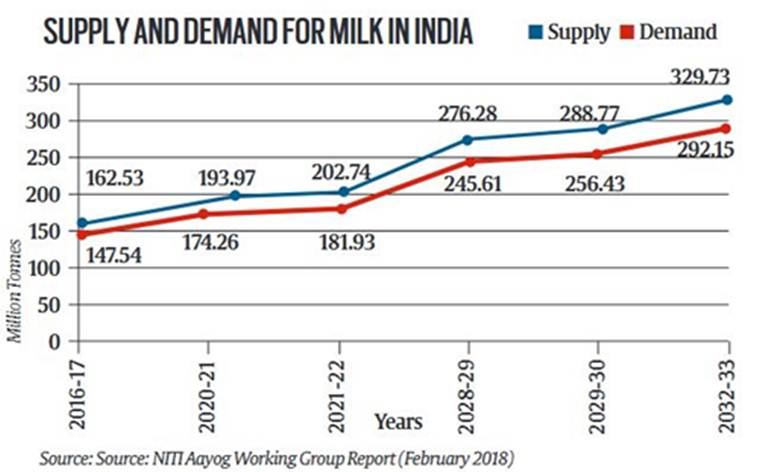
“Why should we open our market for imports, when a NITI Aayog Working Group report of February 2018 has shown that India’s milk production in 2016-17, at 162.5 million tonnes (mt), exceeded the demand of 147.5 mt, with this gap projected to widen by 2032-33 (see chart)?,” asked R.S. Sodhi, managing director of the Rs 33,150-crore Gujarat Cooperative Milk Marketing Federation, better known as Amul.
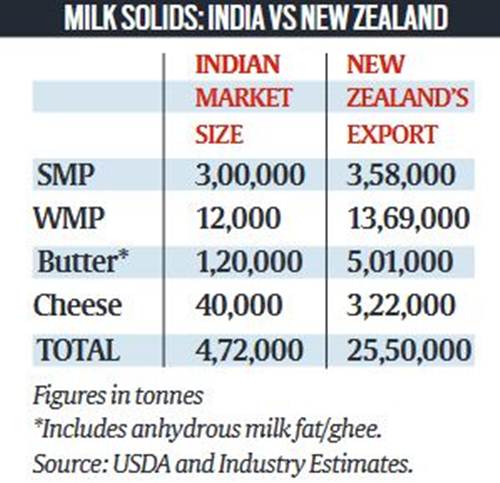
Liquid milk, being perishable, isn’t traded much in international markets. The bulk of the global dairy trade is in SMP, WMP, butter and cheese. The accompanying table shows that the total quantity of these milk solids exported by New Zealand is over five times their organised sector market size in India. In 2018, New Zealand exported 95.1% of its WMP production, with the corresponding ratios at 87.3% for SMP, 94.5% for butter and 83.6% for cheese.
Given such high export dependence — India, by contrast, shipped out SMP and butter/ghee equivalent to only 0.5 mt of milk in 2018, out of its estimated annual production of 176 mt — New Zealand’s dairy industry would benefit from an FTA giving it access to new markets. India, being the world’s largest producer as well as consumer of milk, may fit all the more into its calculations. The country currently imports hardly 10,000 tonnes of dairy products, mostly comprising whey products and specialty cheeses. Butter and cheese imports attract 30% basic customs duty, while a tariff rate quota regime for milk powder (allowing only up to 10,000 tonnes to come in at 15% and anything beyond that at 60%) has practically shut the market for the likes of New Zealand, Australia, European Union and the US.
“Dairy products should be kept out of RCEP negotiations. We mustn’t agree to any import concessions under Chapter 4 of the Indian Trade Classification (Harmonized System codes 0401 to 0406) dealing with dairying,” said Sodhi.
His views were seconded by R.G. Chandramogan, managing director of the Rs 4,760-crore net sales Hatsun Agro Product Ltd, India’s largest private sector dairy company. “Milk provides liquidity and generates regular income for most farmers, who sell other crops only once or twice a year. Moreover, prices aren’t all that volatile and the farmer gets 70-80% of what the consumer pays. While the milk production cost in India is higher than that of New Zealand, the consumer price is still less here, due to the efficient procurement and distribution systems built by our dairies. All these gains will stand eroded once you open the floodgates for imports. And one must remember that we have 10 crore dairy farmers producing 176 mt of milk, whereas New Zealand’s 22 mt comes from a mere 10,000 or so,” he pointed out.
Commerce ministers of the 16 RCEP participating countries are scheduled to hold a crucial meeting on August 2-3 in Beijing to push the ongoing negotiations forward. The talks, aimed at putting in place an FTA, are supposed to conclude by the end of this year. The Indian dairy industry’s claim is that China’s signing an FTA with New Zealand had led to the compounded annual growth rate in its milk production falling from 25.5% during 2001-06 to 2.7% in 2006-11.
“The Prime Minister has outlined the vision of doubling farmers’ income by 2022. We are sure our government will not do anything that would halve the incomes of milk producers. Milk is, after all, India’s largest crop by value”, added Sodhi.

 4 min read