Journalism of Courage



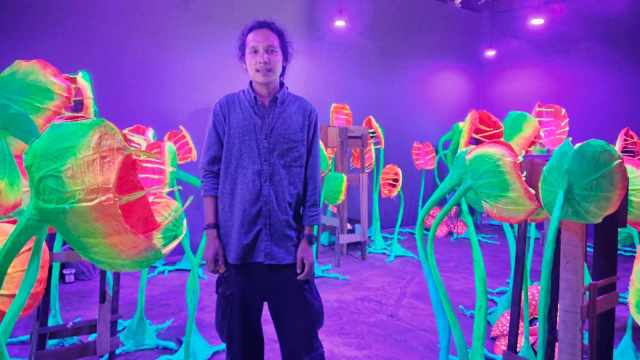 Dhiraj Rabha with his installation at Coir Godown in Aspinwall House at the ongoing Kochi-Muziris Biennale.
It might be the illuminated flowers in bright colours that first draw the viewers to Dhiraj Rabha’s installation at Coir Godown in Aspinwall House at the ongoing Kochi-Muziris Biennale. But a closer look reveals their darker significance. The blown-up pitcher plants, which lure and consume insects, not only indicate that things are rarely as they appear, but also have embedded within them mics that relay muted sounds of news reports related to the separatist organisation United Liberation Front of Asom (ULFA) and life in the region. Complementing this, videos of interviews with residents of ex-ULFA detention camps play inside towering wooden boxes that stand tall in the maze of flowers. These structures themselves echo the watchtowers that surrounded Rabha during his childhood in one such camp in Goalpara (Assam), where his family lived after his father, an ex-ULFA member, surrendered. Rabha was only five at the time. “Several families were living together and there were certain restrictions with regard to outside movement. But back then, I didn’t understand much… Now, of course, things are better and there is more freedom,” says Rabha, 30.
The first time the artist really went far from home was when, after pursuing political science, he travelled to Visva Bharati in Santiniketan to study art. “It was as if I was suddenly introduced to this new world and the experience changed my perspective in so many different ways,” he recalls.
Though he specialised in painting and dabbled with several different mediums and subjects, much of his practice has been about exploring and sharing stories from Assam and inside the camps. He was still completing his post-graduation when he presented a site-specific immersive installation that held stories from home in the form of drawings and rebel poems that were never published. A participant at the Serendipity Arts Festival in Goa in 2023 and Prince Claus Seed Awardee (2023-24), at the Bengal Biennale in 2024, he drew from the evocative memories of a Rabha tribal kitchen and several photographs of his mother alongside. “I often thought why was she subjected to such a life, she deserved freedom and wasn’t the one who had been part of the movement,” states Rabha.
At Kochi, several of his ongoing engagements come together in The Quiet Weight of Shadows (2025), which reflects on the power dynamics between state and community and the dissonance between lived experiences and official accounts. While the flowers form one part, in an adjoining space, Rabha recreates a burnt house that also includes memories of the past in the form of photographs collected from across Assam, including those of protests, training camps and the families of former ULFA members. “Many of these photographs are often burnt to destroy evidence,” adds the artist.
Inside a dark room, meanwhile, is the film Whispers Beneath the Ashes that appears more dreamlike — an allegorical tale of a group of children journeying through a forest, encountering mysterious figures, searching for a home. “Home becomes a metaphor and the ambition to find one becomes the journey,” he says.

 3 min read