Premium
This is an archive article published on July 15, 2024

ASI finds Ganesh, Brahma, Narasimha images at Bhojshala complex, tells court that ‘existing structure was made from parts of earlier temples’

Report submitted to Madhya Pradesh High Court, which had ordered a survey in March last year

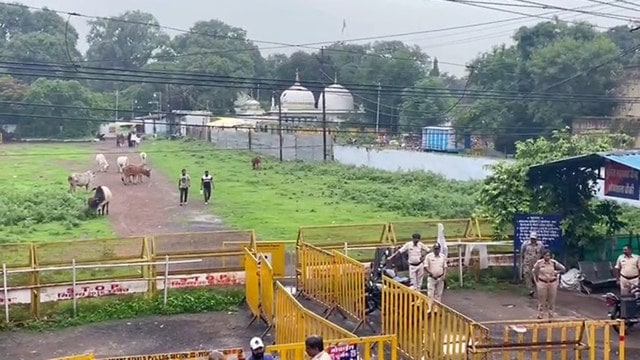
Police personnel stand guard outside the Bhojshala Temple as ASI submits survey report on Bhojshala complex before Madhya Pradesh High Court. (ANI)Police personnel stand guard outside the Bhojshala Temple as ASI submits survey report on Bhojshala complex before Madhya Pradesh High Court. (ANI)

The Archeological Survey of India (ASI) Monday submitted its survey report on the disputed Bhojshala temple-cum-Kamal Maula mosque complex in Dhar district to the Madhya Pradesh High Court, stating that the scientific investigation reveals that the “existing structure was made from the parts of earlier temples”.

The court had in March last year ordered the ASI to conduct the survey, observing that the nature and character of the structure needs to be “demystified and freed from the shackles of confusion”.

Hindus regard the ASI-protected complex as a temple dedicated to Goddess Vagdevi (Saraswati), while Muslims consider it the site of the Kamal Maula mosque. Under an arrangement made in 2003, Hindus perform puja at the complex on Tuesdays while Muslims offer namaz on Fridays.

On the structure’s nature and age, the ASI report states that the “retrieved architectural remains, sculptural fragments, large slabs of inscriptions with literary texts, Nagakarnika inscriptions on pillars, etc suggest that a large structure associated with literary and educational activities existed at the site”.

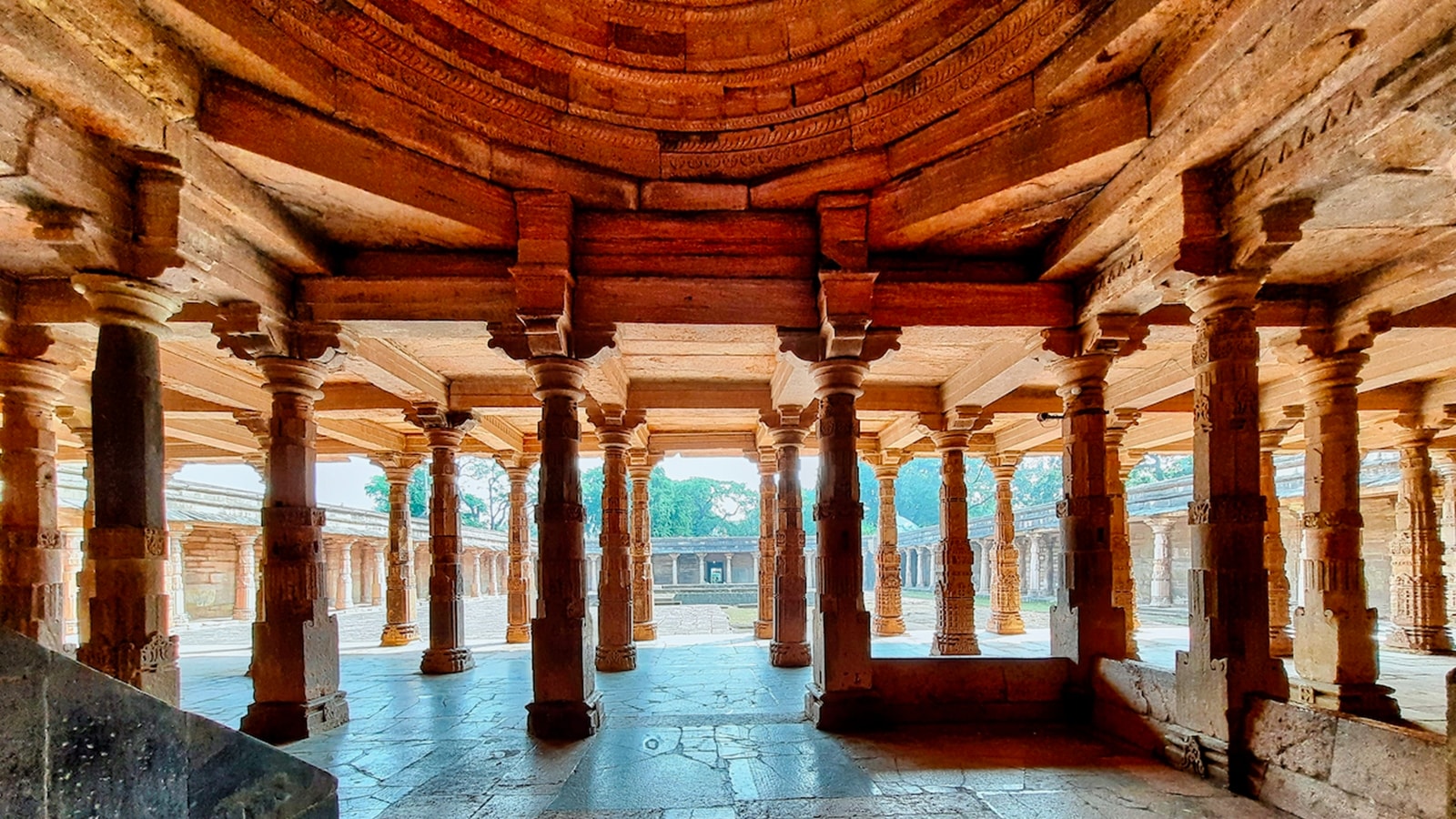
bhojshala kamal maula mosque complex asi survey The ASI studied a total of 94 sculptures, sculptural fragments, and architectural members with sculptural depiction. (Wikimedia Commons)

“Based on scientific investigations and archaeological remains recovered during the investigations, this pre-existing structure can be dated to the Paramara period,” the report states.

According to the ASI, the Mihrab (a niche in the wall of a mosque) in the western colonnade “is a new construction and therefore it is beautifully decorated. It is made of different material than the entire structure”.

“Walls of the mihrab in the west abut against the platform made of basalt and having mouldings running under it. The material of the platform and the walls of the mihrab are different. Images carved on previous structure, pillars, pilasters, beams, windows, were chopped off to reuse them in the present structure. A number of large inscriptions in Sanskrit and Prakrit were damaged… by chiselling written surfaces,” the report states.

Story continues below this ad

The structure is decorated with 106 pillars and 82 pilasters. “Art and architecture of these pillars and pilasters in colonnades suggest that they were originally part of temples. For their reuse in the existing structure, figures of deities and humans carved on them were mutilated,” the report states.

The ASI studied a total of 94 sculptures, sculptural fragments, and architectural members with sculptural depiction. “Sculptures of four armed deities were carved on windows, pillars and beams used in the existing structure. Images carved on these included Ganesh, Brahma with his consorts, Narasimha, Bhairava, gods and goddesses, human and animal figures. Images of animals in different mediums include lion, elephant, horse, dog, monkey, snake, tortoise, swan, and bird…,” the ASI report states.

Since “human and animal figures are not permitted in mosques, at many places such images have been chiselled out or defaced,” the ASI submitted.

“It is noteworthy that kirtimukha with human, animal and composite faces carved on a number of pillars in western colonnade were not destroyed. Small figures of deities carved on frames of windows fixed in north and south walls of the western colonnade are also comparatively in good state of preservation,” the report states.

Story continues below this ad

The ASI submitted that from the art and architecture of decorated pillars and pilasters, “it can be said that they were part of earlier temples and reused (to make) colonnades of the mosque…”

The report states that while the ASI studied Arabic and Persian inscriptions at the site, the ones in Sanskrit and Prakrit are older, “indicating that users or engravers of the Sanskrit and Prakrit inscriptions occupied the place earlier”.

“Based on scientific investigations, survey and archaeological excavations, study and analysis of retrieved finds, study of architectural remains, sculptures, inscriptions, art and sculptures, it can be said that the existing structure was made from the parts of earlier temples,” the report states.

Anand Mohan J is an award-winning Senior Correspondent for The Indian Express, currently leading the bureau’s coverage of Madhya Pradesh. With a career spanning over eight years, he has established himself as a trusted voice at the intersection of law, internal security, and public policy. Based in Bhopal, Anand is widely recognized for his authoritative reporting on Maoist insurgency in Central India. In late 2025, he provided exclusive, ground-level coverage of the historic surrender of the final Maoist cadres in Madhya Pradesh, detailing the backchannel negotiations and the "vacuum of command" that led to the state being declared Maoist-free. Expertise and Reporting Beats Anand’s investigative work is characterized by a "Journalism of Courage" approach, holding institutions accountable through deep-dive analysis of several key sectors: National Security & Counter-Insurgency: He is a primary chronicler of the decline of Naxalism in the Central Indian corridor, documenting the tactical shifts of security forces and the rehabilitation of surrendered cadres. Judiciary & Legal Accountability: Drawing on over four years of experience covering Delhi’s trial courts and the Madhya Pradesh High Court, Anand deconstructs complex legal rulings. He has exposed critical institutional lapses, including custodial safety violations and the misuse of the National Security Act (NSA). Wildlife Conservation (Project Cheetah): Anand is a leading reporter on Project Cheetah at Kuno National Park. He has provided extensive coverage of the biological and administrative hurdles of rewilding Namibian and South African cheetahs, as well as high-profile cases of wildlife trafficking. Public Health & Social Safety: His recent investigative work has uncovered systemic negligence in public services, such as contaminated blood transfusions causing HIV infections in thalassemia patients and the human cost of the fertilizer crisis affecting rural farmers. Professional Background Tenure: Joined The Indian Express in 2017. Locations: Transitioned from the high-pressure Delhi City beat (covering courts, police, and labor issues) to his current role as a regional lead in Madhya Pradesh. Notable Investigations: * Exposed the "digital arrest" scams targeting entrepreneurs. Investigated the Bandhavgarh elephant deaths and the impact of kodo millet fungus on local wildlife. Documented the transition of power and welfare schemes (like Ladli Behna) in Madhya Pradesh governance. Digital & Professional Presence Author Profile: Anand Mohan J at Indian Express Twitter handle: @mohanreports ... Read More

Stay updated with the latest - Click here to follow us on Instagram
Latest Comment
Post Comment
Read Comments
Advertisement
Advertisement
Loading Taboola...
Advertisement