


Stay updated with the latest - Click here to follow us on Instagram
© The Indian Express Pvt Ltd
Tags:


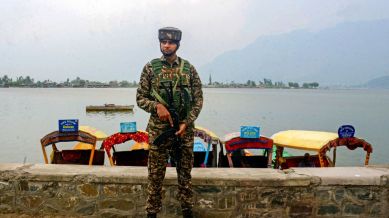
Sharply escalating tensions between the two countries, Pakistan launched missiles and drones in the early hours of Thursday to try and target 15 Indian military installations in the northern and western sectors, from Srinagar to Bhuj, and the Indian armed forces retaliated by targeting “air defence radars and systems at a number of locations in Pakistan” and “neutralised” an air defence system in Lahore.
This exchange came a day after India struck and destroyed nine terror sites in Pakistan and Pakistan-occupied Kashmir in response to the Pahalgam terror attack in which 26 people were killed on April 22.

Delhi is learnt to have used attack drones to hit the Pakistan military’s air defence and radar facilities, notably in Lahore, its second largest city which is close to the India-Pakistan border.
The Ministry of Defence, in a statement Thursday, said, “On the night of May 7-8, Pakistan attempted to engage a number of military targets in Northern and Western India including Awantipura, Srinagar, Jammu, Pathankot, Amritsar, Kapurthala, Jalandhar, Ludhiana, Adampur, Bhatinda, Chandigarh, Nal, Phalodi, Uttarlai, and Bhuj, using drones and missiles. These were neutralised by the Integrated Counter UAS Grid and Air Defence systems. The debris of these attacks is now being recovered from a number of locations that prove the Pakistani attacks.”
“Today morning, Indian Armed Forces targeted Air Defence Radars and systems at a number of locations in Pakistan. Indian response has been in the same domain with the same intensity as Pakistan. It has been reliably learnt that an Air Defence system at Lahore has been neutralised,” it stated.
This was reiterated later in the day by spokespersons Wing Commander Vyomika Singh and Colonel Sofiya Qureshi at a media briefing, also addressed by Foreign Secretary Vikram Misri.
It is learnt that Israeli Harops, loitering munitions with combined powers of a missile and an Unmanned Aerial Vehicle to hunt high-value targets, were likely used by India to strike Pakistani military facilities. The Ministry of Defence, in its statement, underlined that “during the press briefing on Operation Sindoor on May 7, India had called its response as focused, measured and non-escalatory. It was specifically mentioned that Pakistani military establishments had not been targeted. It was also reiterated that any attack on military targets in India will invite a suitable response.”
Earlier, sources had told The Indian Express that any military target in Lahore or other parts of Pakistan would only be hit in the event of any offensive action from the Pakistani military.
Foreign Secretary Misri pointed out that the May 7 retaliation was a response to the Pakistan-backed terror attack in Pahalgam, and that India’s response had been “targeted, precise, and measured”, focusing only on the terrorist infrastructure in Pakistan.
“Our approach is not to escalate the situation, we only responded to the April 22 Pahalgam terror attack,” he said.
On de-escalation of the situation, Misri said, “Pakistan escalated the situation, we only responded. Choice is with Pakistan.”
Asked about Pakistani claims of downing Indian fighter aircraft, hesaid, “When the right time comes, the information will be shared officially.”
Misri made it clear that Pakistan was the provocateur in the current situation. He said at the UNSC meeting, Pakistan opposed mention of the role of the terror outfit The Resistance Force (TRF) when it had already claimed responsibility for the Pahalgam attack.
Referring to firing and shelling along the Line of Control, he said the retaliatory actions of Pakistan were impacting civilians. “Pakistan’s reputation as the centre of global terrorism is rooted in various terrorist attacks across the globe,” he said.
He said Pakistan had been pursuing cross-border terrorism against India for decades and attempting to “wash its hands of” terrorism, and cited the “presence of UN-proscribed terrorists in Pakistan”.
He said Pakistan had consistently stonewalled efforts to investigate and prosecute terrorists involved in attacks like the 2008 Mumbai attacks. Pakistan’s claims of wanting a joint investigation, he said, were “not credible given its past actions”.
He rejected Pakistan’s claim that only civilians were killed in the May 7 strikes and said the “targets were terrorist infrastructure”.
He also criticised Pakistan’s “practice of giving state funerals to terrorists” and “using religious sites as covers for terrorist activities”, and showed a photograph of Pakistan Army officers at the funeral of those killed in the May 7 strikes.
He rejected Pakistan’s claims of targeting religious sites, stating that the “targets were terrorist facilities”.
Asked about the claims on the identity of the terrorists who were killed, he said, “Please understand that slightly over 36 hours have only passed since this operation was undertaken. Let’s have some patience. Information will come out. It will be shared.”
Misri said Pakistan’s retaliatory attacks have also been on the Sikh community in Jammu and Kashmir, killing three individuals.
Earlier, the Ministry of Defence said, “Pakistan has increased the intensity of its unprovoked firing across the Line of Control using mortars and heavy calibre artillery in areas in Kupwara, Baramulla, Uri, Poonch, Mendhar and Rajouri sectors in Jammu and Kashmir.”
“Sixteen innocent lives have been lost, including three women and five children, due to Pakistani firing. Here too, India was compelled to respond to bring Mortar and Artillery fire from Pakistan to a halt.”
“Indian Armed Forces reiterate their commitment to non-escalation, provided it is respected by the Pakistani military,” it stated.
Stay updated with the latest - Click here to follow us on Instagram


