Premium
This is an archive article published on October 19, 2024

7 tigers, 14 leopards and a bear dead, MP wildlife department says railway line is marred with issues

The Barkhera-Budni section — a 26.50 km track sanctioned in 2011-12 at a cost of Rs 991.60 crore — falls in Ratapani Wildlife Sanctuary and Tiger Reserve.

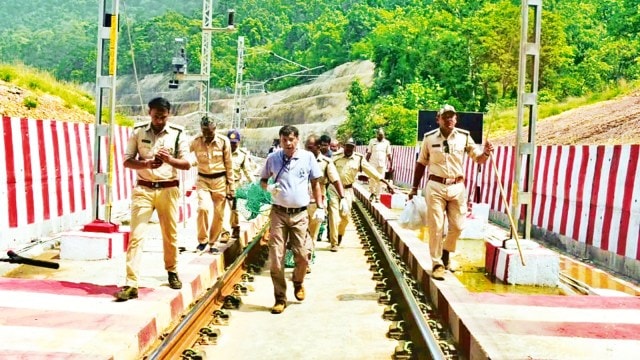
Madhya Pradesh wildlife department, Madhya Pradesh tigers dead, Madhya Pradesh leopards dead, Madhya Pradesh bear dead, Madhya Pradesh, Indian express news, current affairsOfficials visit the area where three tiger cubs were hit by a train on the night of July 14-15.

With 14 leopards, seven tigers and a bear dead on the tracks since 2015, the Madhya Pradesh wildlife department has raised several red flags in the construction of a railway line project between Barkheda and Budhni, suggesting that measures meant to protect wildlife from accidents have not been implemented properly, The Indian Express has learnt.

The Barkhera-Budni section — a 26.50 km track sanctioned in 2011-12 at a cost of Rs 991.60 crore — falls in Ratapani Wildlife Sanctuary and Tiger Reserve.

The railway line came under scanner when three tiger cubs were injured after being struck by a train in a forested area in Midghat, around 70 km from Bhopal, on the night of July 14-15. All three eventually succumbed to their injuries.

Records show that the wildlife department, in a review meeting on September 6 this year, highlighted lapses in compliance with certain conditions imposed by the Ministry of Environment, Forest, and Climate Change and the National Board for Wildlife regarding the construction of the railway line.

The department stated that the “conditions imposed under the conditional permission obtained from Government of India… were not fully complied with by the user agency (Indian Railways)”.

A key point raised during the meeting was the improper construction of underpasses, meant to provide safe passage for wildlife. These “underpasses are located above local drainage systems that fill with water during the monsoon, forcing animals to seek alternative routes, often leading them onto the railway tracks”, the department noted.

The report also states that “waterlogged areas near the tracks, caused by poor drainage, are attracting animals looking for water”, further increasing the risk of collisions. The meeting emphasised the need for developing alternative water sources away from the railway tracks.

Story continues below this ad

Speed limits were another point of contention. While the approved speed limit for trains passing through forest areas was “set at 60 km per hour, caution boards installed by the railway authorities indicate speed limits of 75 and 65 km per hour”, in clear violation of the prescribed safety measures, the department stated.

The issue of track maintenance was also flagged. Joint inspections by field staff, scientists, and veterinarians revealed that “weeds between the tracks obstruct visibility, making it difficult for train pilots to spot wildlife and for animals to avoid oncoming trains”. The removal of these weeds was deemed critical to ensuring the safety of both animals and train operations.

The meeting also highlighted concerns about the accumulation of garbage near railway tracks. Litter from passengers and patrolmen is “not being regularly removed, attracting animals and increasing the likelihood of accidents”.

Forest Range Officer Vikas Kumar Sulia, who was part of the review meeting, told The Indian Express, “We have intimidated the railway authorities on the shortcomings from their end. They have not followed up till now. They promised to build some fencing and then backtracked, promising to first build underpasses. They are also unable to adhere to speed limits. We asked them to first limit speed to 30 km/hr, which they said was not possible, then the speed limit of 60 km/hr was also not followed.”

Story continues below this ad

Wildlife activist Ajay Dubey said “the project is subject to wildlife clearances, and authorities have been slow in implementing them”.

Asked about what has changed since the death of the three cubs, Chief Conservator of Forests Rajesh Khare told The Indian Express, “An expert committee report on the project is awaited. The final report will point the way forward on how to build safeguards. Work has begun on building an overbridge. There was some fencing work which was done but that was not suitable for the tiger’s movement. The stretch is still very vulnerable for animals.”

Senior Divisional Commercial Manager Saurabh Kataria told The Indian Express, “The death of the three tiger cubs is a one-off incident. Bhopal is a tiger capital, there are 25 tigers roaming around the capital. The tigers also end up approaching the track site. There are adequate safety measures in place. We have ensured there is no waterlogging in the area. There are some water bodies near the stretch, so the animals come to drink water. But safety measures are there.”

Western Railway CPRO Harshit Shrivastava said, “The Barkheda-Budhni railway line is ready for train movement. The issues which have been raised with regards to wildlife clearances, the departments concerned will sort it out.”

Story continues below this ad

This is not the first time red flags have been raised. In July 2022, a letter from Chief Wildlife Warden Jasbir Singh Chauhan to the Divisional Railway Manager highlighted significant delays and failures in meeting the imposed conditions for construction within forest areas. In the letter, Chauhan had flagged that “construction of four overpasses remains unfinished” and “work on level crossings, which are also part of the project’s safety measures, is yet to begin”. Chauhan had observed that the project “has seen little progress in implementing crucial environmental mitigation measures”.

Anand Mohan J is an award-winning Senior Correspondent for The Indian Express, currently leading the bureau’s coverage of Madhya Pradesh. With a career spanning over eight years, he has established himself as a trusted voice at the intersection of law, internal security, and public policy. Based in Bhopal, Anand is widely recognized for his authoritative reporting on Maoist insurgency in Central India. In late 2025, he provided exclusive, ground-level coverage of the historic surrender of the final Maoist cadres in Madhya Pradesh, detailing the backchannel negotiations and the "vacuum of command" that led to the state being declared Maoist-free. Expertise and Reporting Beats Anand’s investigative work is characterized by a "Journalism of Courage" approach, holding institutions accountable through deep-dive analysis of several key sectors: National Security & Counter-Insurgency: He is a primary chronicler of the decline of Naxalism in the Central Indian corridor, documenting the tactical shifts of security forces and the rehabilitation of surrendered cadres. Judiciary & Legal Accountability: Drawing on over four years of experience covering Delhi’s trial courts and the Madhya Pradesh High Court, Anand deconstructs complex legal rulings. He has exposed critical institutional lapses, including custodial safety violations and the misuse of the National Security Act (NSA). Wildlife Conservation (Project Cheetah): Anand is a leading reporter on Project Cheetah at Kuno National Park. He has provided extensive coverage of the biological and administrative hurdles of rewilding Namibian and South African cheetahs, as well as high-profile cases of wildlife trafficking. Public Health & Social Safety: His recent investigative work has uncovered systemic negligence in public services, such as contaminated blood transfusions causing HIV infections in thalassemia patients and the human cost of the fertilizer crisis affecting rural farmers. Professional Background Tenure: Joined The Indian Express in 2017. Locations: Transitioned from the high-pressure Delhi City beat (covering courts, police, and labor issues) to his current role as a regional lead in Madhya Pradesh. Notable Investigations: * Exposed the "digital arrest" scams targeting entrepreneurs. Investigated the Bandhavgarh elephant deaths and the impact of kodo millet fungus on local wildlife. Documented the transition of power and welfare schemes (like Ladli Behna) in Madhya Pradesh governance. Digital & Professional Presence Author Profile: Anand Mohan J at Indian Express Twitter handle: @mohanreports ... Read More

Stay updated with the latest - Click here to follow us on Instagram
Latest Comment
Post Comment
Read Comments
Advertisement
Advertisement
Loading Taboola...
Advertisement